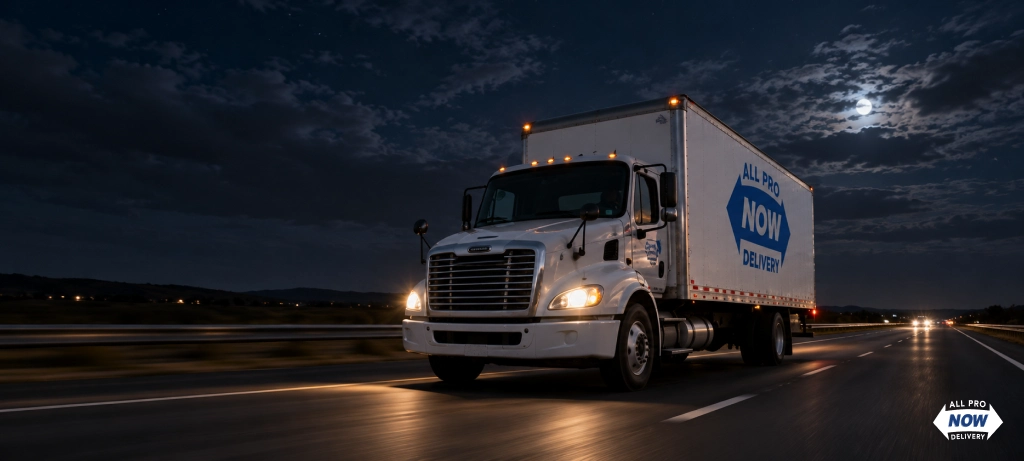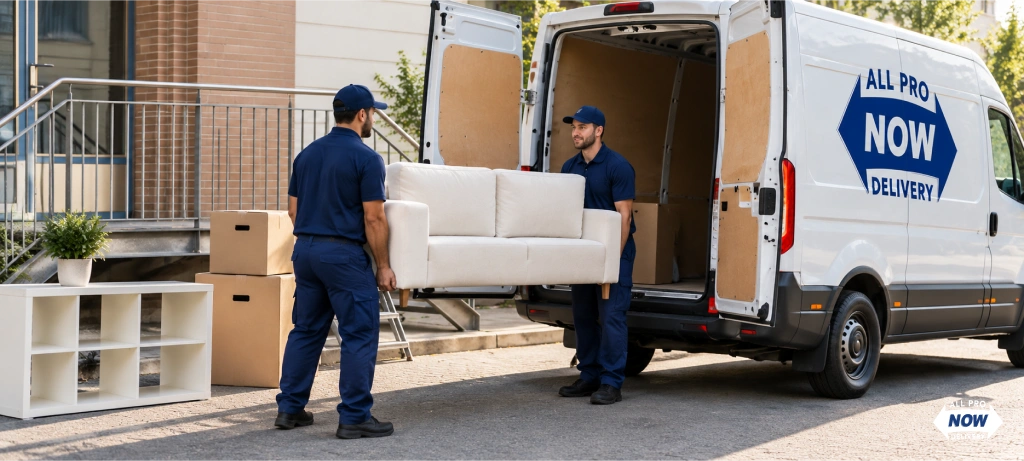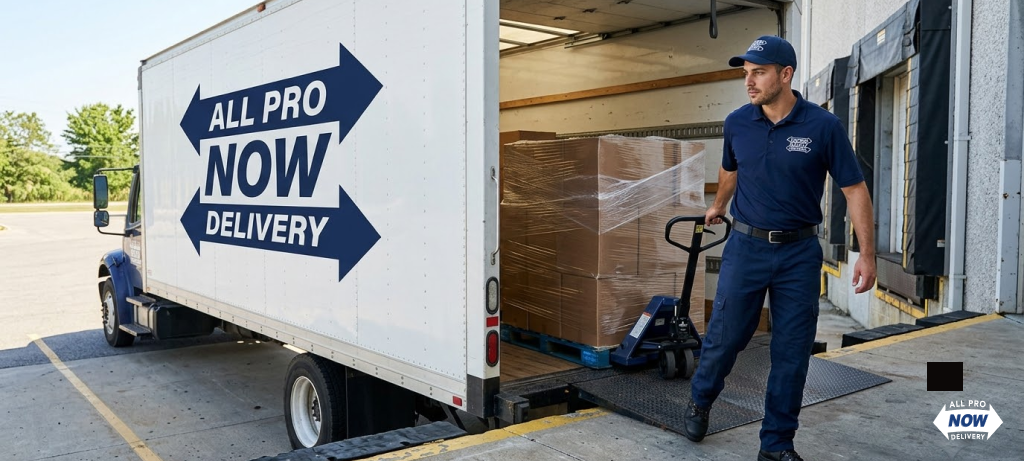

Whether you run a manufacturing plant in Toledo, a medical facility in Columbus, a retail operation in Tampa, or an e-commerce business shipping across Ohio and Florida, one question keeps coming up: how do you get freight moving faster, cheaper, and more reliably without building your own fleet?
The most U.S. businesses is wondering how to partner with a third-party delivery service, and knowing how to do it right is what separates a profitable logistics relationship from a costly mistake. All Pro Now, a technology-driven freight and courier platform with over 50 years of logistics experience, has helped retailers, manufacturers, medical facilities, construction firms, and e-commerce companies across seven states figure out exactly that. This guide covers everything you need to make a smart, informed decision.
Key Takeaways
- The U.S. third-party logistics market was valued at $336.64 billion in 2025 and is growing at 9.3% annually through 2034.
- Partnering with a third-party delivery service eliminates fleet overhead, reduces fuel surcharge exposure, and lets your team focus on core operations.
- Consumer delivery apps and dedicated B2B freight carriers serve fundamentally different needs, matching the right type to your shipment is critical.
- Third-party delivery fees of 20–30% per order on consumer platforms vs. flat-rate per-shipment pricing on B2B carriers represent a major margin difference for retailers.
- National carriers average fuel surcharges of 18–50%. Choosing a transparent regional carrier can reduce that to 0–7%.
- Always vet a partner on five things: geographic coverage, pricing transparency, tracking capability, accountability, and industry experience.
- Start with a trial lane before committing full freight volume.

What Is a Third-Party Delivery Service?
A third-party delivery service is an outside provider that handles transportation and last-mile logistics on behalf of your business. Instead of owning trucks, hiring drivers, and managing dispatch internally, you outsource that function to a specialist.
The market that has grown up around this model is massive. According to Grand View Research, the global third-party logistics (3PL) market is projected to reach $1.87 trillion by 2030, growing at a CAGR of 8.1%. In the U.S. alone, the 3PL market was estimated at $247.4 billion in 2023 and is expected to expand at a CAGR of 9.2% through 2030, driven by e-commerce growth, supply chain complexity, and rising demand for same-day and on-demand delivery.
Third-party delivery spans a wide spectrum. On one end sit consumer-facing apps like DoorDash, Uber Eats, and Instacart platforms designed to connect restaurants and grocery stores with end consumers. On the other end sit dedicated freight carriers that move commercial shipments, parcels, courier documents, LTL freight, and expedited loads under transparent, flat-rate pricing for business accounts.
Understanding which type fits your operation is the critical first step.
Why U.S. Businesses Are Moving Away from In-House Delivery
In-house delivery sounds appealing. In practice, it requires vehicle acquisition or leasing, driver hiring and training, fuel and insurance management, routing software, and 24/7 dispatch support. For most businesses, that is an entire logistics department’s worth of overhead, fixed cost that doesn’t scale down when your order volume does.
According to Technavio, the U.S. 3PL market is set to grow by $146.8 billion between 2025 and 2030, with e-commerce fulfillment volume cited as the primary growth driver. Over 68% of American manufacturers and retailers now depend on 3PL services for nationwide distribution efficiency (Global Growth Insights).
The economic case is direct. A manufacturer in Detroit or Toledo moving parts across state lines doesn’t need to operate its own fleet. A hospital network in Columbus needing same-day specimen transport doesn’t need a courier department. A retailer in Miami shipping to a customer in Orlando needs a reliable same-day run, not a national carrier that routes freight through a distant hub and adds two days of transit time.
Third-party delivery partnerships solve all of those problems at a fraction of the fixed-cost alternative.
In-House vs. Third-Party Delivery: A Side-by-Side Comparison
Before you decide how to partner with a third-party delivery service, it helps to be clear on what you’re trading away and what you’re gaining.
| Factor | In-House Delivery | Third-Party Delivery |
| Startup cost | High (vehicles, insurance, hiring) | Low (per-shipment fees only) |
| Fuel surcharges | Variable, fully absorbed | Negotiated or flat-rate |
| Scalability | Slow — tied to fleet size | Fast — partner absorbs volume swings |
| Technology | Requires software investment | Included (GPS tracking, dispatch, POD) |
| Accountability | Internal management burden | Carrier SLA and performance metrics |
| Best fit | High, stable, predictable volume | Variable, growing, or specialized freight |
For businesses in early growth stages, or those shipping across multi-state corridors like Ohio to Florida or Cleveland to Pittsburgh, third-party delivery almost always wins on economics, especially when the carrier offers flat-rate pricing with no hidden surcharges.
How to Partner With a Third-Party Delivery Service: 7 Steps That Work
Step 1: Define Your Freight Profile
Before contacting any provider, get clear on what you’re actually shipping. Map your typical shipment types (parcels, pallets, temperature-sensitive goods, documents), average weekly order volume, distance range, required delivery windows, and any special handling requirements.
A construction firm in Youngstown shipping hardware to an Akron job site has different needs than a pharmaceutical distributor running the Ohio-to-Florida corridor. Your freight profile determines which partner type makes sense, and which pricing model to prioritize.
Step 2: Choose Between Consumer Platforms and B2B Freight Carriers
This distinction matters more than most business owners realize, particularly for third-party delivery services for retailers.
Consumer platforms like DoorDash or Instacart extend your reach to end customers who are already browsing those apps. The trade-off is steep: commission fees of 20–30% per order, loss of customer data to the platform, limited control over the delivery experience, and margin erosion that compounds over time.
As logistics professionals consistently highlight in industry forums, the core problem with consumer delivery platforms is that the restaurant or retailer is being used as bait to grow the platform’s customer base, not the merchant’s. The platform owns the relationship.
For businesses shipping freight rather than restaurant meals, think manufacturers, distributors, medical operations, and construction companies, a dedicated B2B freight carrier is the right path. You get flat-rate or contracted pricing, live GPS tracking, digital proof of delivery, and a carrier that answers when something goes wrong.
Step 3: Vet Coverage and Service Area Match
Delivery coverage varies more than most businesses expect. Some couriers operate within a single metro. Others cover full states or multi-state corridors. This is especially important for businesses managing consistent freight lanes across the Midwest and Southeast.
AllProNow operates a dedicated driver network, not a broker marketplace, across Ohio, Michigan, Indiana, Pennsylvania, Kentucky, New York, and Florida, covering 25+ cities including Cleveland, Columbus, Toledo, Akron, Youngstown, Detroit, Pittsburgh, Cincinnati, Indianapolis, Tampa, Orlando, and Miami. Same-day pickup is available with 1–2 hour windows across primary service corridors.
Ask any prospective carrier these specific questions:
- Does your coverage include my exact pickup and delivery points?
- Do you serve rural areas between those points, and at what transit time?
- What is your actual on-time delivery rate, not an estimate?
- Is your driver network dedicated or gig-based?
Step 4: Evaluate Pricing Transparency
Commission-based pricing works for consumer food platforms. It does not work for freight. For B2B third-party delivery, you need flat-rate or per-shipment pricing with no fuel surcharge surprises.
National carriers average fuel surcharges of 18–50%, which fluctuate quarterly with no advance notice. AllProNow’s fuel surcharge runs 0–7%, fixed annually, shown upfront before booking, with no hidden accessory fees at invoice. That is a budget predictability difference your operations and finance teams will notice immediately.
When requesting quotes from any third-party delivery partner, verify: Is the quoted rate the invoiced rate? Are fuel, residential delivery, and weekend fees included? Can you get pricing before you book, not after?
Step 5: Confirm Technology and Tracking Capability
A third-party delivery service is only as reliable as its visibility tools. Your team needs to know where a shipment is at any point, not just whether it was marked delivered after the fact.
Look for: real-time GPS tracking from dispatch to delivery, automated customer notifications with live ETA, digital proof of delivery (photo, signature, timestamp), and integration capability with your existing order management or e-commerce platform.
AllProNow’s platform includes real-time shipment tracking, live driver location, and digital proof of delivery, accessible through both the web platform and mobile app. For businesses managing consistent freight lanes, the Transportation Management System (TMS) adds automated dispatch, route optimization, and analytics in a single dashboard.
Step 6: Assess Accountability and Support
When a shipment is late or mishandled, who answers the phone? This is where national carriers frequently fall short, and where regional carriers with skin in the game earn their reputation.
Real accountability means a dedicated account contact, not a call center queue. It means on-time delivery statistics you can verify. Reliable regional carriers achieve 95%+ on-time completion, that number should be available on request, not buried in a sales brochure.
For industries where delivery failure has direct operational consequences, manufacturing, healthcare, legal and financial services, accountability is the entire reason you’re paying for a third-party delivery partner. It is not a bonus feature.
Step 7: Run a Trial Lane Before Committing
Don’t commit your full freight volume to a new partner without a test run. Identify one or two regular lanes, say, Cleveland to Pittsburgh, or Columbus to Cincinnati, and run a month of shipments through the carrier.
Measure on-time performance, communication quality, invoice accuracy, and ease of booking. If the carrier performs consistently on your trial lane, expand the relationship. If they don’t, you haven’t disrupted your broader operation.
This approach protects you from the scenario logistics professionals consistently flag: the difficulty of extracting an operation from a carrier that looks right on paper but underperforms in the field.
Third-Party Delivery for Retailers: What You Need to Know
Retailers face a specific version of this decision. Consumer platforms extend reach to customers already browsing those apps, but at the cost of commission margin and direct customer relationships.
The alternative is booking same-day and scheduled deliveries directly through a freight carrier with per-shipment pricing. For retailers managing consistent delivery routes across Ohio, Michigan, Florida, and Pennsylvania, this model delivers better unit economics as volume grows.
AllProNow’s retail delivery services and retail replenishment capabilities give retailers a direct, transparent path to same-day delivery, without ceding margin or customer data to a consumer platform.
How to Start a Delivery Business from Home Using a Third-Party Model
For entrepreneurs starting a delivery business from home, the third-party model offers the fastest path to operational capability. You don’t need your own fleet on day one.
Define your service area and niche, same-day medical courier, retail e-commerce fulfillment, or construction site delivery are all viable entry points. Then partner with an established carrier for the logistics you can’t yet execute yourself. Look for a carrier that offers platform or API integration from day one, so your customers can book, track, and receive confirmation through your branded front end while the physical delivery runs through your partner’s network.
Key requirements to get started:
- A defined geographic niche with real demand
- A carrier partner with API or platform integration
- Clear pricing you can mark up and communicate to your customers
- A dispatch system that keeps drivers and customers connected in real time
As gig-economy delivery continues to fragment the logistics space, businesses that build on top of established, accountable carriers, rather than assembling patchwork networks of independent contractors, build more defensible, scalable operations over time. For a deeper look at delivery service structures, read AllProNow’s guide on delivery service partner models.
Carrier Comparison: Consumer Apps vs. Regional B2B Freight Carriers
Different business types need fundamentally different partners. This table helps clarify the decision.
| Criteria | Consumer Delivery Apps (DoorDash, Instacart) | Dedicated Regional B2B Carrier (AllProNow) |
| Best for | Restaurants, grocery, retail-to-consumer | Manufacturers, medical, construction, e-commerce freight |
| Commission/fee structure | 20–30% per order | Flat-rate per shipment |
| Customer data | Retained by platform | Retained by your business |
| Fuel surcharges | Variable | 0–7%, fixed annually |
| Tracking | Consumer app | Real-time GPS + digital POD |
| Driver type | Gig workers (personal vehicles) | Dedicated professional fleet |
| Accountability | Platform-level support | Dedicated account management |
| Freight capacity | Passenger vehicle quantities | Sprinter vans (up to 3,600 lbs) and box trucks (up to 10,000 lbs) |
The Market Data That Explains the Shift
The move toward third-party delivery partnerships isn’t a trend businesses are chasing. It’s a structural realignment that’s already happened.
The U.S. third-party logistics market was valued at $336.64 billion in 2025 and is projected to nearly double, reaching $749.46 billion by 2034 at a compound annual growth rate of 9.3%, according to Market Data Forecast. That growth isn’t speculative. It reflects decisions already being made at the operational level across American manufacturing, retail, and healthcare.
More than 68% of U.S. manufacturers and retailers now depend on 3PL services for nationwide distribution efficiency, and over 40% of all U.S. logistics operations have been outsourced to third-party providers (Global Growth Insights). Retail leads the way, the sector capturing 37.3% of the U.S. 3PL market in 2024 (Market Data Forecast), driven by the structural shift from bulk store replenishment to distributed, on-demand fulfillment.
Globally, the picture is just as clear. Grand View Research projects the worldwide 3PL market will reach $1.87 trillion by 2030, growing at 8.1% annually. The online food delivery segment, a subset of the broader third-party delivery ecosystem, was valued at $288.8 billion globally in 2024, with the U.S. portion expanding at a CAGR of 9.6% through 2030.
What these numbers tell you is simple: the businesses that figured out how to partner with a third-party delivery service five years ago are running leaner operations today. The ones still managing in-house fleets without the volume to justify it are absorbing costs their competitors aren’t.

AllProNow: A Regional Third-Party Delivery Service Built for Business
AllProNow is not a gig marketplace. It operates a dedicated professional driver fleet, background-checked, insured, and equipped with commercial vehicles, across a seven-state network that covers the core freight corridors of the Midwest and Southeast.
Service coverage: Ohio (Cleveland, Columbus, Toledo, Akron, Youngstown, Cincinnati, Dayton), Michigan (Detroit, Grand Rapids), Indiana (Indianapolis), Pennsylvania (Pittsburgh), Kentucky (Northern Kentucky / Cincinnati corridor), New York, and Florida (Tampa, Orlando, Miami), all accessible through AllProNow’s same-day delivery platform.
Fleet options:
- Sprinter Vans — up to 3,600 lbs / 4 skids (parcel, courier, small LTL)
- Box Trucks — up to 10,000 lbs / 12 skids (larger LTL loads)
Pricing: Flat-rate, shown upfront. No fuel surcharges on top of the quote. No residential delivery fees. No invoice surprises. Get a freight shipping quote instantly.
Technology: Real-time GPS from dispatch to delivery, digital proof of delivery (photo, signature, timestamp), live customer notifications, and shipment tracking through web and mobile.
Managed logistics: For operations that want to fully outsource their logistics function, AllProNow’s managed logistics services cover carrier and vendor management, lane planning, KPI reporting, and cost optimization, acting as a logistics department your team doesn’t have to run.
Industries served: Retailers, manufacturers, medical facilities, construction firms, legal and financial services companies, and e-commerce operations. For healthcare-specific requirements, see AllProNow’s medical delivery services guide.
The Bottom Line on How to Partner With a Third-Party Delivery Service
The process isn’t complicated, but each decision matters. Define your freight profile first. Match the partner type to your shipment category, consumer apps for restaurant and grocery-to-consumer, dedicated carriers for everything that requires commercial freight handling. Vet coverage, pricing transparency, technology, and accountability before you commit volume. Run a trial lane before you expand.
Businesses across Ohio, Florida, Michigan, Indiana, Pennsylvania, and Kentucky are running leaner, faster logistics operations by partnering with regional carriers that know their markets, own their fleets, and are accountable to every shipment. That is what a real third-party delivery partnership looks like.
Ready to see if All Pro Now is the right fit? Visit All Pro Now to get an instant zip-to-zip quote or speak with a logistics specialist, no contracts, no commitments to start.