
Every pallet that leaves a warehouse starts with the same question: what will this cost? A freight shipping quote answers that question, but not every quote tells the truth. Pricing has only gotten more volatile this year. Carriers pushed general rate increases in the 5.5 to 7.5 percent range for 2026, and the LTL Producer Price Index has climbed at close to 5 percent a year on average for three decades running. That backdrop makes it more important than ever to understand what a quote actually reflects before you book a shipment.
AllProNow is a regional logistics platform built on more than 50 years of trucking experience through its parent company, All Pro Freight Systems, founded in Cleveland, Ohio in 1990. We’ve watched businesses across Ohio, Michigan, Pennsylvania, Indiana, Kentucky, and Florida get burned by numbers that change after pickup. This guide breaks down how freight pricing actually works, so your next quote holds up.
Key Takeaways
- A freight shipping quote is built from seven core factors: weight, freight class, dimensions, distance, hazard status, accessorials, and liability coverage.
- LTL (less-than-truckload) rates are dynamic. The same lane can cost double depending on the day and the direction.
- Reweighs, reclassifications, and surprise accessorial fees are the most common reasons a shipping quote balloons after delivery.
- Carrier capacity is still tight. The American Trucking Associations has pointed to a driver shortage north of 80,000, which keeps upward pressure on rates industry-wide.
- Flat-rate regional carriers like AllProNow remove much of that unpredictability for shippers moving freight across the Midwest and Southeast.
What Goes Into a Freight Shipping Quote
A freight shipping quote isn’t a single number pulled from thin air. Carriers and brokers calculate it from seven variables, and understanding them is the first step to spotting a fair rate.
If you request a quote from three different carriers, you’ll likely get three different numbers. That’s normal. What matters is knowing which variables drove the gap.
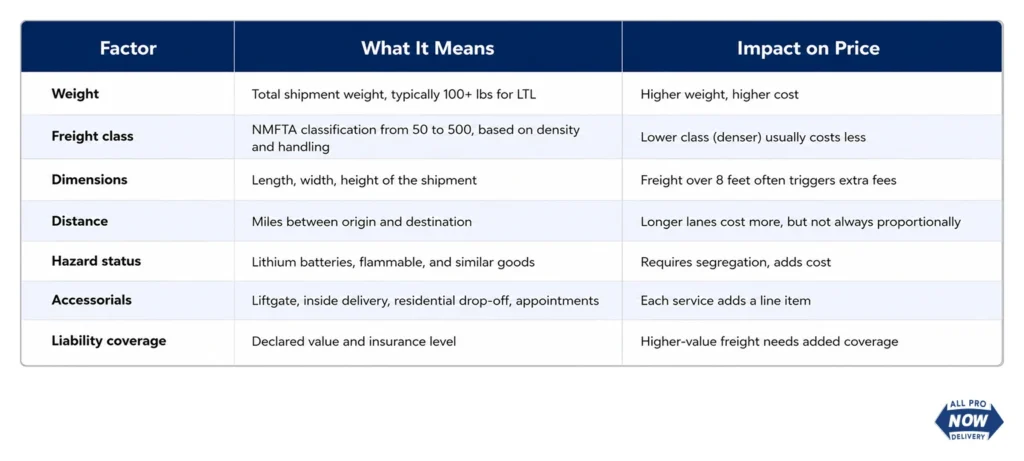
Freight class deserves extra attention. The National Motor Freight Traffic Association updated roughly 5,000 commodity classifications in its recent overhaul, which means a class that was accurate a year ago may no longer match your product. Reviewing your classification annually can prevent costly reclassification disputes.
Why LTL Freight Quotes Change by the Day
If you’ve ever gotten two wildly different quote numbers for what feels like the same shipment, you’re not imagining it. LTL pricing is dynamic, driven almost entirely by supply and demand.
A van load from Boston to Chicago might be cheap because trucks are abundant on that route. Run the same lane in reverse, Chicago to Boston, and the rate can climb sharply because fewer trucks are heading that direction. It has nothing to do with cost to operate the truck. It’s the ratio of available trucks to available loads.
Capacity itself has been shrinking industry-wide. A major LTL carrier’s 2023 bankruptcy pulled roughly 12 percent of national LTL capacity out of the market, and that capacity has never fully returned. Layer on a persistent driver shortage, and it’s easy to see why a freight shipping quote from a national carrier can look completely different from a regional specialist’s rate on the exact same lane. Brokers and carriers with strong lane density, meaning they run that specific corridor often, can usually offer a tighter, more consistent quote than a carrier stretching to cover it occasionally.
How Brokers Build a Freight Shipping Quote (5-Step Process)
Understanding how the pros do it helps you evaluate whether your own quote is realistic.
Step 1: Gather full shipment details. Equipment type (van, reefer, flatbed), origin, destination, and any special handling needs like pallet exchange, dock access, or forklift requirements. Every one of these changes the price.
Step 2: Check historical lane pricing. Rating tools show 30, 60, and 90-day averages for a given lane and equipment type. This sets a baseline, but historical data alone won’t produce an accurate spot-market rate.
Step 3: Test the spot market. Brokers post the load and start low, then work upward based on carrier response. This finds the true market rate rather than what a carrier wishes they could charge.
Step 4: Cross-check with lane history. Carriers who’ve run a specific lane repeatedly in the past 60 to 90 days are worth calling directly, even without a posted truck. They often know the lane is cold.
Step 5: Apply the markup. Once the true cost to move the freight is known, brokers typically add 10 to 20 percent. That final number becomes your freight shipping quote.
Knowing this process matters because it explains why lowball online freight shipping quote tools can mislead you. They’re often pulling from Step 2 data alone, without validating against the live spot market.
LTL Freight Quote vs. Parcel: Which Do You Need?
Not every shipment needs a full LTL freight quote. The table below outlines the general dividing line.
| Shipment Profile | Best Option | Why |
| Under 100–150 lbs, small box | Parcel (UPS, FedEx Ground) | Lower cost and faster for small items |
| 150 lbs+, palletized | LTL freight quote | Built for pallet-sized freight sharing trailer space |
| Oversized or 500+ lbs | LTL or dedicated regional carrier | Avoids dimensional weight penalties |
| Time-sensitive regional freight | Same-day regional carrier | Beats standard LTL transit windows |
Getting this distinction wrong is a common way shippers overpay. Forcing an oversized pallet through a parcel carrier invites dimensional weight surcharges. Sending a 40-pound box through LTL means paying minimum freight charges for something that didn’t need them.
Common Mistakes That Wreck a Freight Shipping Quote
Real shippers report the same problems over and over. Surprise adjustments are the most frequent complaint tied to online freight shipping quote tools and broker marketplaces.
Reweigh charges, reclassification fees, and dimensional differences can show up days or weeks after delivery. One shipper on a logistics forum described paying an extra $600 reweigh charge on a $1,700 shipment, plus duplicate $65 “adjustment” fees on unrelated line items. Another reported waiting two weeks for a pallet pickup that never showed on schedule.
Documentation is the best defense. Weigh the shipment on a platform scale, photograph it before pickup, and round measurements up rather than down. Carriers can’t dispute what you’ve already recorded.
Marketplace quote sites can beat carrier-direct pricing because they leverage bulk buying power. But a third party in the chain also means more places for information to get lost, which can extend transit times or delay tracking updates.
The lesson is consistent across broker forums and shipper reviews alike: a cheap freight shipping quote upfront isn’t the full cost if it comes with unpredictable add-ons later.
Tips to Lower Your Freight Shipping Quote
- Work with a broker or platform with strong buying power: Comparing multiple carrier rates in one place typically beats calling carriers one by one.
- Ship more per load: Consolidating shipments reduces the per-unit cost of every quote you receive.
- Tighten your packaging: Smaller, denser packaging directly lowers freight class and therefore price.
- Negotiate a lane-specific rate: If you ship the same corridor repeatedly, a dedicated rate often beats requesting a new freight quote every time.
- Simplify delivery requirements: Fewer liftgates, fewer appointments, fewer accessorials.
- Automate quoting: API-driven tools cut the time and headcount needed to manage freight shipping quote requests at scale.

Getting a Freight Shipping Quote Across Ohio, Michigan, Pennsylvania, Indiana, Kentucky, and Florida
Freight pricing gets simpler when a carrier owns the lane instead of subcontracting it out. AllProNow runs a dedicated regional driver network across a four-state Midwest footprint plus Florida.
| Region | Metro Areas Covered | Typical Service |
| Northeast Ohio / Michigan | Cleveland, Akron, Canton, Youngstown, Detroit | Same-day, 1–2 hr pickup |
| Central & Southern Ohio | Columbus, Toledo | Same-day, 1–2 hr pickup |
| Pennsylvania / Indiana | Pittsburgh, Indianapolis | Regional LTL and parcel |
| Florida | Tampa, Orlando, Miami | Regional LTL and same-day |
Because these lanes run daily, a freight shipping quote from AllProNow reflects flat-rate pricing with no fuel surcharges and no residential delivery surprises. Retail, manufacturing, healthcare, aerospace, and construction shippers use this model to move parcels, LTL freight, and same-day loads without the reweigh disputes common on national broker marketplaces.
For businesses moving freight between Cleveland and Detroit, Columbus and Indianapolis, or Miami and Orlando, a regional specialist with dense lane coverage generally outperforms a national network on both price consistency and transit time. That density is exactly what keeps a freight shipping quote accurate from the first estimate to the final invoice.
Getting Your Next Freight Shipping Quote Right
A freight shipping quote is only useful if it holds up after pickup. Know the seven pricing factors, understand that LTL rates shift with supply and demand, and watch for accessory fees before they become a surprise invoice.
If your freight moves through Ohio, Michigan, Pennsylvania, Indiana, Kentucky, or Florida, AllProNow offers flat-rate, same-day LTL and parcel service with transparent pricing and no hidden fees. Get an instant freight shipping quote at AllProNow and see the real number upfront, no phone calls required.