
How much does courier service cost? For most U.S. businesses, a local same-day run falls between $30 and $60. Urgent, drop-everything jobs can top $150. The range is wide because courier pricing isn’t a single number. It’s a formula built from distance, speed, vehicle size, and handling rules.
This guide comes from the team at AllProNow, a regional same-day carrier running routes across Ohio, Michigan, Pennsylvania, Indiana, Kentucky, and Florida. Below, we break down real 2026 rates, what pushes them up or down, and how to budget without overpaying.
Key Takeaways
- Local same-day courier runs typically cost 30–60. Rush windows add 20–50, and STAT jobs run 90–160+.
- Per-mile rates climb with vehicle size, from about $1.40 per mile for a sedan to over $5 for refrigerated vans.
- USPS and UPS are cheaper for non-urgent parcels but take one to five days. Couriers win when timing, custody, or size matters.
- Surcharges for fuel, wait time, weekends, and after-hours can raise a bill 10–50%. Always ask for the full fee schedule.
- Recurring deliveries cost less on scheduled routes or dedicated contracts than on one-off, on-demand calls.
What a Courier Service Is (and Why It’s Priced Differently)
A courier service moves an item directly from pickup to drop-off, usually the same day. One driver handles it end to end. There’s no sorting hub and no overnight stop.
Parcel carriers like USPS, UPS, and FedEx work differently. Your box rides through a network of hubs with millions of others. That scale lowers cost per package but adds time and handoffs. Our breakdown of carrier vs. courier covers the operational differences in more depth.
This distinction explains most pricing confusion. With a courier, you’re buying a vehicle and a driver’s time. With a parcel carrier, you’re buying a slice of a massive network, priced by weight and zone.
The U.S. Courier Market in 2026: Size, Growth, and Key Players
Delivery is a large, steadily growing industry. Mordor Intelligence sizes the U.S. courier, express, and parcel market at about $201.65 billion in 2026, projecting roughly $252.71 billion by 2031 at a 4.62% annual growth rate. It names USPS, Amazon Logistics, UPS, FedEx, and OnTrac as the major players.
The fastest-growing slice matters most for courier pricing. Express services grew at nearly 6% a year, drawing price-insensitive shippers in healthcare, industrial components, and urgent consumer replacements.
That’s why regional couriers stay in demand. National carriers optimize for volume. Hospitals, law firms, and factories often need speed and accountability instead. Rising last-mile delivery costs add to the pressure on every shipper.
How Much Does Courier Service Cost? Typical 2026 Price Ranges
Published 2026 industry benchmarks give a useful baseline. Standard same-day deliveries within 10 miles run about 30–45, rush jobs of two to four hours run 40–60, and STAT jobs start around 65–100. At 21–40 miles, those tiers rise to roughly 55–85, 70–95, and 110–175+.
Typical 2026 Courier Prices by Service Type
| Service Type | Typical 2026 Cost | Best For |
| Standard same-day (0–10 miles) | 30–45 | Documents, small parts, retail orders |
| Standard same-day (11–20 miles) | 40–60 | Cross-metro deliveries |
| Rush (2–4 hour window) | 40–95 | Time-sensitive, not critical |
| STAT / immediate | 65–175+ | Specimens, line-down parts, court filings |
| Daily scheduled route (~28 miles) | 60–115/day | Labs, pharmacies, recurring pickups |
Vehicle size shifts the math just as much. Heavier loads need bigger vans or trucks, and per-mile rates rise accordingly.
Per-Mile Courier Rates by Vehicle (2026 Benchmarks)
| Vehicle | Per-Mile Rate | Typical Load |
| Sedan | 1.40–1.90 | Envelopes, small boxes |
| Small SUV | 1.60–2.20 | Multiple cartons |
| Cargo van / sprinter van | 2.20–3.75 | Cartons up to a few skids |
| Refrigerated vehicle | 3.50–5.25 | Specimens, vaccines, perishables |
| Box truck | Quoted by miles, skids, and weight | Palletized and LTL freight |
Per-mile rate ranges are drawn from 2026 healthcare courier pricing benchmarks for sedans, SUVs, cargo vans, and refrigerated units. For a deeper look at the math, see our guide on how much to charge for delivery per mile.
Here’s an insider detail. On a small-business forum, one route owner said a 230-mile, 7-hour route pays an independent contractor about $140, while on-demand stat work pays roughly $0.90 per mile. That’s driver pay, not your price. The courier company adds insurance, dispatch, tracking, and margin on top.
How Much Does Courier Service Cost vs. USPS and UPS?
If a package can wait a few days, parcel carriers are usually cheaper. At July 2026 prices, USPS Ground Advantage starts at $7.90 retail with two-to-five-day delivery, while Priority Mail starts at $11.00 with one-to-three-day delivery. Both include $100 of insurance and tracking, with a 70-pound limit.
Shipping a 20 lb Box – Courier vs. USPS (2026)
| Option | Approx. Cost | Delivery Time |
| USPS Ground Advantage (commercial, Zone 1) | $16.46 | 2–5 business days |
| USPS Ground Advantage (commercial, Zone 8) | $40.39 | 2–5 business days |
| USPS Priority Mail (commercial, Zone 8) | $68.06 | 1–3 business days |
| Local same-day courier (0–10 miles) | 30–45 | Same day, often within hours |
USPS figures reflect July 2026 commercial rates for a 20 lb package by zone. Counter prices run higher. Retail Ground Advantage for that same box costs roughly $55.50 to $69.40 to zones 7 and 8.
Three 2026 changes affect your budget right now:
- A temporary 8% surcharge took effect April 26, 2026, on Priority Mail Express, Priority Mail, Ground Advantage, and Parcel Select. It expires January 17, 2027.
- On July 12, USPS cut its dimensional divisor from 166 to 139 and moved to round-up measuring, which raises billable weight on large, light boxes. Details are in USPS’s Price List Notice 123.
- Holiday pricing is coming. The retail Priority Mail Flat Rate Envelope rises from $12.90 to $13.90 from October 4, 2026, through January 17, 2027, per Pitney Bowes’ USPS rate overview.
UPS Ground follows a similar zone-and-weight model, then adds fuel, residential, and oversize surcharges. Get a live quote before assuming it’s cheaper. Our guide to how long ground shipping takes explains the transit-time tradeoff.
The practical rule: pay for a courier when a missed deadline costs more than the price gap.
What Drives Courier Pricing: 7 Cost Factors
These levers explain nearly every quote you’ll receive.
1. Urgency. Speed costs the most. Benchmarks add about 20–30 for a 2-hour window and 50–120+ for STAT service. See how urgent shipping services are dispatched.
2. Distance and zones. Most couriers price by mileage bands or city zones. Long one-way runs may include return “deadhead” miles.
3. Vehicle type. A sedan handles envelopes. A sprinter van or box truck handles skids, which raises the rate.
4. Weight and dimensions. Oversized items need bigger vehicles or a second person.
5. Handling requirements. Medical shipments may require temperature control, chain of custody, and OSHA bloodborne pathogens training.
6. Timing. Nights, weekends, and holidays carry premiums.
7. Surcharges. Typical courier surcharges include fuel at 8–12%, after-hours at 20–35, weekends at 1.5×, and wait time at 1.25–2.25 per minute. Fuel surcharges usually track the U.S. Energy Information Administration diesel index. Our explainer on how fuel surcharges are calculated walks through the formula.
Pricing Models Explained
Couriers bill in five main ways. Knowing yours helps you compare quotes fairly.
Per-mile pricing combines a base fee with a mileage rate and suits one-off runs. Zone or flat-rate pricing charges a fixed amount per delivery area, which simplifies budgeting. Hourly billing fits multi-stop or wait-heavy jobs. Scheduled routes use a fixed daily or weekly rate. Dedicated contracts reserve a driver and vehicle, often on one- or two-year terms.
In one industry interview, a courier operator said most of his contracts run one to two years. Month-to-month deals exist but usually hinge on strict performance metrics.
The same operator described a Tampa company delivering to 16 retailers with its own trucks. After testing five lanes with an outside courier, it saved close to 30% and outsourced all 16. It also stopped paying for vehicle damage, maintenance, and extra payroll costs.
Real-World Cost Examples by Industry and City
These are illustrative 2026 estimates based on the benchmarks above. Your actual quote will vary.
Legal – Cleveland, OH: A same-day court filing from a downtown firm to a suburban courthouse, about 12 miles, typically runs 40–60. A 2-hour deadline adds 20–30. Learn more about same-day delivery in Ohio.
Healthcare – Columbus, OH: A daily lab route with several clinic pickups often costs 60–115 per day. That beats paying 30–45 per stop on demand. Our medical courier services guide covers compliance requirements.
Automotive and manufacturing – Detroit, MI, and Toledo, OH: A line-down part moved 40 miles by cargo van can cost 110–175+ on a STAT basis. Compare that against the cost of an idle production line. See same-day delivery in Michigan.
Industrial – Pittsburgh, PA: Moving two skids across Western Pennsylvania is typically quoted by mileage plus vehicle class. See same-day delivery in Pennsylvania.
Retail – Tampa, Orlando, and Miami, FL: Store-to-store transfers work best on scheduled routes, where per-stop costs fall as volume grows. See same-day delivery in Florida.
How Much Do Couriers Make?
Driver pay explains part of the price. According to Bureau of Labor Statistics May 2023 data, U.S. couriers and messengers earn a median of $17.65 per hour, with a mean of $18.44. About 72,000 people work in the occupation. Medical and diagnostic laboratories employ more couriers than any other industry.
Independent contractors often earn more per hour on paper. However, they cover their own fuel, insurance, and vehicle wear. That’s why a quote always sits well above the driver’s cut.
How to Choose a Courier and Budget Smartly
Use this five-step framework before signing anything.
- Sort deliveries by urgency. Many “STAT” jobs can safely move to a 2–4 hour window. That shift alone can cut costs significantly.
- Map recurring stops. If you run the same pickups daily, convert them into a scheduled route.
- Match the vehicle to the load. Don’t pay box-truck rates for envelopes or cram skids into a sedan.
- Request an all-in quote. Ask for base rate, mileage, fuel, wait time, and after-hours fees in writing. Our freight shipping quote guide shows what a complete quote includes.
- Measure total cost, not unit price. A cheap courier that misses a filing or spoils a specimen becomes the most expensive option.
Questions to ask every courier: What’s your on-time rate? Do you provide GPS tracking and digital proof of delivery? Are drivers employees or gig workers? What insurance covers my cargo? Do you serve my full area?
Red flags: No published fee schedule, vague coverage, no proof-of-delivery system, or prices that change after booking.
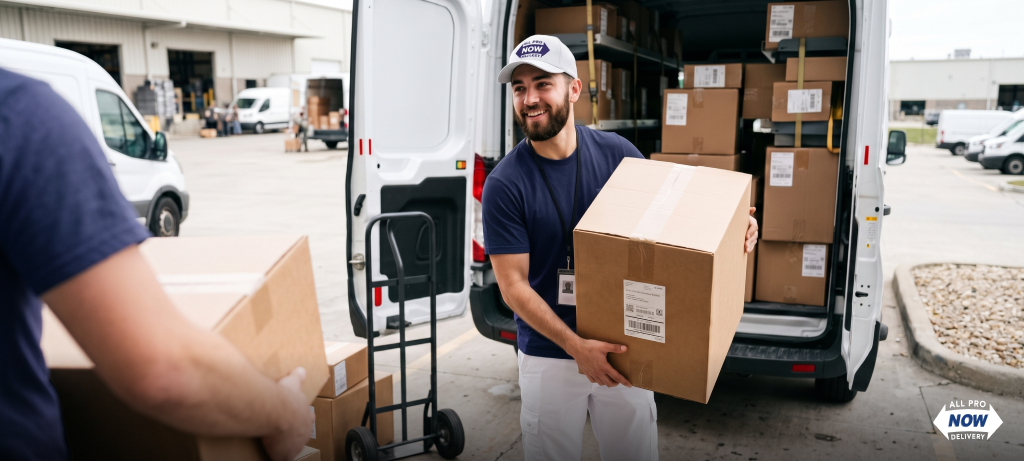
Same-Day Courier Service in Ohio, Michigan, Pennsylvania, and Florida
For businesses in AllProNow’s footprint, here’s what the service looks like on the ground. AllProNow brings over 50 years of operating experience, 80,000+ shipments delivered, and 99% on-time performance. Its fleet includes sprinter vans carrying up to 3,600 lbs and box trucks carrying up to 10,000 lbs. The company also received the 2025 Acuity Insurance Outstanding Safety Performance Award.
AllProNow’s same-day courier service targets the cost drivers covered above. It offers pickup within one to two hours, live GPS updates every 60–90 seconds, digital proof of delivery with signature, photo, and GPS timestamp, and flat-rate pricing without post-booking surcharges.
Coverage spans Ohio, Michigan, Indiana, Pennsylvania, Kentucky, New York, and Florida, across 25+ cities including Cleveland, Columbus, Toledo, Akron, Youngstown, Detroit, Pittsburgh, Cincinnati, Indianapolis, Tampa, Orlando, and Miami. Check the full service area and vehicle capacity to confirm your lanes.
[Image alt suggestion: “How much does courier service cost for same-day freight – AllProNow box truck delivering skids in Columbus, Ohio”]
How We Sourced These Numbers
Price ranges combine 2026 industry rate benchmarks, current USPS price filings, and federal labor data. Market figures come from Mordor Intelligence. Driver wages come from the BLS Occupational Employment and Wage Statistics program. City examples are estimates and not guaranteed quotes.
The Bottom Line on Courier Costs
So, how much does courier service cost? Plan on 30–60 for a routine local run, 90–160+ for STAT work, and 60–115 per day for a scheduled route. Your real price depends on urgency, distance, vehicle, and handling.
Match the service to the stakes. Use USPS or UPS when a few days is fine. Use a courier when a late delivery costs more than the delivery itself.
Ready to price your next shipment? Contact AllProNow for a flat-rate quote and see exactly how much courier service costs for your route, with no surprise fees.