Your package says “out for delivery.” Now you’re watching the door and refreshing the tracking page. At AllProNow, this final stretch is our whole focus. How long does last mile delivery take? It can take anywhere from about one hour to several business days. The answer depends on distance, carrier, service level, and what you’re shipping.
AllProNow brings more than 50 years of logistics experience and runs its own fleet. We handle same-day and scheduled deliveries across Ohio, Michigan, Western Pennsylvania, Indiana, Northern Kentucky, and Florida. This guide covers what drives last-mile timing, realistic ranges by service type, and how businesses can get faster, more predictable deliveries.
Key Takeaways
- Typical range: Last mile delivery takes about 1–8 hours with a same-day courier. Through national parcel networks, it usually takes 1–3 business days.
- “Out for delivery” usually means today. Most carriers complete these stops by the end of the day.
- Common delays come from traffic, failed delivery attempts, weather, peak seasons, and bad address data.
- International shipments must clear customs before the last mile starts, which often adds 1–5 business days.
- Dedicated regional carriers can shrink last-mile time from days to hours on short lanes.
- Real-time tracking with live ETAs is now standard, not a perk.
What Is Last Mile Delivery?
Last mile delivery is the final leg of a shipment’s journey. It runs from a local hub or warehouse to the end destination. That destination might be a home, a job site, a store, or a hospital.
It’s also called “final mile delivery.” For a deeper primer, see our guide on what last mile delivery is. Despite the short distance, it’s the most complex and costly leg of shipping. We break down why in our post on last mile delivery costs.
Demand for this leg keeps climbing. The U.S. Census Bureau estimated retail e-commerce sales of $340.2 billion in the second quarter of 2026, up 12.2% from a year earlier. Online sales made up 17.1% of total retail. (U.S. Census Bureau) Every one of those orders needs a last-mile trip.
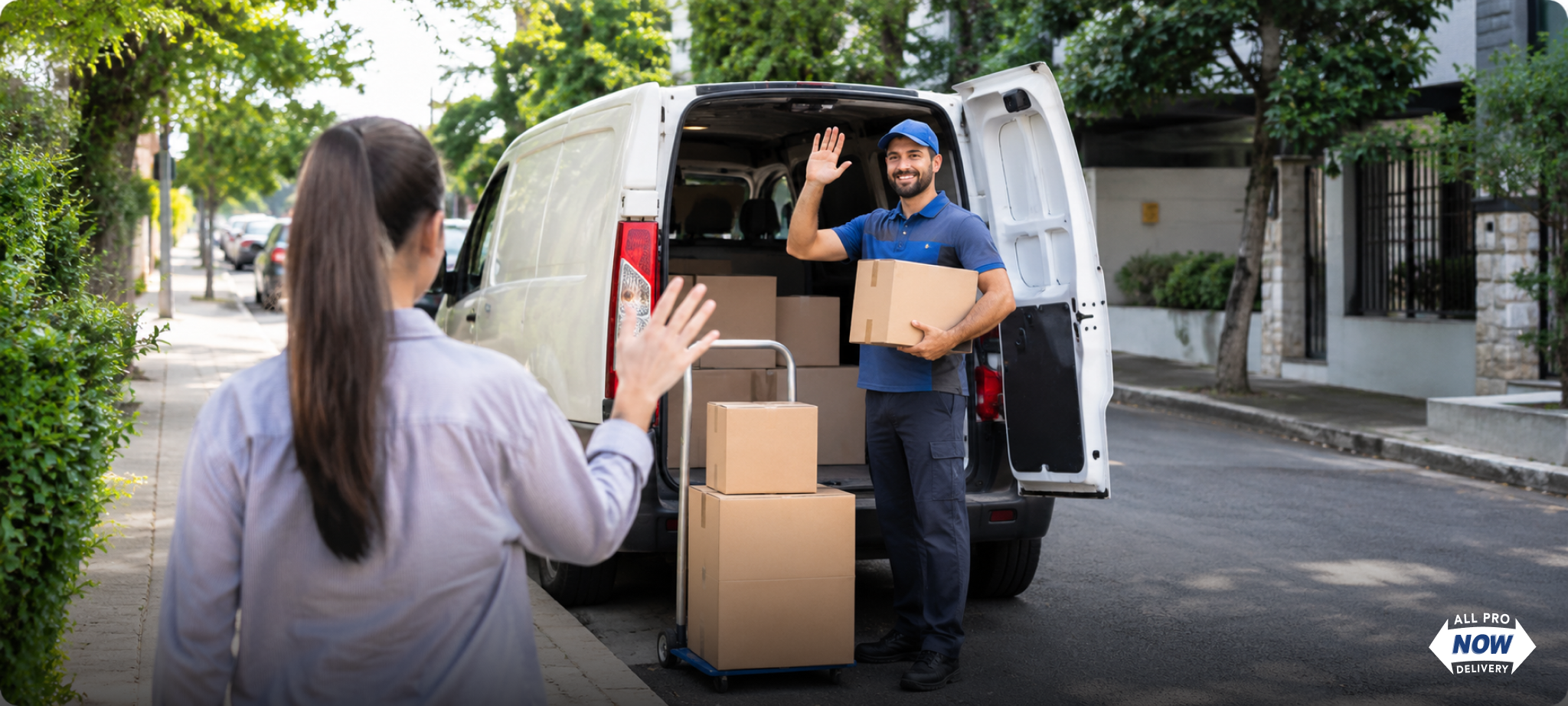
The Last Mile Delivery Process, Step by Step
Knowing the last mile delivery process shows where time goes. Most shipments move through five stages.
1. Arrival at the local hub. The shipment reaches a nearby sorting facility or cross-dock.
2. Sorting and route assignment. Packages are scanned, sorted by ZIP code, and assigned to drivers. Routing software sequences the stops.
3. Loading and dispatch. The driver loads in route order. Tracking usually flips to “out for delivery” here.
4. Transit and stops. A dense route in Columbus or Detroit may include dozens of stops. Your arrival time depends on your place in the sequence.
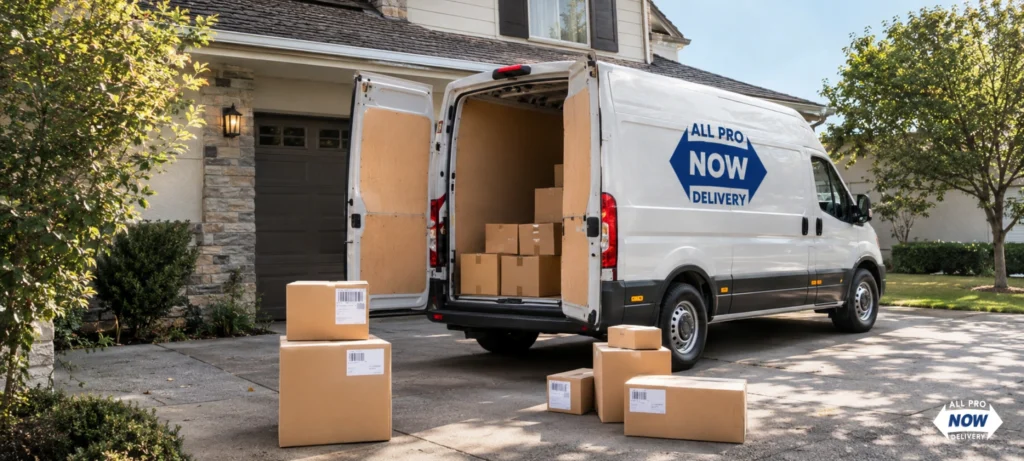
5. Delivery and proof. The driver drops off the shipment and captures proof of delivery, such as a signature or photo.
With a dedicated courier, steps one through three collapse into minutes. The driver picks up your freight and heads straight to the destination. There’s no hub stop and no shared route.
So, How Long Does Last Mile Delivery Take by Service Type?
Service level is the biggest factor in your timeline. The table below shows realistic ranges based on standard industry practice.
| Service Type | Typical Last-Mile Time | Best For | Example Lane |
| On-demand / rush courier | 1–4 hours | Urgent parts, medical supplies | Akron to Canton, OH |
| Same-day scheduled | Same business day | Retail restocks, daily B2B runs | Across metro Detroit, MI |
| Next-day regional | 12–24 hours | Planned regional freight | Cleveland, OH to Pittsburgh, PA |
| National parcel network | 1–3 business days | Standard e-commerce orders | Hub to home, any state |
| LTL final mile | 1–3 business days | Palletized freight with appointments | Toledo, OH to Fort Wayne, IN |
These are typical ranges, not guarantees. Distance, cutoff times, and freight size can move any shipment up or down.
How Long Does Last Mile Delivery Take with FedEx, UPS, and USPS?
Many people search for carrier-specific timing, especially for FedEx. Once a package reaches the final stage, the national carriers behave similarly.
When FedEx tracking shows the package is on the delivery vehicle, it typically arrives that same day. Residential stops often run into the evening. Business deliveries usually land during business hours.
UPS and USPS follow the same pattern. “Out for delivery” means delivery today, unless an exception occurs. If a package misses its sort window, add a business day. If tracking stalls for 48 hours, contact the carrier.
How Long Does Last Mile Delivery Take for International Shipments?
International shipments add a big step before the last mile even starts: customs clearance. A package can sit at a port of entry for a few hours or several days.
After clearance, a domestic last mile carrier usually takes over. That might be USPS, a national parcel network, or a regional courier. The final leg then typically runs 1–5 business days.
This handoff can make tracking confusing. You may get a new last mile tracking number from the local carrier. Check your original tracking page for a “transferred” note that lists the new number.
What Slows Down Last Mile Delivery?
Even well-run networks face delays. Traffic is a growing culprit. Americans lost an average of 63 hours in traffic in 2024, the highest level ever measured, according to the 2025 Urban Mobility Report. Delays are also spreading beyond traditional weekday rush hours. (Texas A&M Transportation Institute)
Federal data points the same way. The Federal Highway Administration found daily congestion averaged 3 hours and 23 minutes across 52 of the largest metro areas in 2024. That’s 38 minutes more than in 2023. Miami ranked among the metros with the highest Travel Time Index. (FHWA)
Here’s how the main delay factors play out across the regions AllProNow serves.
| Delay Factor | Regional Example | Typical Impact | How to Reduce It |
| Traffic congestion | I-75 in Detroit, I-95 in Miami | Adds 30–90+ minutes per route | Book early pickups and use off-peak windows |
| Winter weather | Lake-effect snow in Cleveland and Erie | Same-day becomes next-day | Build buffer days from December to March |
| Hurricane season | South Florida and Gulf Coast | Multi-day pauses during storms | Pre-stage inventory before storms hit |
| Peak season | Holiday rush nationwide | Adds roughly 1–2 business days | Ship earlier and lock in carrier capacity |
| Failed delivery attempts | Closed docks, locked gates | Pushes delivery to the next day | Share dock hours and a contact phone number |
| Bad address data | Missing suite numbers | Misroutes and returns | Validate addresses at checkout |
Florida shippers should plan around storm season. NOAA notes the Atlantic hurricane season runs from June 1 to November 30. The historical peak typically runs from mid-September through October. (National Hurricane Center)
Last Mile Delivery Tracking: What Each Status Means
Last mile delivery tracking has improved dramatically. Most carriers now offer live updates, and some show the driver on a map. Here’s how to read the most common statuses. For more detail, see our guide on how to track your shipment online.
| Tracking Status | What It Means | Expected Next Step |
| Arrived at local facility | The package reached your area’s hub | Usually goes out within 24 hours |
| Out for delivery | It’s on the truck today | Delivery by end of day |
| Delivery exception | A problem came up, such as a bad address | Contact the carrier quickly |
| Transferred to local carrier | A handoff happened (common internationally) | Look for a new last mile tracking number |
| Delivered | Drop-off confirmed with proof | Check with neighbors or reception if it’s missing |
Some platforms also give a last mile delivery forecast. This is a predicted arrival window based on driver progress and route data. Forecasts are usually accurate within a few hours, but they’re estimates. Our post on what expected delivery means explains the difference.
Why Last Mile Speed Matters by Industry
For consumers, a late package is annoying. For businesses, it costs real money.
Manufacturing: A missing part can halt a production line in Toledo or Youngstown. The downtime usually costs far more than an expedited delivery.
Healthcare: Clinics and labs depend on on-time supplies and specimens. See our guide to medical delivery services.
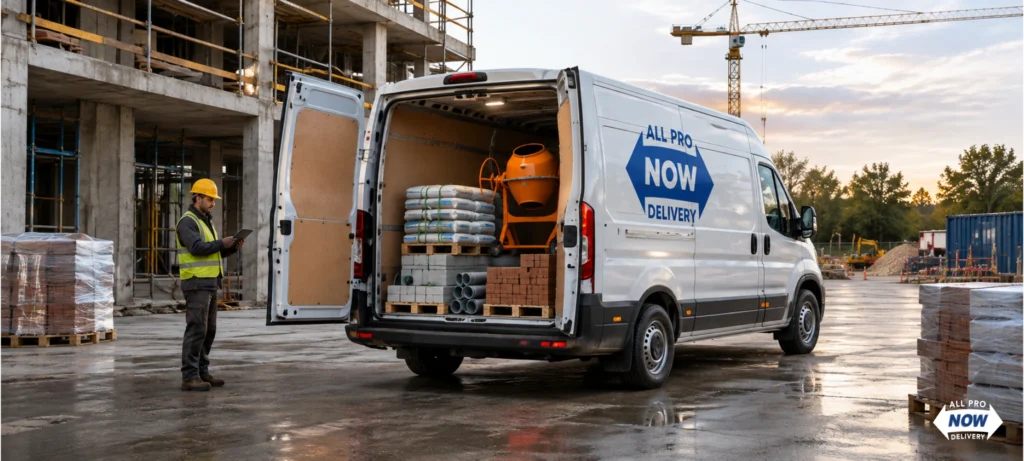
Construction: Crews waiting on materials burn paid labor hours. Job-site deliveries need tight timing.
Retail and e-commerce: Shoppers expect speed. Unreliable final-mile service can quietly erode repeat business.
How Businesses Can Speed Up Last Mile Delivery
You can’t control the weather. You can control most other factors. These steps make the biggest difference.
Match the service level to the urgency: Save rush delivery for truly time-critical freight. Use scheduled or next-day service for everything else.
Work with a regional last mile carrier: Regional carriers know local roads, docks, and receiving hours. Learn what to look for in a last mile carrier.
Clean up address and contact data: Include suite numbers, dock details, and a reachable phone number. This one step cuts failed attempts.
Book early in the day: Morning pickups give carriers more room to finish same-day.
Match the vehicle to the load: A Sprinter van moves small loads quickly. A box truck handles larger palletized freight in one trip.
Require real-time tracking and digital POD: Visibility lets you answer customers instantly and settle disputes fast.
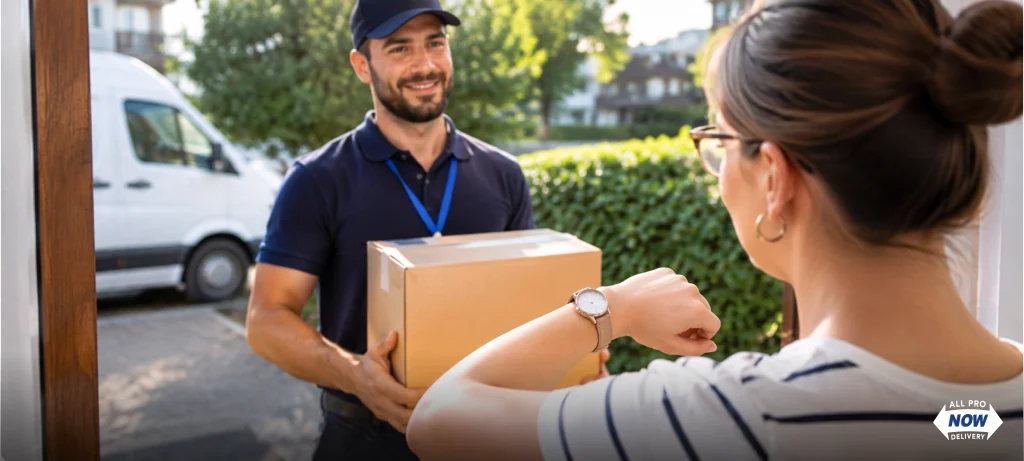
How AllProNow Handles the Last Mile
AllProNow owns its fleet. That means no brokers and no handoffs to unknown subcontractors. Your freight stays with one accountable carrier from pickup to drop-off. We hold DOT 3463495 and MC 1131330, and we received the 2025 Acuity Insurance Outstanding Safety Performance Award.
Our last mile delivery service puts a dedicated driver on time-critical loads. Most deliveries are completed the same day. Sprinter vans carry up to 3,600 pounds, or about four skids. Our 26-foot box trucks carry up to 10,000 pounds, or about 12 skids.
We cover Cleveland, Akron/Canton, Youngstown, Toledo, and Columbus, Ohio, plus Detroit, Michigan and Pittsburgh. Service extends across Ohio, Michigan, Pennsylvania, Florida, Indiana, and Northern Kentucky. Check our full service area and vehicle capacity for details.
The Bottom Line
So, how long does last mile delivery take? Expect about 1–8 hours with a same-day courier and 1–3 business days through national parcel networks. International shipments add customs time first. Traffic, weather, peak seasons, and address errors can stretch any timeline.
If your business can’t afford to wait, the right carrier makes all the difference. Get an instant quote from AllProNow and see how fast your next delivery can move across Ohio, Michigan, Pennsylvania, Florida, and beyond.