Packages stall. Tracking goes silent. A shipment shows “accepted by the last mile carrier” for days, sometimes weeks, and no one has a clear answer. For businesses running operations across Ohio, Michigan, Indiana, Pennsylvania, Kentucky, New York, and Florida, that silence isn’t an inconvenience. It’s a revenue problem, a production stoppage, or a patient waiting on a lab result.
The last mile carrier is the delivery company responsible for the final leg of any shipment, the handoff from a distribution hub to your door, dock, or job site. It is the most expensive, most failure-prone, and most customer-visible part of the entire supply chain. Getting it right is no longer optional.
This blog breaks down exactly what last mile carriers are, how the delivery process works, where it breaks down, and what industries across the Midwest and Southeast need from a final mile carrier to keep operations running without disruption.
Key Takeaways
- A last mile carrier is the delivery company responsible for the final leg of a shipment, from a regional hub to your door, dock, or job site.
- Last mile delivery accounts for 53% of total shipping costs, making carrier selection one of the highest-leverage decisions in your supply chain.
- The most common failure points are facility backlogs, scan errors, lost packages at handoff, and zero real-time visibility, all preventable with the right carrier.
- A failed delivery costs an average of $17.20 per package to reattempt in the U.S. and Capgemini finds that suboptimal last mile operations can erode profits by up to 26% over three years.
- 85% of shoppers say a poor delivery experience will stop them from ordering from that retailer again.
- For industries across Ohio, Michigan, Indiana, Pennsylvania, Kentucky, New York, and Florida, manufacturing, healthcare, legal, retail, and construction, the stakes go beyond customer satisfaction. A stalled delivery can shut down a production line, delay a patient, or miss a court filing deadline.
- The fix isn’t complicated: choose a last mile carrier with live GPS tracking, upfront flat-rate pricing, same-day dispatch capability, and documented proof of delivery on every run.
What Does “Last Mile Carrier” Actually Mean?
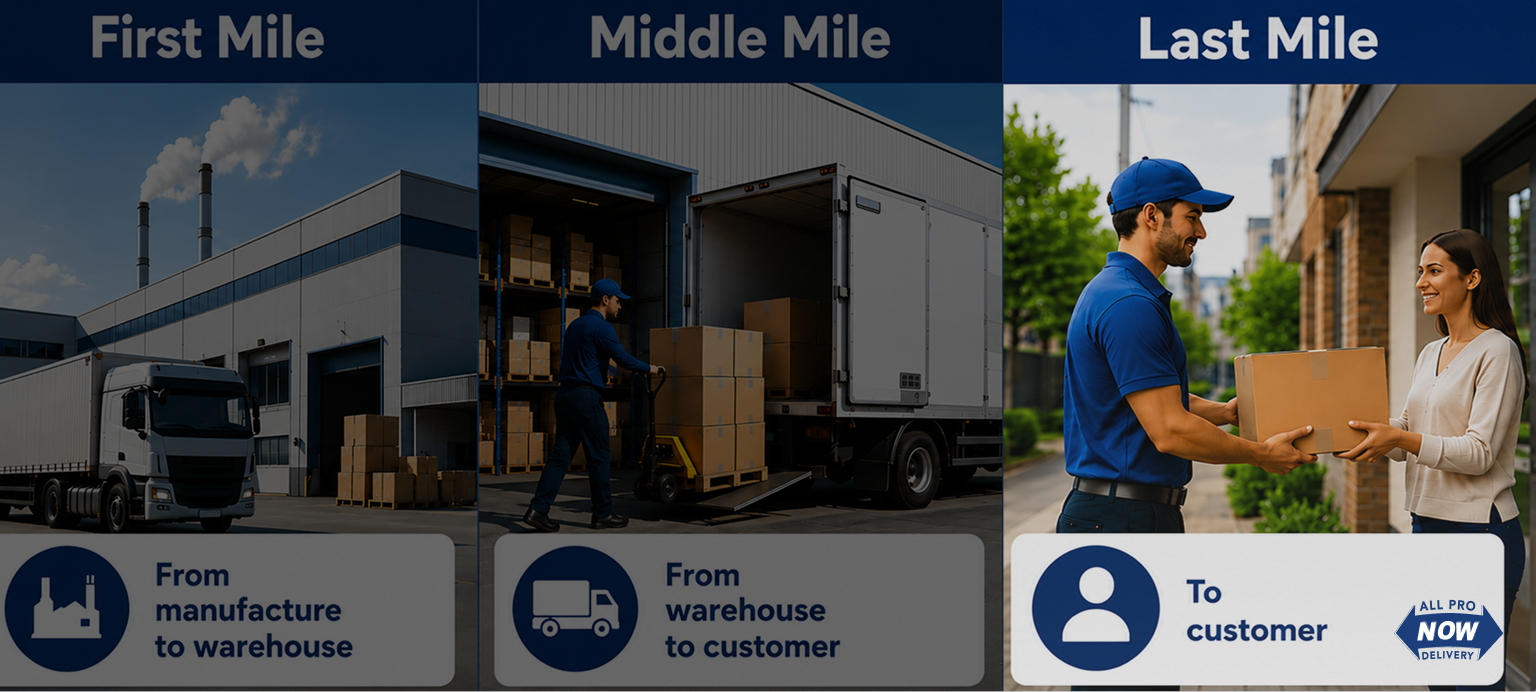
The term last mile carrier refers to the logistics company that completes the final delivery leg from a regional sortation or distribution center to the final destination address. It is sometimes called a final mile carrier or last mile delivery carrier, and the terms are used interchangeably across the industry.
The “last mile” is a logistics term, not a literal measurement. That final stretch can span a few city blocks in downtown Cleveland or 60 rural miles outside Pittsburgh. In both cases, the carrier handling that delivery is the last mile carrier.
The stage is deceptively short. It is also disproportionately expensive.
According to research published by Statista, last mile delivery accounts for 53% of total shipping costs, more than warehousing, long-haul freight, and sortation combined.
That number alone explains why carrier selection at the final mile isn’t a procurement checkbox. It is a core business decision.
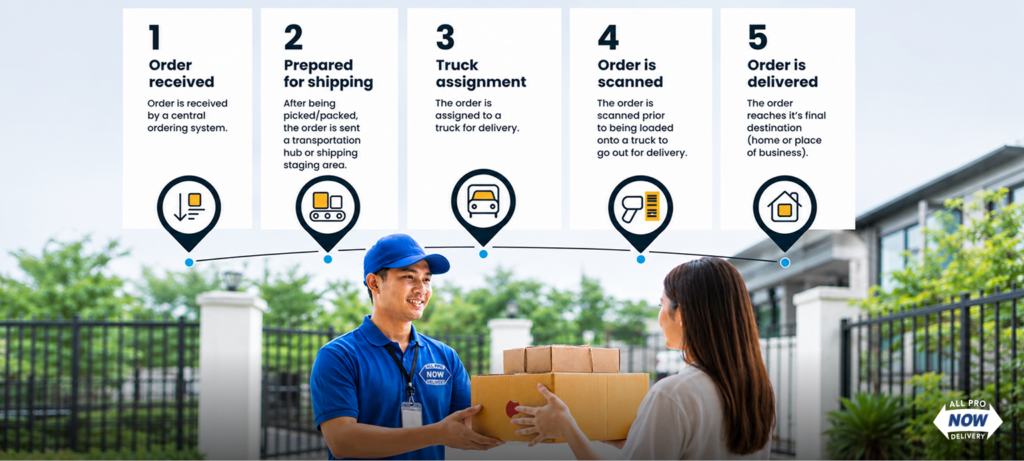
How Last Mile Delivery Actually Works: Step by Step
Understanding the full journey helps pinpoint where delays, losses, and cost overruns originate.
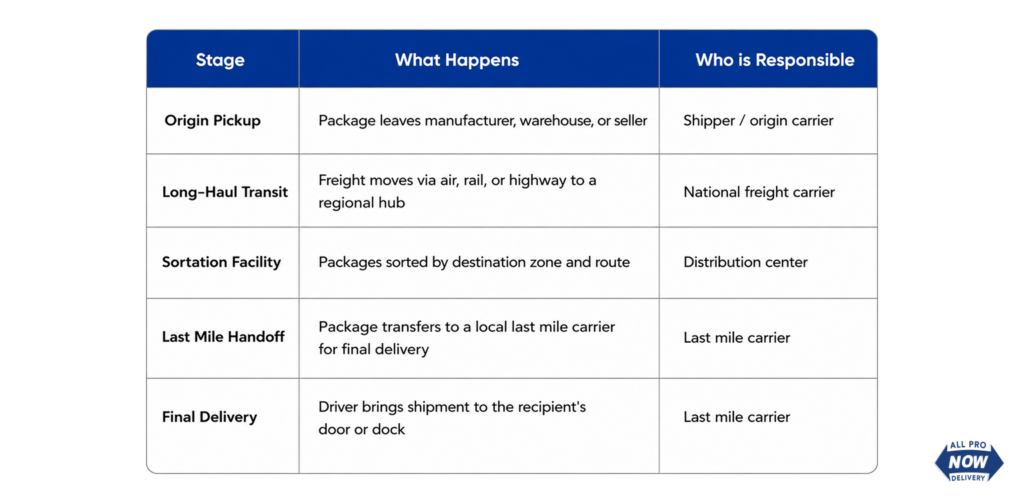
The bottleneck, and the most common source of complaints, is the transition between the sortation facility and the last mile carrier. This handoff is where tracking goes dark, packages get lost, and delivery timelines become unpredictable.
Why Last Mile Delivery Fails: The Real Causes
Most delivery failures don’t happen in transit. They happen at the handoff, in the facility, or because the wrong carrier was matched to the shipment in the first place.
Scanning Errors During Peak Periods: During high-volume shipping events, Black Friday, the holiday season, Chinese New Year for international freight, packages move rapidly through facilities. Scan errors are common. A package may appear to jump cities or cross state lines in minutes. That’s a data error, not physical movement. It doesn’t resolve itself without carrier intervention.
Facility Backlogs: The last mile carrier handoff doesn’t mean immediate dispatch. Sortation facilities build up inventory. A package accepted at a Columbus hub may sit two to four days before a driver picks it up. Economy shipping options make this worse. The status update looks stalled, but the package is simply queued.
Lost Packages at Handoff: Smaller parcels are especially vulnerable when transferring between carriers. Without tight chain-of-custody documentation, photos, signatures, GPS-timestamped receipts a lost package at the handoff point becomes nearly impossible to trace. This is the scenario that ends in refund disputes and replacement orders.
No Real-Time Visibility: Many last mile delivery carriers provide status updates logged hours after the fact, not live GPS tracking. Businesses are left guessing. WISMO (“where is my order”) calls consume customer service capacity. According to Bringg’s delivery research, 31% of retailers and 3PLs say visibility is their toughest operational challenge, and it starts exactly here.
Carrier-to-Shipment Mismatch: A standard parcel van isn’t built for oversized construction materials. A gig-platform driver isn’t equipped for HIPAA-compliant medical transport. Using a carrier without the right vehicle, compliance protocols, or route knowledge for your freight type creates failure before the driver leaves the facility.
The Business Cost of Getting the Last Mile Wrong
The financial stakes are concrete, well-documented, and compounding.
Start with the baseline: according to Statista and the Capgemini Research Institute, last mile delivery already consumes 53% of total shipping costs. That’s before a single package goes missing or arrives late.
When deliveries fail, the cost doesn’t stop at the redelivery attempt. Statista data from Loqate puts the average cost of a failed delivery in the U.S. at approximately $17.20 per package. Multiply that across hundreds of shipments per month and the number becomes a serious margin problem. The Capgemini Research Institute goes further, finding that businesses that don’t optimize last mile delivery risk profits declining by up to 26% over three years, a figure that tracks directly with rising redelivery costs, lost customers, and operational inefficiency.
The customer side of the equation is equally damaging. An Ipsos study of over 1,000 online shoppers found that 85% say a poor delivery experience would prevent them from ordering from that retailer again. That is not a satisfaction metric. That is a customer retention crisis playing out one failed delivery at a time. A 2025 Gartner report adds that 65% of failed deliveries trace back to inaccurate addresses or missed delivery windows, failures that live tracking and proactive communication directly prevent.
The picture is consistent across surveys. A 2024 CNBC report found that 85% of retail executives named reducing cost-per-order as their single biggest last mile priority. They’re not focused on speed alone. They’re focused on the cumulative cost of getting the last mile wrong, repeatedly, at scale.
For manufacturers in Toledo and Cleveland, the math runs differently but hits just as hard. A stalled delivery on a critical part shuts down a production line. An idle manufacturing line in Ohio’s automotive and aerospace sector can cost tens of thousands per hour. The last mile carrier you choose either keeps that line running or doesn’t.
Last Mile Carrier Tracking: How to Stay Informed
Tracking visibility is one of the most consistent pain points businesses report, and one of the most preventable.
What actually works for last mile carrier tracking:
1. Request a Carrier-Specific Tracking Number: When a shipment transfers to a last mile carrier, it often receives a new tracking number unique to that carrier’s system. Without it, you’re tracking outdated data from the previous carrier. Ask your supplier or logistics partner for this number at the point of handoff.
2. Use Third-Party Aggregators: For international shipments (common on platforms like AliExpress), tools such as 17track and ParcelApp pull data from multiple carriers simultaneously. They often surface updates that the retailer’s own tracking portal misses entirely after the last mile handoff.
3. Demand Live GPS, Not Status Updates: Status updates are logged after movement occurs. Live GPS shows you where your driver is right now. For time-critical business shipments, medical specimens, manufacturing parts, legal documents, the difference between these two capabilities is operationally significant.
4. Set Up Proactive Delivery Notifications: SMS or email alerts tied to each tracking event reduce inbound customer service inquiries. According to the Capgemini Research Institute, 82% of customers satisfied with their delivery experience will share and recommend the brand to friends and family. Visibility is the primary driver of that satisfaction.
For business shipments, none of this should require workarounds. A competent last mile delivery carrier provides all of it by default, live GPS, digital proof of delivery with photo, signature, and GPS timestamp, and proactive alerts from pickup through drop-off.
Last Mile Carrier Meaning Across U.S. Industries
The mechanics of last mile delivery are the same across industries. The stakes, and the requirements, are not.
Manufacturing: Ohio, Michigan, Indiana
Ohio ranks among the top manufacturing states nationally, with automotive, aerospace, and industrial machinery concentrated in Cleveland, Toledo, Akron, and smaller cities like Canton and Youngstown. These facilities run on precise production schedules.
A parts shortage or equipment failure can shut a line down within the hour. A last mile carrier that can dispatch within 60–90 minutes of booking, deliver same-day, and provide live tracking from pickup to drop-off is not a premium service for Ohio manufacturers. It is a baseline operational requirement.
Healthcare and Medical: Cleveland, Detroit, Pittsburgh, Florida
Hospitals, diagnostic laboratories, pharmacies, and urgent care networks across Cleveland, Detroit, Pittsburgh, and throughout Florida depend on final mile carrier performance as a patient safety issue, not a logistics preference.
Lab specimens, prescription medications, surgical instruments, and blood products require time-controlled delivery with documented chain-of-custody at every handoff. AllProNow serves healthcare facilities across all of these markets with compliant, precision-handled medical transport and live GPS tracking on every run.
Legal and Financial Services: Columbus, Indianapolis, Pittsburgh
Law firms handling court filings, title companies managing closing documents, and financial institutions moving time-sensitive paperwork can’t absorb a delayed or unconfirmed delivery. Digital proof of delivery, with timestamp, GPS location, and signature, is non-negotiable. The right last mile carrier provides it on every job.
Retail and E-Commerce: Cincinnati, Akron, Detroit, Tampa
Retailers managing store replenishment, B2B inventory transfers, and customer-facing deliveries need a last mile carrier that operates appointment-based drop-offs, calls ahead for commercial deliveries, and handles bulk freight alongside individual parcels. Delivery failures in retail track directly to negative reviews and lost repeat business. FarEye’s 2022 survey, cited by Chain Store Age, found that 85% of consumers won’t shop with a retailer again after a poor delivery experience.
Construction: Across the Seven-State Corridor
Construction firms shipping oversized freight, steel, pipe, HVAC equipment, lumber, need last mile delivery carriers operating the right vehicle for the load. A passenger van handling a 3,000 lb. Steel order creates a damage risk before the driver leaves the yard. Flat-rate, upfront pricing on vehicle-matched shipments protects project budgets.
How to Choose a Last Mile Carrier: Evaluation Checklist
| Criterion | What to Look For | Red Flag |
| Pricing transparency | Flat-rate, upfront pricing before booking | Fuel surcharges, residential fees, surprise invoices |
| Dispatch speed | Driver assigned within minutes of booking | 2–4 hour wait windows with no confirmation |
| Tracking capability | Live GPS updated every 60–90 seconds | Status updates logged hours after movement |
| Proof of delivery | Photo, signature, GPS timestamp, digitally stored | Paper-only POD or no documentation |
| Vehicle options | Sedans through box trucks matched to freight type | One vehicle class for all shipment sizes |
| Industry expertise | Experience in your sector (medical, manufacturing, legal) | Generalist platform with no vertical focus |
| Delivery scope | Regional depth in your operating markets | National platform with thin local coverage |
| Support availability | 24/7 dispatch team reachable by phone | Business-hours-only support window |
Regional depth matters more than national reach for most business shippers. A carrier that knows the routes between Columbus and Pittsburgh, or between Detroit and Cleveland, will outperform a national platform parachuting a gig driver into an unfamiliar market every single time.
AllProNow: Last Mile Carrier Service Across Seven States
AllProNow is a technology-driven last mile carrier built specifically for the industries and markets that make up the Midwest and Southeast’s economic backbone. With over 50 years of regional logistics experience, AllProNow operates a dedicated professional driver network, not a gig marketplace, across a seven-state corridor where on-time delivery carries real consequences.
Service Geography: Ohio (Cleveland, Columbus, Toledo, Akron, Canton, Youngstown, Cincinnati, Dayton), Michigan (Detroit and metro Wayne County), Pennsylvania (Pittsburgh and Western PA), Indiana, Northern Kentucky, New York, and Florida statewide, including Tampa, Miami, and Orlando.
Industries Served: Manufacturing, healthcare and medical, legal and financial services, retail and e-commerce, construction, and aerospace.
What AllProNow delivers on every shipment:
- Driver dispatched within minutes of booking
- Live GPS tracking updated every 60–90 seconds
- Digital proof of delivery, photo, signature, GPS timestamp
- Flat-rate pricing with no fuel surcharges, no residential fees, no surprise invoices
- 24/7 dispatch support
- Multi-stop delivery on a single order
- Vehicles from sedans to box trucks, matched to freight specifications
For businesses managing consistent freight lanes between Columbus and Pittsburgh, Cincinnati and Indianapolis, or Cleveland and Detroit, AllProNow’s regional expertise translates directly into on-time performance, not just occasional.
When to Escalate: A Decision Framework for Stalled Shipments
For consumers tracking packages from international platforms, Reddit discussions and user communities consistently report the same experience: “accepted by last mile carrier” is often the last update they see. Here is a practical framework for handling it.
Days 1–7 after handoff: Use third-party tracking tools. Check for a new last mile carrier tracking number. The facility may be processing a backlog.
Days 8–14: Contact the seller directly. Sellers often have access to carrier status information that isn’t reflected in the public tracking feed.
Day 15+: Begin a formal dispute with the platform. Screenshot the stalled tracking page as evidence.
Day 30+: Escalate to a full refund dispute if no resolution. Most platforms require documented tracking evidence showing no movement.
For business shipments: none of these steps should ever be necessary. A professional last mile delivery carrier eliminates the tracking blackout that makes this escalation process necessary in the first place.
Your Last Mile Carrier Is a Business Decision, Not a Logistics Footnote
The last mile isn’t the end of your supply chain. It’s the moment that defines whether a customer reorders, a production line stays running, or a patient gets what they need on time.
According to McKinsey and the Capgemini Research Institute, last mile delivery represents 28–53% of total shipping costs, and businesses that fail to optimize it risk profit declines of up to 26% over three years. According to Ipsos, 85% of shoppers who experience a poor delivery won’t come back.
The last mile carrier you choose isn’t a line item. It’s a lever for retention, operational continuity, and profitability.
For businesses across Ohio, Michigan, Indiana, Pennsylvania, Kentucky, New York, and Florida, AllProNow is purpose-built for this challenge. Same-day dispatch, real-time tracking, transparent flat-rate pricing, and 50+ years of regional logistics expertise in the markets your operations depend on.
Ready to solve your last mile carrier challenge? Visit allpronow.net to get an instant quote, book a driver in minutes, and track every shipment live from pickup through proof of delivery.