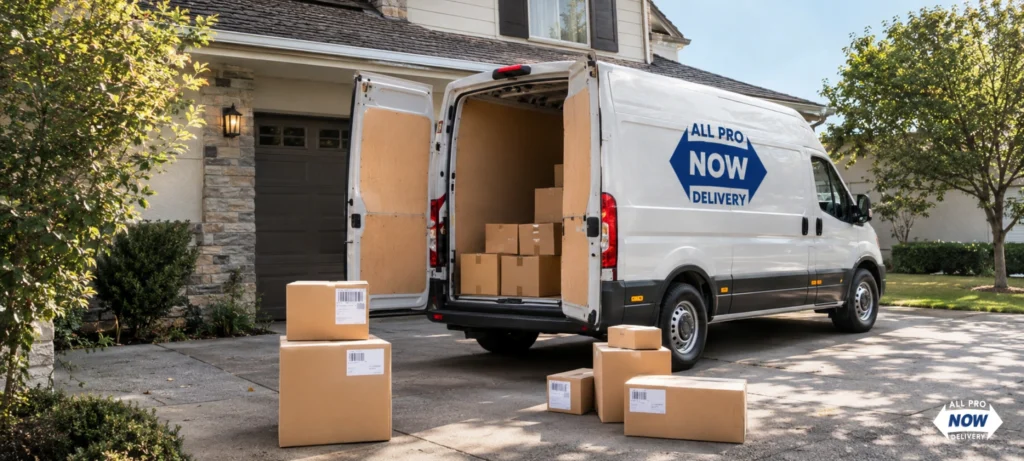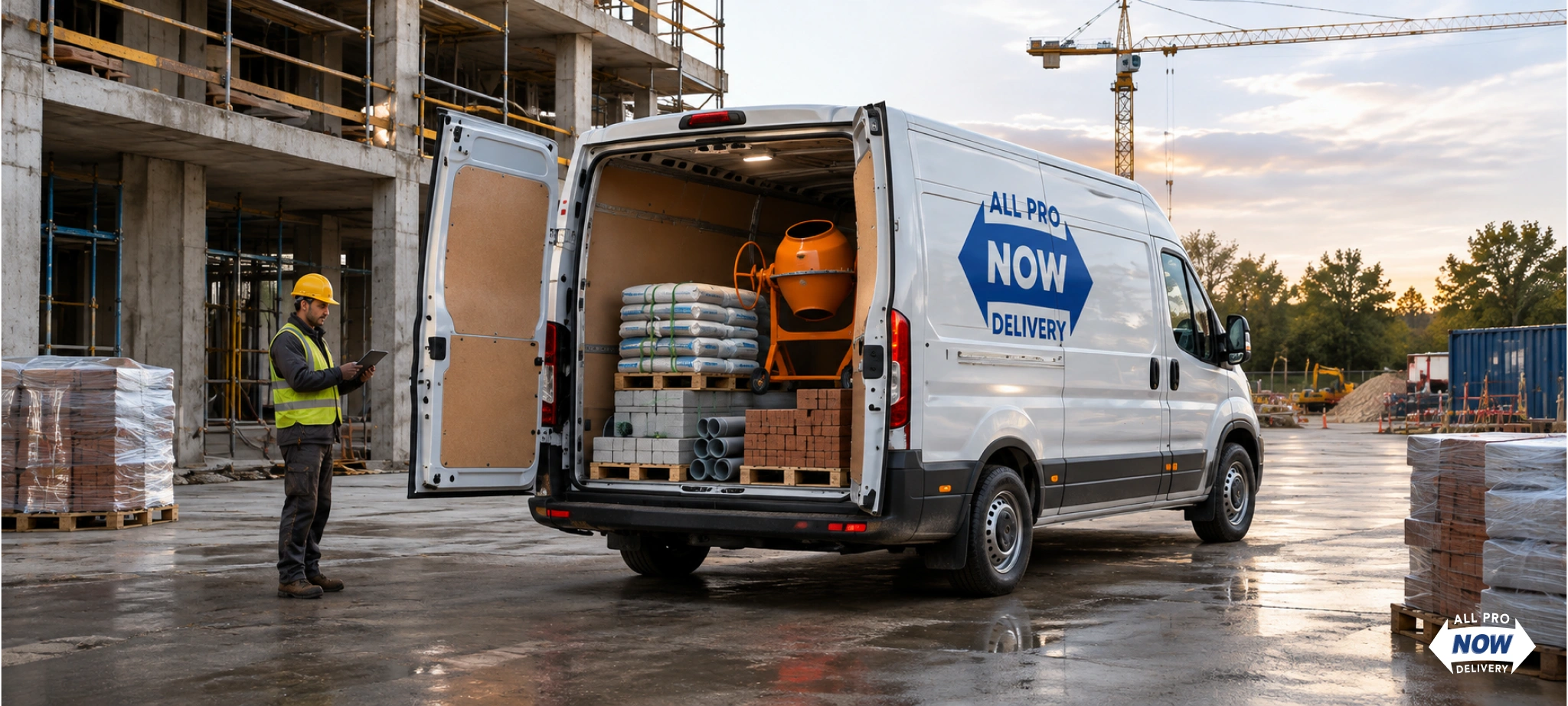
A job doesn’t stall because of bad weather alone. It stalls when the crew shows up and the drywall, fasteners, or pallets of blocks haven’t. That’s where AllProNow comes in. AllProNow is a same-day delivery and freight company backed by more than 50 years of logistics experience.
Its owned fleet handles construction materials delivery for contractors, supply yards, and manufacturers across Ohio, Michigan, Pennsylvania, Indiana, Kentucky, and Florida.
This blog covers how construction materials delivery works, what drives cost, how to pick the right vehicle, and how to plan drops so crews never stand around. Whether you’re framing in Columbus or finishing a tenant build-out in Tampa, the same rules apply.
Key Takeaways
- Construction materials delivery moves supplies from a yard, warehouse, or plant straight to your jobsite, saving crews hours of pickup runs.
- Match the vehicle to the load. Sprinter vans carry up to 3,600 lbs (about 4 skids). 26-foot box trucks carry up to 10,000 lbs (about 12 skids).
- Federal rules require ties rated for at least half the cargo’s weight. Professional carriers handle this for you.
- Same-day delivery is realistic on regional routes when you book early and confirm site access.
- Compare total landed cost, not base rate. Fuel surcharges and accessorial fees make or break the budget.
- Loose bulk aggregate needs a dump truck. Bagged or palletized aggregate can ride in a box truck.
Why Construction Materials Delivery Matters More Than Ever
The U.S. construction market is massive, and timing pressure is real. The Census Bureau estimated July 2026 construction spending at a seasonally adjusted annual rate of $2,157.6 billion, according to its monthly construction spending report. Every one of those dollars depends on materials showing up on time.
Labor is the other half of the equation. Construction employment reached about 8,337,000 in May 2026, up 68,000 from a year earlier, per AGC’s analysis of BLS data. Skilled workers are expensive and hard to replace. Pulling them off the job for supply runs wastes your most valuable resource.
What Is Construction Materials Delivery?
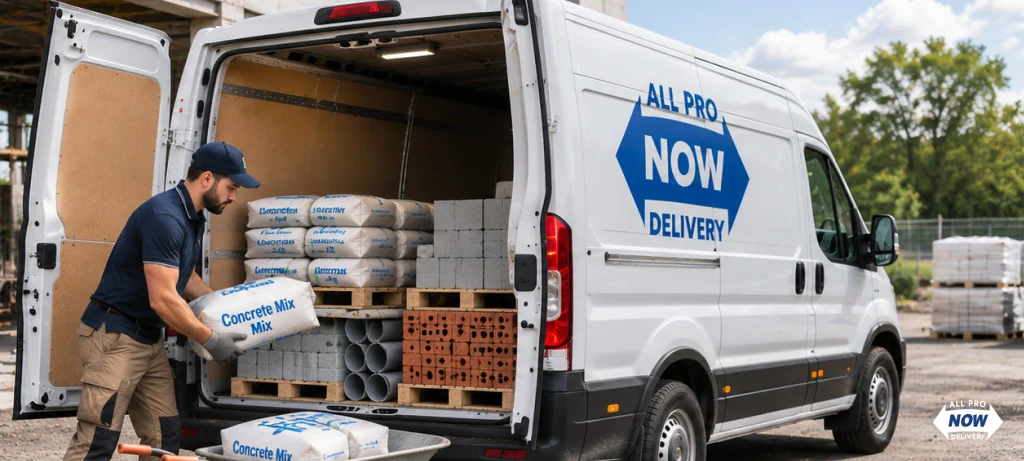
Construction materials delivery is the transport of building supplies from a source point to a jobsite or staging area. Sources include lumberyards, supply houses, distribution centers, and manufacturing plants. The goal is simple: right materials, right place, right time.
A good building materials delivery service does more than haul freight. It coordinates timing, confirms access, secures the load, and documents the handoff. That documentation matters when a superintendent signs for 40 boxes and later finds 38.
Common loads include drywall, insulation, and roofing bundles. Fasteners, anchors, tools, and hardware ship constantly. So do plumbing fittings, electrical supplies, HVAC parts, bagged concrete, doors, windows, and cabinets. Most move as B2B deliveries between suppliers and contractors.
Self-Haul vs. Professional Delivery: The Real Math
Many contractors still send a crew member to the yard in a pickup. It feels cheaper. It usually isn’t.
Look at wages alone. The Bureau of Labor Statistics lists average hourly earnings in construction at $39.06 for June 2026 (BLS industry data). A two-hour supply run costs roughly $78 in wages before benefits, fuel, and truck wear. Repeat that several times a week, and self-haul quietly drains your margin.
| Factor | Self-Haul (Crew Pickup) | Professional Construction Materials Delivery |
| Labor impact | Skilled worker off site 1–3 hours per run | Crew stays on the job |
| Load capacity | Limited by pickup or trailer | Van or box truck sized to the load |
| Securement | Often improvised | Done to federal standards |
| Damage risk | Higher on fragile or heavy items | Lower with proper strapping and skids |
| Documentation | Paper slip, if any | Digital proof of delivery with time stamp |
| Scheduling | Depends on who’s free | Booked windows with live tracking |
Loading and Securement: Why Compliance Protects You
Unsecured loads damage materials and create serious liability. Federal rules exist for a reason. Under the FMCSA cargo securement rules, the combined working load limit of a securement system must be at least half the weight of the cargo it restrains.
In practical terms, a 20,000-pound load needs tiedowns with a combined working load limit of at least 10,000 pounds. Most contractors hauling their own materials never run that calculation. Professional carriers do it on every load.
AllProNow takes safety seriously. The company earned the 2025 Acuity Insurance Outstanding Safety Performance Award, a signal that its drivers handle freight carefully.
How to Choose the Right Vehicle for Your Load
Picking the wrong vehicle is one of the costliest delivery mistakes. Too small means two trips. Too large means paying for empty space or failing to fit the site.
| Vehicle | Capacity | Best For |
| Sprinter van | Up to 3,600 lbs, about 4 skids (15.7′ x 4.4′ x 6′) | Hardware, fixtures, tools, rush parts, tight urban sites |
| 26′ box truck | Up to 10,000 lbs, about 12 skids (25.11′ x 8.1′ x 8.1′) | Drywall, insulation, palletized block, larger LTL loads |
| Dump truck | Varies by axle count | Loose gravel, sand, topsoil, bulk aggregate delivery |
A note on aggregate delivery: loose stone and sand require a dump truck from a quarry or landscape supplier. Bagged or palletized aggregate is different. It ships safely in a box truck alongside other supplies. For large-volume loose material, see our guide to bulk transportation.
Construction Materials Delivery Across Ohio, Michigan, Pennsylvania, and Florida
Construction materials delivery looks different in every market. Local conditions shape timing, access, and vehicle choice. Here’s how that plays out across AllProNow’s service area.
| Region | Key Cities | Local Delivery Considerations |
| Ohio | Cleveland, Akron/Canton, Youngstown, Columbus, Toledo | Winter weather tightens windows; early-morning drops are popular |
| Michigan | Detroit and surrounding metro | Manufacturing and redevelopment drive frequent parts and fastener runs |
| Western Pennsylvania | Pittsburgh | Hills and narrow streets favor smaller vehicles |
| Indiana & Northern Kentucky | Regional corridors | Daily routes connect distribution hubs to suburban projects |
| Florida | Statewide coverage | Year-round building; heat and storms push drops into mornings |
Ohio forms the core of the network. Cleveland and Northeast Ohio see steady commercial and industrial work. In Detroit, short-notice runs between suppliers and plants are routine. Pittsburgh crews often rely on a van to reach tight urban sites a larger truck can’t.
Industries That Rely on Building Materials Delivery
Construction materials delivery supports more than general contractors. Several industries depend on it daily.
General and specialty contractors: Framers, electricians, plumbers, and HVAC installers need parts delivered in sequence with each build phase.
Building supply yards and distributors: Many supply houses lack enough trucks for peak demand. Outsourcing overflow lets them promise fast turnaround without adding fleet cost.
Manufacturers: Producers of tools, fasteners, tape, and building components ship regularly to dealers and jobsites. Brands like Stanley, Shurtape, and Oatey already trust AllProNow with their freight.
Property managers and facilities teams: Renovations and repairs often need small, urgent deliveries rather than full truckloads.
Step-by-Step: How to Plan a Smooth Construction Materials Delivery
Most delivery problems trace back to planning gaps, not driving. Follow these steps to keep every drop clean.
Step 1: Build an accurate materials list. Note item counts, total weight, and skid dimensions. Your supplier’s packing slip is a good starting point. Accurate numbers drive accurate quotes.
Step 2: Confirm site access. Check gate codes, loading zones, overhead clearance, and ground conditions. Tell the carrier if trucks must avoid soft soil or a fresh slab.
Step 3: Choose your timing. Book same-day delivery for urgent gaps. Schedule recurring drops for predictable phases like framing or rough-in. Early-morning windows usually beat traffic and heat.
Step 4: Get an upfront quote. Confirm fuel surcharges, wait-time fees, and liftgate charges before you book.
Step 5: Assign a receiver. Someone on site should inspect and sign. Unattended drops invite theft and disputes.
Step 6: Track and verify. Use live tracking to time your crew. Check the load against the slip and confirm digital proof of delivery.
What Does Construction Materials Delivery Cost?
There’s no single price. Any company quoting one without details is guessing. Distance is the biggest driver. Vehicle size, urgency, weight, and handling needs follow close behind.
Surcharges are where budgets break. Many national carriers add fuel surcharges of 18% to 50%, adjusted quarterly. AllProNow keeps its fuel surcharge between 0% and 7%, fixed annually and shown upfront. Rates still vary by lane, weight, and timing. Learn more in our explainer on how fuel surcharges are calculated.
Big-box retailers offer delivery too, but terms vary widely. Our breakdown of Home Depot delivery charges shows how those fees compare. The smart move is always to compare total landed cost, not base rate.
Red Flags When Hiring a Construction Material Delivery Service
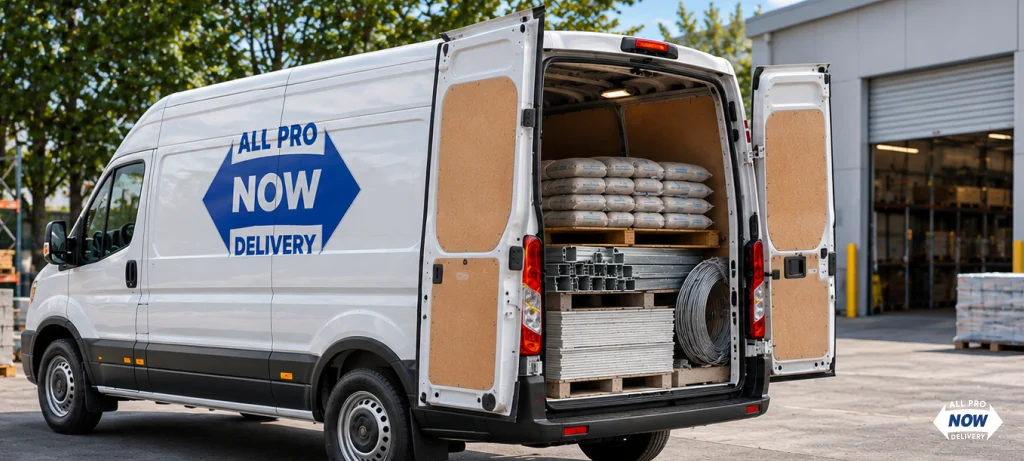
Not every carrier is built for jobsite work. Watch for these warning signs:
- No real-time tracking. You can’t plan crew time around a truck you can’t see.
- Vague pricing. Fees that appear only on the invoice signal trouble.
- Brokered loads. Your freight may change hands with no accountability.
- No proof of delivery. Without signed records, missing items become your loss.
- No DOT or MC numbers. Legitimate carriers list credentials openly.
AllProNow operates under DOT 3463495 and MC 1131330. It owns its fleet and never brokers loads. You get one point of accountability from pickup to drop.
How Technology Improves Delivery of Construction Materials
Modern delivery construction materials workflows run on data, not phone tag. Live GPS tracking shows the truck’s location and ETA, so superintendents can line up forklift operators right before arrival. Digital proof of delivery captures signatures and photos instantly, cutting disputes.
For supply yards and manufacturers shipping often, AllProNow offers managed logistics services and a transportation management system. These tools help when you’re coordinating dozens of weekly jobsite drops rather than one-off runs.
Make Construction Materials Delivery Work for Your Next Project
Reliable construction materials delivery is a scheduling tool, not just a trucking expense. When materials arrive on time and intact, crews stay productive and projects stay profitable.
Start with an accurate load list. Match the vehicle to the job. Insist on upfront pricing, live tracking, and signed proof of delivery. Those habits prevent most of the headaches contractors complain about.
If you build, supply, or manufacture across Ohio, Michigan, Western Pennsylvania, Indiana, Northern Kentucky, or Florida, AllProNow can help. Get an instant quote for same-day or scheduled construction materials delivery, and keep your next jobsite stocked without the guesswork.