A plain explanation of business-to-business delivery: what it means, how it differs from consumer shipping, the five delivery models, why just-in-time matters in B2B e-commerce, and the last mile problems that cause most failed deliveries.
Key takeaways
- B2B means business-to-business — the recipient is another company at a commercial address, usually against a purchase order.
- The defining constraint is the receiving window, not the distance. Miss it and the freight comes back undelivered.
- Five delivery models cover almost all B2B freight: on-demand, scheduled route, dedicated, pool distribution and cross-docking.
- Just-in-time delivery trades inventory cost for delivery risk. It only works with carriers that hit their windows consistently.
- Most last mile failures are execution failures — windows, equipment, paperwork, appointments and visibility — not routing failures.
What does B2B mean in delivery?
B2B stands for business-to-business. In a delivery context it identifies who receives the goods: another company, at a commercial address, during business hours, usually against a purchase order. The alternative is B2C — business-to-consumer — where the recipient is a private individual at a residential address.
That single difference in recipient changes almost everything downstream. A consumer parcel can be left on a porch at any hour. A B2B shipment has to arrive at a dock that may only accept freight between 7am and 2pm, be unloaded with equipment the destination may or may not have, and be signed for by someone authorised to accept it against paperwork that has to match an open order.
Understanding how business-to-business deliveries work.
What are B2B delivery solutions?
B2B delivery solutions are the combination of service levels, vehicle types, routing models, tracking technology and proof-of-delivery processes a carrier uses to move goods between businesses. A complete solution typically spans same-day and next-day service, parcel through LTL freight, scheduled recurring routes, live GPS visibility, digital proof of delivery, and a transparent surcharge structure.
The word “solution” gets overused in logistics marketing. In practice it means one thing: whether a carrier can cover every shipment size you have without you needing three separate accounts.
B2B Shipping vs. B2B Courier vs. B2B Freight vs. B2B Delivery — What’s the Difference?
These four terms get treated as synonyms in search, but they sit at different points on the same spectrum — shipment size, urgency and how the price is built. Getting the distinction right matters because each one is a genuinely different-sized market with a different growth curve, which is part of why buyers researching “B2B shipping” and buyers researching “B2B courier” are usually solving two different problems.
What is B2B shipping?
B2B shipping is the umbrella commercial transaction — booking, transit, invoicing and delivery of goods from one business to another — regardless of mode. It’s priced on weight, distance, or pallet count rather than a flat consumer rate, and it’s the term that covers parcel, LTL and full truckload activity collectively.
What is a B2B courier?
A B2B courier is the fastest, smallest-footprint version of B2B shipping: one urgent item, one vehicle, dispatched immediately rather than folded into a scheduled route. Courier demand is a real and growing slice of B2B delivery — same-day delivery services broadly are expanding at roughly 20.8% a year, heading toward an estimated $17.8 billion market in 2026, according to industry shipping-statistics research. That growth is a direct signal of how much urgent, single-shipment B2B and B2C volume carriers now have to absorb outside their scheduled routes.
What is B2B freight?
B2B freight is the opposite end of the spectrum: palletized or bulk shipments — LTL through full truckload — priced by pallet count, weight or lineal feet, and usually requiring dock or liftgate handling. Freight is not a niche corner of B2B shipping; the U.S. LTL market alone is valued at roughly $118.68 billion in 2026, growing at a 4–6% annual rate, according to Mordor Intelligence’s LTL market analysis. Freight is the largest dollar value of the four terms even though it moves the fewest individual shipments.
What is B2B in logistics?
In logistics, B2B describes any process — warehousing, transportation, fulfillment or delivery — that moves goods between two commercial entities rather than to an individual consumer. It typically sits upstream of B2C in the supply chain: a B2B shipment (manufacturer to retailer) is often the step before a B2C delivery (retailer to shopper).
B2B shipping, courier, freight and delivery compared
| Term | Typical shipment | Speed | 2026 market signal |
| B2B delivery | Any size — the umbrella term | Varies by model | Covers all of the below |
| B2B shipping | Parcel through full truckload | Standard transit | US shipping revenue projected at $201B+ (SellersCommerce) |
| B2B courier | Single urgent package or document | Same-day, immediate dispatch | Same-day segment growing ~20.8%/yr toward $17.8B |
| B2B freight | Palletized or bulk, LTL to full truckload | Standard to scheduled | US LTL market ~$118.68B, growing 4–6%/yr |
How B2B delivery differs from consumer delivery
| Factor | B2C delivery | B2B delivery |
| Recipient | Private individual | Another business |
| Destination | Residential door | Loading dock, receiving desk, job site |
| Timing | Carrier’s schedule, any hour | Fixed receiving window, often appointment-only |
| Order size | One or a few items | Bulk, multi-package, palletised |
| Order frequency | Occasional, unpredictable | Recurring, forecastable |
| Equipment needed | None | Liftgate, pallet jack, sometimes forklift |
| Documentation | Tracking number | Purchase order, bill of lading, signed POD |
| Payment | Card at checkout | Invoice on net terms |
| Pricing basis | Zone and weight | Mileage band, pallet count, lineal feet, service level |
| Cost of a failure | A dissatisfied customer | A stopped line, an empty shelf, a stalled job site |
The five B2B delivery models
Almost all business-to-business freight moves under one of these five structures. Knowing which one your business needs is more useful than comparing carrier brands.
MODEL 1: On-demand delivery
Booked per shipment, dispatched immediately. Used for line-down parts, urgent replenishment and anything where waiting for the next scheduled run is not an option.
Trade-off: highest per-shipment cost, maximum flexibility.
MODEL 2: Scheduled route delivery
A recurring multi-stop run covering the same business addresses on a fixed timetable, with a dedicated driver and an optimised stop sequence.
Trade-off: lowest cost per stop, requires predictable volume.
MODEL 3: Dedicated delivery
A vehicle and driver assigned exclusively to one customer, effectively an outsourced private fleet without the capital cost or the hiring.
Trade-off: full control, requires enough volume to justify the vehicle.
MODEL 4: Pool distribution
Freight is consolidated to a regional point, then broken out for local delivery to many destinations in the same area.
Trade-off: efficient for wide regional distribution, adds a handling step.
MODEL 5: Cross-docking
Inbound freight transfers straight onto outbound vehicles with no storage in between. The warehouse becomes a sorting floor rather than a holding facility.
Trade-off: removes inventory holding cost entirely, demands precise timing.
IN PRACTICE
Most businesses run two
A typical distributor runs scheduled routes for predictable replenishment and keeps on-demand available for exceptions. The mistake is running everything on-demand because the routes were never set up — which quietly triples the freight bill.
B2B Shipping Companies vs. B2B Delivery Services — What’s Included
“B2B shipping company” and “B2B delivery services” get used as if they’re interchangeable. They answer different questions — one is about who is moving your freight, the other is about what they’re selling you.
What is a B2B shipping company?
A B2B shipping company is the carrier itself — the business that owns, or brokers, the trucks, drivers, terminals and technology used to move freight between companies. Fleet ownership is not a minor detail: in the LTL sector, the top 25 carriers control roughly 91% of a $52.8 billion addressable market, and carrier-level research from Warp found that nearly every public carrier outside of one operates above an 84% operating ratio — meaning 84+ cents of every revenue dollar goes to running the network, leaving thin margin for service failures. That’s the financial backdrop behind why fleet-owned, asset-based carriers on your specific lanes tend to hit windows more consistently than broker-routed freight: broker capacity gets pulled first when a network is under margin pressure.
What do B2B delivery services include?
B2B delivery services are what that shipping company actually sells: the service levels, tiers and add-ons a customer can book. A complete set of B2B delivery services typically includes same-day and next-day delivery, parcel through LTL freight, scheduled recurring routes, live GPS tracking, digital proof of delivery, and dock/liftgate handling. See AllProNow’s full business shipping solutions for how these are packaged.
What is a B2B custom delivery service?
A B2B custom delivery service is a delivery arrangement built around one customer’s specific constraints — a non-standard receiving window, a dedicated vehicle type, a unique route sequence, or specialized handling — rather than a standard published service tier. Custom services are typically priced and contracted individually rather than booked off a rate card.
What to check before you sign: reuse the seven-question carrier checklist below — fleet ownership, fuel surcharge, lane coverage, scheduled-route capability, proof of delivery, dock/liftgate handling and USDOT verification are the same questions whether you’re evaluating a B2B shipping company or negotiating a custom delivery service. See AllProNow’s service area and vehicle capacity for lane coverage across Ohio, Michigan, Indiana, Western Pennsylvania, Northern Kentucky and Florida.
SERVICE TIERS
Parcel, courier, LTL and expedited — what the terms mean
| Tier | Typical shipment | Priced on | Use when |
| Parcel | Individual packages, commonly under 75 lbs | Flat package rate | You ship a steady daily volume of small packages |
| Courier | Single urgent package or document | Mileage band, single-package rate | One item cannot wait for the next scheduled run |
| LTL | Pallets and skids, part of a trailer | Pallet count, weight, lineal feet | Too big for parcel, too small for a full truck |
| Expedited freight | Time-critical pallets or oversize | Dedicated run pricing | The deadline costs more than the freight does |
| Full truckload | A complete trailer | Lane rate | Volume fills a trailer or the freight cannot share space |
All Pro Now covers parcel through expedited freight on one account — see B2B delivery services.
Routed, LTL, express and dedicated vehicle B2B shipping solutions compared
Beyond the standard tiers above, four specialized B2B shipping solutions cover the remaining edge cases — and the data on cross-docked versus dedicated freight is a genuinely useful reason to know which one you’re booking. One cross-dock freight network tracked across 790,000+ shipments recorded a 0.81% damage rate, against a 1.24% industry average, according to Warp’s 2026 LTL research — evidence that fewer handoffs, not just faster transit, is what actually drives freight damage down. That’s the operational logic behind choosing dedicated vehicle shipping over a standard hub-and-spoke LTL routing for anything fragile or high-value.
| Solution | What it means | Best for |
| B2B routed delivery services | A fixed, recurring multi-stop route covering the same business addresses on the same schedule every time — the service-level name for Model 2 (Scheduled route delivery) above. | Predictable, recurring B2B replenishment |
| B2B LTL shipping solutions | Less-than-truckload freight consolidated with other shippers’ pallets on the same trailer, priced by pallet count and lineal feet rather than a full lane rate. | Palletized freight too big for parcel, too small to justify a full truck |
| B2B express shipper | A shipper or service prioritizing speed over consolidation — same-day or immediate-dispatch handling for time-critical B2B freight, similar in urgency to expedited freight but scoped to a single shipment. | Line-down parts, urgent replenishment, missed-window recovery |
| Dedicated vehicle shipping with no transfers or cross-docking | One truck carries the freight from pickup straight to delivery. The load never transfers to another vehicle and never touches a cross-dock facility. | High-value, fragile, or time-critical freight where handoffs create risk |
JUST-IN-TIME
The importance of JIT delivery in B2B e-commerce
Just-in-time delivery is an inventory strategy in which materials arrive only as they are needed for production or sale, rather than being held in a warehouse. In B2B e-commerce it lets a business list and sell stock it does not physically hold.
The appeal is straightforward. Inventory sitting in a warehouse is working capital that cannot be spent on anything else, plus rent, plus handling, plus the risk that it becomes obsolete before it sells. JIT removes most of that.
What JIT gives you
- Working capital freed from stored inventory
- Lower warehouse space and holding cost
- Reduced obsolescence risk on parts and perishables
- A wider catalogue than you could physically stock
- Faster response to demand shifts, with no dead stock to clear
What JIT costs you
- No buffer stock — one late delivery stops production
- Total dependence on carrier on-time performance
- Higher freight frequency, so smaller and more shipments
- Greater exposure to supplier and weather disruption
- Requires accurate demand forecasting to work at all
The practical implication
JIT converts an inventory cost into a delivery risk. That is a good trade only if the carrier is genuinely reliable. This is why JIT operations select carriers on published on-time percentage and surcharge stability, not on the lowest quoted rate — a carrier that is 5% cheaper and 3% less reliable is far more expensive once a line stops.
LAST MILE CHALLENGES
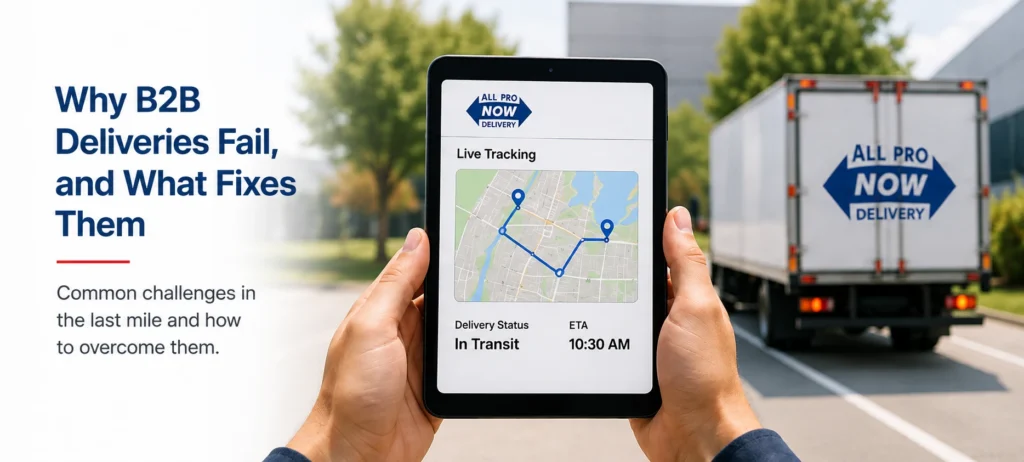
Why B2B deliveries fail, and what fixes them
Five recurring failure modes account for most missed B2B deliveries. None of them are distance problems.
| Challenge | What goes wrong | What fixes it |
| Receiving windows | Docks stop accepting freight at a fixed hour; arriving late means not delivering at all | Confirm the window before dispatch and build the route around it |
| Unloading equipment | A pallet arrives at a site with no forklift on a truck with no liftgate | Match equipment to the destination at booking, not on arrival |
| Paperwork mismatch | Missing PO, wrong bill of lading, or a number receiving cannot match to an open order | Digital documentation that travels with the load |
| Appointment scheduling | Larger receivers require a booked slot; without one you queue behind those who have one | Book appointments as part of dispatch, with call-ahead |
| Visibility gaps | Nobody knows a delivery is late until it already is, when recovery options are expensive | Live GPS with accurate ETAs so exceptions surface early |
| Surcharge volatility | Fuel surcharges of 18–50% reset quarterly, making freight budgets unplannable | Contract a fixed annual surcharge and get the accessorial schedule in writing |
| Broker handoffs | The carrier who quoted the job is not the one driving it; nobody spoke to your receiver | Use an asset-owning carrier on recurring lanes |
Deeper treatment of these failure modes: B2B last mile delivery.
Same-Day and Quickest B2B Delivery Options for Retailers
Retailers have a narrower problem than distributors: a shelf or a customer order needs filling today, not on next week’s scheduled route — and the cost of getting it wrong is measurable. In one 2026 survey of shipping behavior, over 90% of shoppers abandon a purchase when shipping costs look too high, per ecommerce shipping data from Flowlu, while on the fulfillment side, 65% of customers stop shopping with a retailer after two to three late deliveries, and 14% leave after just one, according to a Voxware survey cited in ProcurementTactics’ 2026 supply chain statistics report. For retailers, the choice of B2B delivery option is a retention decision as much as a logistics one.
What is the quickest B2B delivery option for retailers?
For retailers, on-demand courier delivery is the quickest B2B delivery option — a single urgent shipment booked and dispatched immediately, typically arriving within hours rather than a scheduled window. See on-demand delivery services. It costs more per shipment than a routed delivery but requires no advance booking, which is the trade-off that matters most during a stockout.
What is B2B same-day shipping?
B2B same-day shipping picks up and delivers a business shipment within the same business day it was booked, using either an immediate-dispatch courier for a single item or a same-day route for multiple stops. It sits between on-demand delivery (fastest, single shipment) and next-day parcel service (slower, lower cost) on the speed-versus-cost curve.
Where does B2B parcel delivery fit for retailers?
B2B parcel delivery — individual packages, commonly under 75 lbs, priced at a flat rate — is the right fit for retailers with steady, predictable daily replenishment volume rather than urgent one-off shortages. Retailers typically combine a parcel account for routine restocking with an on-demand or same-day courier service reserved for stockouts and time-critical items. See AllProNow’s same-day delivery page for coverage details.
What Is B2B Delivery Management?
B2B delivery management is the process and software layer that plans, schedules, tracks and documents B2B shipments across all five delivery models above — route planning, dock-appointment scheduling, live GPS tracking, digital proof of delivery, and fuel-surcharge tracking. It matters because visibility is still the exception, not the norm: only about 6% of businesses report full supply chain visibility, per ProcurementTactics’ 2026 supply chain research, which is exactly the visibility gap described in the last-mile challenges table above.
The upside of closing that gap is measurable: AI-assisted logistics tools can cut logistics costs by roughly 15% and lift service efficiency by up to 65%, according to the same ProcurementTactics data. AllProNow’s managed logistics services and transportation management software cover this layer directly — turning the five delivery models and the last-mile fixes above from a checklist into a repeatable, proactive operation instead of a reaction to a missed window.
CHOOSING A CARRIER
Seven questions worth asking before you sign
1. Do you own your fleet?
Or is this load going to a broker? It determines who is accountable when something fails.
2. What is the fuel surcharge?
Ask for the percentage range and how often it resets. Get it in writing.
3. Do you run my lanes?
Not a national coverage map — the specific origin and destination pairs you actually ship.
4. Can you run scheduled routes?
Recurring multi-stop capability is what separates a carrier from a courier app.
5. What proof of delivery?
Signature, timestamp and photograph, delivered digitally — or a paper slip that arrives next week.
6. Dock and liftgate handling?
Confirm they can meet appointment requirements and unload where you are sending freight.
7. What is your USDOT number?
Verify it free on the FMCSA SAFER system. A carrier that hesitates here is telling you something.
Need a B2B carrier that hits the window?
50+ years, 100,000+ shipments, 99% on-time, own fleet, 0–7% fuel surcharge. Ohio, Michigan, Indiana, Western Pennsylvania, Northern Kentucky and Florida.
B2B Logistics Terms — Quick Reference
Markup note: tag this table with DefinedTermSet / DefinedTerm schema in addition to the page’s existing FAQPage and Article schema — defined-term tables are disproportionately favored for AI Overview and AEO/GEO citation because they’re low-ambiguity and easy to extract verbatim.
| Term | One-line definition | When it applies |
| B2B delivery | The umbrella term for any movement of goods between two businesses. | Any business-to-business shipment, regardless of size or speed |
| B2B shipping | Moving goods business-to-business by any mode, priced by weight, distance or pallet count. | General transactional shipping between companies |
| B2B courier | A same-day, point-to-point service for one urgent package or document. | A single item that cannot wait for a scheduled route |
| B2B freight | Larger, palletized or bulk business-to-business shipments (LTL to full truckload). | Pallets, skids or bulk goods too large for parcel |
| Parcel | Individual packages, commonly under 75 lbs, at a flat package rate. | Steady daily volume of small packages |
| LTL (less-than-truckload) | Pallets and skids sharing trailer space with other shippers’ freight. | Too big for parcel, too small for a full truck |
| Full truckload | A complete trailer dedicated to one shipper, priced by lane rate. | Volume fills a trailer or freight cannot share space |
| Expedited freight | Time-critical pallets or oversize freight moved on dedicated-run pricing. | The deadline costs more than the freight does |
| B2B routed delivery | A fixed, recurring multi-stop route on a set schedule. | Predictable, recurring replenishment |
| Dedicated vehicle shipping | One vehicle and driver assigned exclusively to one customer, no transfers or cross-docking. | High-value or time-critical freight where handoffs create risk |
| Cross-docking | Inbound freight transferred straight to outbound vehicles with no storage in between. | High-volume distribution with precise timing |
| Just-in-time (JIT) delivery | Materials arrive only as needed for production or sale, not held in a warehouse. | Businesses trading inventory cost for delivery risk |
| B2B delivery management | The process/software layer that plans, schedules, tracks and documents B2B shipments. | Any operation running more than one delivery model |