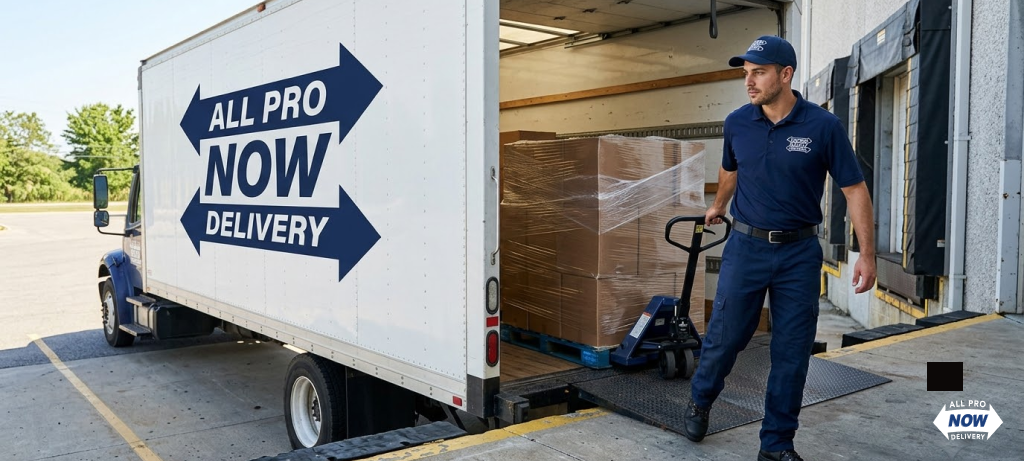

Moving freight in bulk sounds straightforward. More volume, fewer shipments, lower cost per unit. That’s the theory. In practice, bulk transportation is where a lot of operations quietly lose money — through the wrong vehicle choice, the wrong carrier for the lane, or a consolidation strategy that saves on paper but creates problems at the dock.
For manufacturers, distributors, construction companies, and healthcare operations moving high volumes across Ohio, Michigan, Indiana, Pennsylvania, Kentucky, and Florida, getting bulk transportation right isn’t about finding the cheapest rate. It’s about matching freight weight, volume, and timing to the right service — and having a carrier with the fleet and visibility to back it up.
This guide covers what bulk transportation actually means in a regional freight context, the data behind why it matters, and the practical framework for building a bulk freight strategy that performs consistently.
The term “bulk transportation” gets used in two distinct ways, and confusing them leads to bad carrier decisions.
In ocean and rail logistics, bulk refers to unpackaged commodities — coal, grain, ore, chemicals — shipped loose in carriers without individual packaging. That’s a separate category. In regional trucking, bulk transportation means moving large volumes of packaged or palletized freight in commercial vehicles, typically in quantities that approach or exceed the capacity of a single vehicle.
The global bulk cargo services market was valued at $259.4 billion in 2023 and is growing at 4% annually. In the U.S., road freight holds 64.36% of the freight and logistics market share — making trucking the backbone of regional bulk movement. For businesses operating in Ohio’s industrial corridor, that means the vast majority of bulk freight is moving by truck, not rail or waterway, regardless of what intermodal options exist on paper.
In practical terms, regional bulk transportation covers three common scenarios. First, full or near-full truckload shipments where a single business fills or nearly fills a commercial vehicle — sprinter vans handling up to 3,600 lbs, box trucks handling up to 10,000 lbs. Second, LTL consolidation where multiple shippers share vehicle space on common lanes, reducing per-unit cost. Third, multi-stop bulk distribution where a single vehicle delivers to multiple locations on an optimized route — common in manufacturing supply chains and retail replenishment.
Understanding which scenario fits your freight is the first decision. Getting it wrong costs more than just the freight bill.
The Real Cost of Getting Bulk Transportation Wrong
The cost of a poor bulk transportation strategy rarely shows up in a single invoice. It accumulates across multiple budget lines — and most operations aren’t tracking it correctly.
| Cost Category | What Causes It | Typical Impact |
| Excess vehicle capacity | Booking a box truck for freight that fits a sprinter van | Paying for unused capacity on every shipment |
| Under-capacity bookings | Booking a sprinter van for freight requiring a box truck | Re-delivery costs, loading failures, missed windows |
| LTL vs. FTL misjudgment | Shipping LTL when volume qualifies for truckload pricing | 30–40% higher freight cost per load |
| Accessorial charge accumulation | Liftgate, residential delivery, detention fees not anticipated | Quoted rate vs. actual rate divergence |
| Consolidation timing errors | Holding freight too long to achieve consolidation savings | Missed delivery windows, production delays |
| Carrier mismatch | Using a gig-based or consumer carrier for industrial bulk freight | Insufficient vehicle capacity, no commercial handling |
Manufacturing captured 28.77% of the U.S. freight and logistics market share in 2024. That concentration reflects just how much industrial bulk freight moves through Ohio, Michigan, and Indiana manufacturing corridors every day. For a Youngstown parts manufacturer shipping components to Detroit, or a Columbus distributor moving bulk retail inventory to Tampa — the cost of a carrier mismatch compounds across every lane, every week.
How Bulk Transportation Works: Vehicle Matching to Freight Type
The foundation of an effective bulk transportation strategy is matching freight characteristics to the right vehicle. This sounds obvious. It’s consistently where mid-market shippers make the most expensive mistakes.
| Vehicle Type | Weight Capacity | Pallet Capacity | Best For |
| Sprinter Van | Up to 3,600 lbs | Up to 4 skids | Parcel bulk, courier freight, small LTL, same-day industrial |
| Box Truck | Up to 10,000 lbs | Up to 12 skids | LTL freight, larger industrial loads, construction materials |
| Full Truckload | 40,000+ lbs | 24–26 pallets | High-volume bulk shipments filling an entire trailer |
For regional bulk transportation between Ohio and Florida, sprinter vans and box trucks handle the majority of business-to-business freight that doesn’t justify full truckload commitment. A manufacturer in Toledo shipping 8 skids to a Detroit supplier uses a box truck. A healthcare distributor in Columbus moving 3 skids of medical supplies to Pittsburgh uses a sprinter van. Choosing the right vehicle for each load is what keeps bulk transportation cost-effective rather than just fast.
Route optimization compounds the vehicle matching decision. A Cleveland distributor shipping to eight Northeast Ohio locations daily covered 180 miles under manual routing. Optimization software reduced that to 135 miles — 25% fewer miles on the same stops, with annual fuel savings exceeding $12,000 per vehicle. At bulk transportation scale, that efficiency multiplies across the entire fleet.
Bulk Transportation Across Ohio and Florida: Regional Variables That Matter
Bulk transportation doesn’t operate in a vacuum. Regional variables — infrastructure, weather, seasonal demand, industry concentration — determine which bulk strategies work reliably and which ones look good on a spreadsheet until they hit reality.

Ohio
Ohio’s manufacturing concentration makes it one of the highest-volume bulk freight corridors in the country. Interstate highways I-71, I-75, I-76, I-77, I-80, and I-90 provide the connectivity. Cleveland, Columbus, Toledo, Akron, Youngstown, and Cincinnati generate consistent industrial bulk freight demand — raw materials inbound, finished goods outbound, components moving between facilities.
Winter weather from November through March is a genuine operational variable. Snow and ice reduce highway speeds, affect loading dock operations, and increase accident frequency on key freight corridors. Bulk transportation strategies serving Ohio lanes need weather contingency logic — carriers that monitor conditions in real time and adjust routing before delays compound rather than after.
Ohio also sits at the intersection of major industrial supply chains. Automotive components move between Northeast Ohio and Michigan. Building materials flow from Ohio suppliers to Indiana and Kentucky construction markets. Bulk pharmaceutical and medical supply shipments connect Cleveland and Columbus healthcare hubs to Pittsburgh and Northern Kentucky facilities. Each of these lanes has distinct timing and handling requirements that a bulk carrier needs to understand operationally, not just geographically.
Florida
Florida’s bulk transportation dynamics are fundamentally different from Ohio’s. The state’s peninsula geography creates concentrated demand along both coasts — Miami, Tampa, Orlando, and Jacksonville — with long inter-city distances. Tampa to Miami covers 280 miles. Jacksonville to Miami covers 350 miles. Bulk shipments on these lanes operate under transit time pressures that short-haul Ohio freight doesn’t face.
Hurricane season from June through November creates seasonal risk that bulk transportation operations serving Florida must plan around. Major storms don’t just delay individual shipments — they close distribution corridors, flood warehouse facilities, and create cascading capacity constraints that affect freight movement for weeks. Carriers without proactive weather monitoring and rerouting capability create operational liability for businesses depending on reliable bulk delivery.
Florida’s tourism seasonality creates predictable demand surges in winter months and around major holidays. Retailers and distributors running bulk inventory replenishment into Florida from Ohio and Midwest distribution points need carriers with consistent capacity availability during peak periods — not just average conditions.
Ohio to Florida Long-Haul Bulk
The Ohio-to-Florida corridor represents one of the most commercially significant long-haul bulk lanes in the eastern U.S. Cleveland to Tampa covers approximately 1,100 miles. Columbus to Miami covers approximately 1,200 miles. These aren’t short-haul shipments where a missed window is a minor inconvenience. They’re multi-day transits where real-time visibility, accurate ETA management, and exception alerting are operational requirements.
For manufacturers in Northeast Ohio shipping finished goods to Florida distribution centers, or for Florida retailers replenishing from Ohio warehouse operations, bulk transportation on this corridor requires a carrier whose visibility infrastructure covers the entire transit — not just the origin leg.
Industry Applications: Where Bulk Transportation Is Most Critical
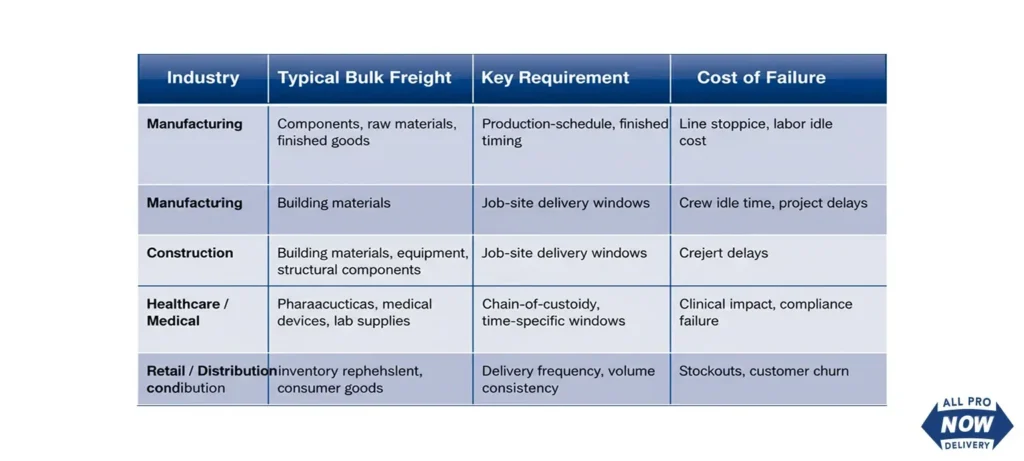
Different industries use bulk transportation differently. The freight type, the delivery window requirements, and the consequences of failure vary significantly.
Manufacturing and Industrial Distribution
Manufacturing bulk transportation is defined by timing precision. A Toledo parts supplier delivering components to 15 vendors on a single assembly line isn’t just moving freight — they’re feeding a production system that has zero tolerance for late arrivals. Too early creates storage problems. Too late stops the line.
Bulk transportation in this context requires vehicle capacity matched exactly to shipment size, routing optimized for industrial congestion patterns, and live tracking that surfaces delays early enough to adjust production sequencing before the impact hits. Ohio’s manufacturing corridor — Cleveland, Youngstown, Akron, Toledo, Columbus — generates this kind of time-critical bulk freight daily.
Construction and Building Materials
Construction bulk transportation operates under unique constraints. Materials must arrive within specific windows when contractors have labor deployed to receive them. A box truck delivering structural steel to a Cincinnati job site needs to hit a two-hour delivery window — not an approximate ETA. Missing that window doesn’t just delay the delivery. It idles an entire crew.
Oversized or heavy construction materials require commercial vehicles with appropriate capacity and, in some cases, specialized handling. Bulk transportation for construction sites in Indianapolis, Columbus, and across Ohio can’t be handled by passenger vehicles or gig-based carriers. Commercial vehicle capacity is the minimum requirement, not a premium option.
Healthcare and Medical Supply
Healthcare bulk transportation combines volume requirements with compliance obligations. Hospitals and healthcare facilities across Cleveland, Columbus, Pittsburgh, and Northern Kentucky move bulk pharmaceutical inventories, medical device shipments, and laboratory supplies on schedules that have clinical consequences if missed.
Temperature-controlled pharmaceuticals require documentation that conditions were maintained throughout transit. Laboratory specimens moving in bulk between physician offices and central testing facilities require chain-of-custody records and timed delivery windows. Bulk transportation for healthcare isn’t just about moving volume — it’s about moving volume with documented precision.
Technology That Makes Bulk Transportation Reliable
The gap between bulk transportation that performs consistently and bulk transportation that creates operational problems is almost always a technology gap — specifically, the difference between carriers that rely on check-in calls and those that operate on connected platforms.
| Technology Component | Function | Operational Benefit |
| Live GPS Telematics | Continuous position updates every 60–90 seconds | Real-time location on every active bulk shipment |
| TMS Route Optimization | Calculates efficient multi-stop routes before dispatch | 20–25% reduction in total miles driven |
| Automated Exception Alerts | Flags delays and deviations the moment they occur | Catch problems before delivery windows close |
| Digital Proof of Delivery | Signature, photo, GPS timestamp at handoff | Instant delivery confirmation, compliance documentation |
| Load Consolidation Tools | Identifies opportunities to combine LTL shipments | Up to 40% freight cost reduction on qualifying loads |
For bulk transportation at LTL scale — multiple businesses sharing vehicle capacity on common Ohio and Florida lanes — load consolidation is where the technology investment pays off most directly. A Columbus warehouse shipping three separate LTL orders to Tampa on the same day can consolidate into one load, reducing total freight cost by up to 40% versus three separate LTL charges. TMS planning surfaces these opportunities automatically. Manual planning misses them.
Choosing a Bulk Transportation Carrier: What to Actually Evaluate
The carrier evaluation decision for bulk transportation goes beyond rate comparison. The right questions separate carriers that perform from carriers that quote well.
| Evaluation Factor | What to Ask | What Good Looks Like |
| Vehicle Capacity | What vehicles are in the fleet, and what are their weight/pallet limits? | Dedicated commercial fleet — sprinter vans and box trucks — not personal vehicles |
| Geographic Coverage | Which specific lanes do you serve with dedicated capacity? | Regional expertise in your primary lanes, not just state-level coverage |
| Tracking Infrastructure | Is GPS tracking live or periodic? | Position updates every 60–90 seconds, not batch updates |
| Exception Management | Are delay alerts automatic or manual? | Automatic alerts the moment a shipment deviates from plan |
| Proof of Delivery | Photo confirmation or full digital POD? | GPS-confirmed timestamp, signature, photo at point of handoff |
| Pricing Transparency | Are all fees included in the quoted rate? | No fuel surcharges or accessorial fees added post-booking |
| On-Time Performance | What are lane-specific on-time delivery statistics? | 95%+ on-time; top regional carriers achieve 99% |
One specific question worth asking any bulk carrier: what happens when a shipment runs behind? The answer tells you whether the carrier has real exception management built into their operations or whether you’re going to find out about problems when the delivery window has already closed.
AllProNow Bulk Transportation Services
AllProNow provides bulk transportation for manufacturers, distributors, healthcare operations, and construction companies across Ohio, Michigan, Indiana, Pennsylvania, Kentucky, and Florida. The dedicated commercial fleet — sprinter vans handling up to 3,600 lbs and box trucks handling up to 10,000 lbs — covers regional bulk freight from Cleveland, Columbus, Toledo, Akron, Youngstown, and Pittsburgh through Indiana, Michigan, Northern Kentucky, and into Florida markets including Tampa, Miami, and Orlando.

LTL freight service handles bulk shipments that don’t fill an entire vehicle, with load consolidation tools identifying opportunities to reduce freight costs on common Ohio and Florida lanes. Route optimization runs before every dispatch. Live GPS tracking covers every active shipment. Digital proof of delivery — signature, photo, GPS-confirmed timestamp — is captured at the point of handoff on every load.
AllProNow’s instant quote calculator shows exact bulk transportation pricing before commitment. No fuel surcharges added post-booking. No accessorial fees that weren’t quoted upfront. Transparent pricing across a dedicated commercial fleet with 99% on-time delivery performance.
Ready to move bulk freight that actually performs on schedule? Visit AllProNow.net for an instant quote or talk to a logistics expert about your specific Ohio and Florida lanes.