
Late shipments are costing American businesses more than most realize, and the damage goes far beyond a single missed deadline. On time delivery is the metric that separates reliable operations from ones quietly hemorrhaging customers, productivity, and profit.
At AllProNow, we’ve spent over 50 years building a logistics network across Ohio, Michigan, Pennsylvania, Indiana, Kentucky, Florida, and New York that exists for one reason: to help businesses deliver on time, every time.
This blog breaks down exactly what on time delivery means, what the numbers actually look like across industries, and what it takes to consistently hit the window your customers expect.
Key Takeaways
| What You Need to Know | Why It Matters |
| OTD measures the % of shipments arriving by the promised date | It’s the single clearest signal of supply chain reliability |
| World-class manufacturers target 98%+ OTD | Anything below 85% sustained is a structural crisis, not a metric |
| Supply chain disruptions cost companies ~8% of annual revenue in 2024 | Late deliveries are a financial problem, not just a service one |
| 73% of customers switch to a competitor after repeated bad experiences | OTD failures drive silent churn before customers say a word |
| OTD ≠ OTIF — timing and completeness are separate failure modes | Measuring only one gives you an incomplete picture |
| The #1 cause of poor OTD is overpromising lead times | Fixing the commitment is often faster than fixing operations |
| Real-time on time delivery tracking cuts reaction time to delays | Visibility converts reactive firefighting into proactive resolution |
What is On Time Delivery?
On time delivery (OTD) measures the percentage of shipments that arrive at their destination by the confirmed delivery date. It is one of the most fundamental KPIs in supply chain management, and one of the most frequently misunderstood.
The formula is simple:
OTD Rate (%) = (Number of On-Time Deliveries ÷ Total Deliveries) × 100
A supplier shipping 1,000 orders in a month, with 950 arriving on the promised date, has a 95% OTD rate. That number tells customers whether they can plan around you, and tells your operation whether it’s functioning as promised.
It’s also important to clarify what OTD does not measure. On time delivery is not the same as On-Time In-Full (OTIF). OTIF checks whether an order arrived both on schedule and complete. OTD only measures timing. You can hit 100% OTD with a partial order and still leave your customer’s production line short. Both metrics matter; they measure different failure modes.
According to MetricHQ, how “on time” is defined varies meaningfully by industry: manufacturing traditionally uses exact-date compliance, retail commonly allows a ±1-day window, and healthcare or pharmaceutical delivery may require precision down to the hour. Applying a one-size-fits-all definition is one of the most common measurement mistakes businesses make.
Why On Time Delivery Failures Are More Expensive Than They Look
Most businesses think about late delivery as a customer service problem. In reality, it’s a financial one.
Supply chain disruptions cost companies an average of 8% of annual revenue in 2024, according to a report cited by impact economist. The average delivery time for raw materials stood at 81 days as of October 2024, still 25% longer than pre-pandemic norms, per Deloitte’s 2025 Manufacturing Industry Outlook. Every layer of delay compounds downstream.
At the customer level, the consequences are just as direct. According to Zendesk’s benchmark data, 73% of consumers will switch to a competitor after multiple bad experiences. In B2B environments, the tolerance is even lower, missed delivery windows in automotive, healthcare, and aerospace don’t generate complaints. They generate canceled contracts.
The hidden costs of poor OTD stack up fast:
- Expedited shipping premiums to recover a missed window
- Idle labor costs when production lines wait on parts
- Emergency inventory purchases at above-market rates
- Customer churn that rarely announces itself before it happens
One practitioner in a supply chain forum put it plainly: “The customers are ordering while they’re looking for your replacement.” That observation reflects something McKinsey’s 2024 consumer research confirms, customers who experience chronic delivery failures quietly begin exploring alternatives long before they stop buying.
On Time Delivery Benchmarks by Industry
Not all OTD targets are equal. What counts as “good” depends entirely on your sector, your customers, and the operational stakes of a missed window. Here’s how benchmarks break down across the industries AllProNow serves.
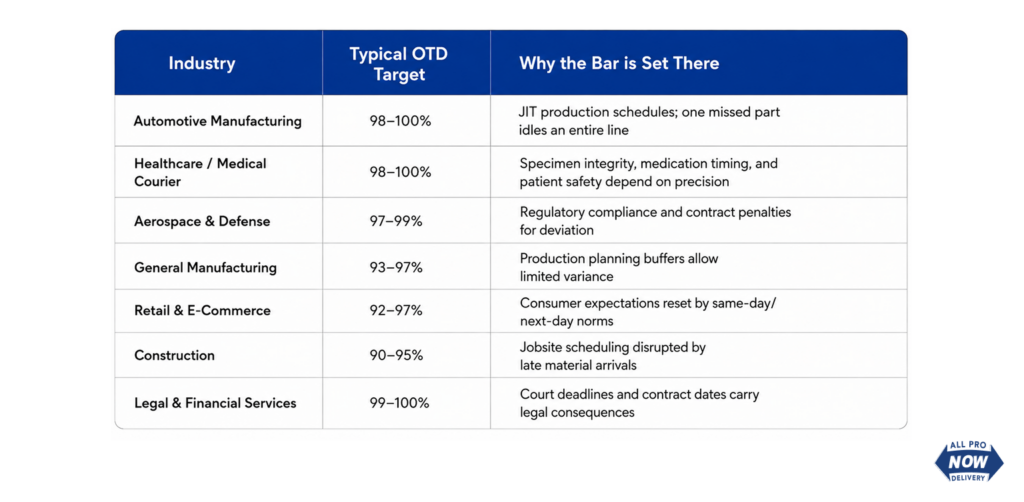
World-class manufacturers target 98% OTD or higher to minimize operational risk, according to SourceDay’s benchmark analysis. Companies operating below 85% on a sustained basis are not managing a metric, they are managing a crisis.
OTD vs. Related Metrics: What Each One Actually Measures
On time delivery is frequently confused with adjacent KPIs. Understanding the differences helps businesses measure the right things and diagnose the right problems.
| Metric | What It Measures | What a Failure Indicates |
| On Time Delivery (OTD) | Did the shipment arrive by the promised date? | Scheduling, carrier, or logistics failure |
| On-Time In-Full (OTIF) | Did the shipment arrive on time AND complete? | Fulfillment or inventory failure layered on top of timing |
| First Time Right (FTR) | Did the goods arrive without defects or quality issues? | Production or quality control failure |
| Delivery In Full On-Time (DIFOT) | Were all ordered items correct, complete, and on time? | Broadest measure of end-to-end fulfillment quality |
Each metric isolates a different failure point. A business with high OTD but low OTIF is getting shipments out on time but incomplete inventory or fulfillment problems. A business with high OTIF but low FTR is shipping complete orders on schedule, but with quality defects a production problem. OTD is where the diagnostic chain typically begins.
The Root Causes of Poor On Time Delivery
A 2024 study by Supply Chain Quarterly found that 64% of manufacturers say OTD is harder to achieve now than it was five years ago, despite having more tools at their disposal. That gap between capability and performance has identifiable causes.
1. Overpromising Lead Times
Sales teams commit to delivery windows that operations cannot consistently support. When your actual median delivery runs 50% behind your stated lead time, the issue isn’t capacity alone, it’s the promise made at the front end.
The fix is direct: align your quoted lead times with your actual delivery performance. Customers told 7–10 days who receive in 5 are delighted. Customers told 4–6 days who receive in 9 are quietly finding alternatives.
2. No Real-Time Shipment Visibility
Businesses without live on time delivery tracking react to problems after the damage is done. By the time a delay surfaces, the customer already knows before you do.
The fix: implement a platform with GPS tracking, automated driver status updates, and digital proof of delivery. AllProNow’s shipper portal gives businesses across Northeast Ohio, Columbus, Detroit, Pittsburgh, and beyond complete visibility from pickup through confirmed drop-off.
3. Carrier Inconsistency and Broker Layers
Broker-model logistics networks add accountability gaps between shipper and driver. When the carrier has no direct accountability for your delivery window, OTD variance becomes structurally unavoidable.
The fix: work with dedicated driver networks, not broker marketplaces. AllProNow owns its fleet and dispatches directly, one accountable party from booking through delivery.
4. Misaligned Inventory Positioning
Even the most reliable carrier cannot compensate for inventory that isn’t where it needs to be when it’s needed. Delivery commitments made before inventory is confirmed are delays waiting to happen.
The fix: integrate OTD tracking with inventory management. If your data shows delays clustering at a specific stage, quality inspection, a particular fulfillment node, a specific lane, that’s where process improvement effort belongs.
5. Disconnected Accountability
In many organizations, the team that promises a delivery date is not the team that bears consequences when that date is missed. Sales commits. Operations misses. The customer escalates back to sales. The loop repeats.
The fix: make OTD data visible across sales, operations, and leadership at the same time, not siloed in a shipping spreadsheet reviewed once a week.
How On Time Delivery Tracking Works in Practice
Modern on time delivery service doesn’t run on phone calls or manual status checks. It runs on technology, and the gap between businesses that use it and those that don’t shows up directly in OTD rates.
According to McKinsey’s 2025 logistics research, early adopters of AI-driven logistics tools report up to 30% efficiency gains in last-mile delivery. Real-time visibility isn’t just operationally useful, it’s a competitive differentiator.
Here’s what a well-built OTD tracking workflow looks like for businesses in Columbus, Akron, Detroit, Indianapolis, Cincinnati, Pittsburgh, and Tampa:
- Booking: Shipment created via portal; driver matched and dispatched within minutes
- Pickup confirmation: Live GPS lock established; ETA calculated automatically
- In-transit visibility: Driver status updates push to shipper and recipient; no inbound calls to dispatch
- Delivery confirmation: Digital proof of delivery captures photo, signature, and timestamp at the moment of drop-off
- Reporting: All shipment data stored in portal for OTD rate calculation, invoice review, and audit trail
For medical couriers transporting lab specimens in Cleveland or pharmaceutical products in Detroit, step 5 is not optional, it’s a compliance requirement. For construction firms in Pittsburgh or Columbus receiving large-format materials on a jobsite schedule, step 3 is what prevents a crew from standing idle.
Industries Where On Time Delivery Is Non-Negotiable
AllProNow serves businesses where a late delivery isn’t a minor inconvenience, it’s a crisis. Here’s how OTD performance plays out across the specific industries and regions the company operates in.
| Industry | Key Cities Served | What a Missed Window Actually Means |
| Automotive Manufacturing | Toledo, Detroit, Akron, Indianapolis | Idle production line; measurable per-hour cost of downtime |
| Healthcare & Medical | Cleveland, Detroit, Pittsburgh, Florida statewide | Compromised specimen, delayed diagnosis, medication timing failure |
| Legal & Financial Services | Columbus, Pittsburgh, Youngstown | Court deadline missed; legal consequence, not just complaint |
| Retail & E-Commerce | Ohio metro markets, Florida statewide | Failed appointment delivery; customer churn; negative reviews |
| Construction | Columbus, Cleveland, Pittsburgh, Cincinnati | Idle crew on jobsite; cascading schedule delay |
| Pharma & Research | Cleveland, Detroit, Northern Kentucky | Chain-of-custody break; regulatory exposure |
In automotive and aerospace manufacturing, concentrated across Ohio, Michigan, and Indiana, OTD expectations sit at 98–100%. A replacement component that arrives hours late can idle a production line at costs that exceed the entire logistics budget for that shipment. In healthcare networks spanning Cleveland, Detroit, and Pittsburgh, specimen degradation windows are measured in hours. In legal services across Columbus and Pittsburgh, court filing deadlines do not flex.
What a Reliable On Time Delivery Service Actually Looks Like
When evaluating logistics partners, look for specific operational capabilities, not marketing language. Here’s what separates providers who consistently deliver on time from those who don’t.
Transparent, upfront pricing: Hidden fuel surcharges, residential fees, and accessorial charges don’t just inflate costs, they signal that a provider prioritizes billing over accountability. AllProNow publishes rates before booking with zero hidden fees.
Dedicated drivers, not brokers: Broker-model platforms introduce accountability gaps at every handoff. AllProNow operates a dedicated driver network, dispatching directly from booking, no intermediary layers.
1–2 hour pickup windows: For time-critical freight, same-day pickup isn’t a premium feature. It’s the baseline. AllProNow dispatches the nearest available driver immediately upon booking.
24/7 dispatch and support: Medical emergencies and production failures don’t follow business hours. A logistics partner that goes dark after 5 PM is not a partner for businesses that operate around the clock.
Multi-stop capability: Healthcare networks, multi-location retailers, and construction supply chains often require multiple pickups or drop-offs in a single order. AllProNow handles multi-stop shipments with full live tracking maintained throughout.
Digital proof of delivery: Photos, signatures, and timestamps uploaded at the moment of delivery, not reconstructed hours later. Available in the portal immediately, without a request to dispatch.

AllProNow’s On-Time Delivery Commitment
AllProNow backs its same-day courier and parcel delivery services with a 99% on-time guarantee across its seven-state network: Ohio, Michigan, Pennsylvania, Indiana, Kentucky, New York, and Florida.
That coverage spans 25+ major cities: Cleveland, Columbus, Cincinnati, Toledo, Akron, Dayton, Youngstown, Detroit, Pittsburgh, Indianapolis, and markets throughout Florida with over 100,000 shipments delivered and 50+ years of regional logistics experience behind every dispatch.
The platform combines a dedicated driver network with a real-time shipper portal, giving manufacturers, medical facilities, legal teams, retailers, and construction firms the tracking, documentation, and delivery consistency they need to honor their own commitments downstream.
On Time Delivery Starts Before the Truck Leaves
Poor on time delivery doesn’t happen at the loading dock. It happens when lead times are overpromised, when visibility breaks down mid-route, and when no one in the chain is held accountable for the gap between commitment and performance.
Supply chain disruptions cost companies an average of 8% of annual revenue. Raw material delivery times still run 25% longer than pre-pandemic norms. And 73% of customers will switch to a competitor after repeated failures. The cost of getting on time delivery wrong is well-documented. The path to getting it right is equally clear.
If your business operates in Ohio, Michigan, Pennsylvania, Indiana, Kentucky, New York, or Florida and you need an on-time delivery service that treats your window as its own, AllProNow is built for exactly that.
Get an instant quote at allpronow.net. No phone calls. No contracts. Upfront rates, driver dispatch in minutes, and live on-time delivery tracking from pickup to proof of delivery.
Your customers are counting on you. Count on AllProNow.