
Finding the best freight carriers for small businesses isn’t about picking the biggest name. It’s about finding a partner who answers the phone, quotes you fairly, and shows up on time. AllProNow, a regional freight and logistics platform headquartered in Westlake, Ohio, has spent over 50 years helping small and mid-sized shippers move freight without the runaround national brokers create.
This blog breaks down what actually matters when choosing a carrier, backed by independent industry data, and shows where a regional partner like AllProNow fits into that decision.
Freight shipping isn’t optional for most small businesses. If you make, sell, or distribute a physical product, you’re shipping something every week. The problem is that most freight advice online is written for enterprise shippers moving thousands of pallets a month. That’s not you. You need carriers who understand small volume, tight margins, and unpredictable schedules.
Key Takeaways
- The best freight carriers for small businesses combine competitive LTL rates with real accountability, not just low quotes.
- The 2023 shutdown of a major national LTL carrier permanently removed roughly 12% of industry capacity, according to C.H. Robinson, tightening options and pushing rates up industry-wide.
- The American Trucking Associations reports trucks move 72.7% of all U.S. domestic freight tonnage, making carrier selection a core operational decision, not a side task.
- LTL freight carries a materially higher damage rate (2% to 5%) than other modes because of repeated handling, per FleetWorks’ 2025 freight damage analysis.
- Businesses in Ohio, Michigan, Indiana, Pennsylvania, Kentucky, and Florida have a regional option in AllProNow for both LTL coordination and same-day delivery, backed by a documented 99% on-time record.
Why Carrier Selection Matters More in 2026
The freight market small businesses are shipping into today looks different than it did five years ago. Understanding the backdrop helps explain why the “best carrier” question has real financial stakes now.
Trucks move 72.7% of all domestic freight tonnage in the United States, carrying 11.27 billion tons of freight in 2024 alone, according to the American Trucking Associations. That scale means even small inefficiencies in carrier selection ripple through your entire cost structure.
Capacity is also tighter than it used to be. C.H. Robinson’s 2026 industry outlook notes that a major national LTL carrier’s 2023 bankruptcy permanently removed roughly 12% of national capacity, and that supply never fully returned. PLS Logistics projects general rate increases of 5.5% to 7.5% across 2026 as remaining carriers absorb higher labor, insurance, and equipment costs.
That combination, fewer carriers and rising rates, is exactly why small businesses can’t afford to default to whichever carrier is most familiar. The best freight carriers for small businesses in this environment are the ones offering transparent pricing and flexibility, not just a recognizable logo.
Top LTL Freight Companies Small Businesses Actually Use, and How AllProNow Fits In
When people search for the best freight carriers for small businesses in the USA, the same national names come up: Old Dominion, Estes, Saia, XPO, ABF Freight, and R+L Carriers. Each brings something different to the table.
| Carrier | Known For | Best Fit For |
| Old Dominion | Low damage claim rates, strong on-time performance | Businesses prioritizing reliability over lowest price |
| Estes Express | Employee-owned, deep terminal network | Industrial freight, building materials |
| Saia | Competitive regional pricing | Southeast and Midwest shippers |
| XPO | Large national footprint, strong tech/TMS integration | Businesses needing broad national coverage |
| ABF Freight (ArcBest) | Handles specialized and time-sensitive freight | Businesses with unusual freight requirements |
| R+L Carriers | Privately owned, straightforward pricing | Regional lanes, predictable service |
Here’s the problem for small businesses: managing relationships with several of these carriers, comparing quotes lane by lane, and chasing down a real person when something goes wrong, is a full-time job most small shippers don’t have time for.
This is where AllProNow changes the equation. Instead of picking one national carrier and hoping it fits every shipment, AllProNow coordinates LTL freight across a vetted carrier network and layers in same-day and next-day delivery for anything the big carriers can’t move fast enough.
For businesses across Cleveland, Columbus, Detroit, Pittsburgh, Indianapolis, Cincinnati, Tampa, Orlando, and Miami, that means one point of contact, flat-rate pricing, and real-time GPS tracking instead of six different carrier logins and six different rate sheets.
If you’re comparing the best freight carriers for small businesses on your own, that table above is a fair starting point. If you’d rather have a regional partner already manage that comparison and carrier relationship for you, that’s the role AllProNow plays.
Regional LTL Carriers vs. National Names: Why Location Matters
The best freight carriers for small businesses aren’t always the biggest ones. Regional LTL carriers often outperform national networks on specific lanes because they know the local terminals, traffic patterns, and customer base.
If your business ships primarily within Ohio, Michigan, Indiana, Pennsylvania, Kentucky, or Florida, a regional logistics partner can offer faster response times than national carriers are built to provide, especially for same-day or urgent freight.
AllProNow operates exactly this kind of regional model. Its core hubs in Westlake, Ohio, and Sanford, Florida, connect a service footprint built for speed and local accountability.
| Region | Core Cities Served | Common Industries |
| Northeast Ohio | Cleveland, Akron, Canton, Youngstown, Westlake | Manufacturing, retail, medical |
| Ohio & Kentucky | Columbus, Toledo, Cincinnati, Lexington | Retail, construction, distribution |
| Michigan & Indiana | Detroit, Indianapolis, Grand Rapids, Saginaw | Manufacturing, e-commerce |
| Pennsylvania & NY | Pittsburgh, Johnstown, Buffalo | Construction, industrial |
| Florida | Tampa, Orlando, Miami, Fort Myers, Jacksonville, Sanford | Medical, retail, e-commerce |
Retailers, manufacturers, medical facilities, and construction firms in these markets rely on this kind of coverage because their freight needs are urgent and local. A lab specimen or piece of medical equipment can’t wait several days for a national network to route it through a distant hub.
How to Vet the Best Freight Carriers for Small Businesses
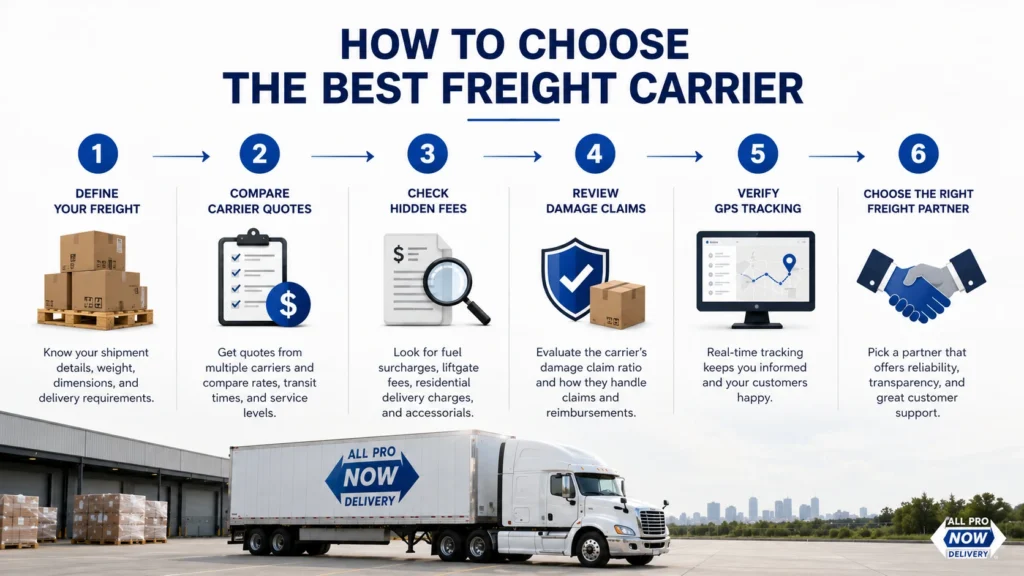
Choosing a carrier shouldn’t be a guessing game. Here’s a practical process small businesses can follow, whether you’re comparing national carriers directly or evaluating a regional partner like AllProNow.
Step One: Define your freight profile. Know what you ship, how often, and what equipment it needs. Palletized retail goods need a dry van. Refrigerated products need a reefer. Steel or lumber needs a flatbed.
Step Two: Get quotes from more than one source. Pricing varies more than most business owners expect, especially as 2026 rate increases take hold industry-wide.
Step Three: Ask about accessorial fees upfront. Oversized freight, liftgate service, residential delivery, and inside delivery can all add unexpected charges. The National Motor Freight Traffic Association updated roughly 5,000 commodity classification categories in 2025, and outdated freight classifications are a common source of overbilling. Get current classifications and accessorial terms in writing before you book.
Step Four: Check damage and claims performance. LTL freight sees damage rates between 2% and 5%, notably higher than rail or intermodal shipping, according to FleetWorks’ freight damage research. Ask any carrier directly about their damage rate and claims process before committing volume.
Step Five: Confirm real-time tracking. The best freight carriers for small businesses in 2026 offer GPS tracking, digital proof of delivery, and live ETAs as standard, not premium add-ons.
| Vetting Question | Why It Matters |
| What’s your average damage claim rate? | Industry average is 2%–5% for LTL; ask carriers to disclose theirs |
| Are accessorial fees itemized before booking? | Prevents surprise charges on oversized or residential freight |
| Do you offer flat-rate pricing? | Protects against mid-2026 general rate increases |
| Is there a dedicated contact for my account? | Reduces resolution time when issues come up |
| Do you provide real-time GPS and digital POD? | Baseline expectation for accountability in 2026 |
Common Mistakes Small Businesses Make When Choosing a Freight Carrier
Most freight mistakes come down to a lack of research. Business owners often default to the most familiar carrier name without comparing rates or service levels elsewhere.
Another common mistake is ignoring lane-specific pricing. A carrier that’s excellent for cross-country freight might be mediocre for short regional hauls. The best freight carriers for small businesses are often chosen on a lane-by-lane basis, not as a single all-purpose vendor.
Small businesses also underestimate the value of a dedicated point of contact over a generic call center queue. That single relationship often matters more than the quoted rate when something goes wrong mid-shipment.
Finally, many businesses skip negotiating altogether. Freight rates are rarely fixed, and getting a second quote to use as leverage is standard, accepted practice in this industry.
How AllProNow Fits Into Your Freight Strategy
For businesses shipping within its footprint, AllProNow offers a practical alternative to juggling multiple national carrier relationships. The platform combines LTL freight coordination with same-day and next-day parcel delivery, backed by real-time GPS tracking, digital proof of delivery, and flat-rate pricing with no fuel surcharges.
This matters most for businesses that need urgent, local moves alongside standard LTL freight. A construction firm in Pittsburgh might need scheduled appointment deliveries for building materials. A retailer in Columbus might need same-day delivery to compete with larger e-commerce chains.
A medical facility in Tampa might need time-sensitive lab specimen transport. AllProNow’s dedicated driver network and documented 99% on-time performance are built around exactly these use cases.
Final Thoughts: Choosing the Best Freight Carriers for Small Businesses
There’s no single “best” carrier for every business. The best freight carriers for small businesses are the ones that match your specific lanes, freight type, and service needs, backed by real accountability and transparent pricing.
Start by mapping out your shipping patterns. Get multiple quotes. Ask hard questions about fees, damage rates, and tracking. And if you ship within AllProNow’s Midwest-to-Florida corridor, request a customized quote today and see how a regional freight partner compares to your current carrier.