Businesses across the US lose thousands of dollars every year not because they chose a bad carrier, but because they chose the wrong type of carrier for their freight. Late deliveries, billing surprises, and zero accountability aren’t fringe complaints. They’re the norm when a shipper picks a carrier based on brand name alone rather than actual fit.
The question, what are the best freight shipping companies in the US? is legitimate and important. But the answer isn’t a ranked list you can copy-paste into a vendor email. It depends on your freight type, your lanes, your delivery urgency, and the kind of operational reliability your business actually needs.
The US freight and logistics market is worth an estimated $1.43 trillion in 2026, growing at a 3.8% CAGR, with road freight commanding nearly 64% of total revenue. There are more than 354,000 freight businesses operating in the US right now. Choosing the right one means knowing how to filter fast and accurately.
This blog gives you the framework to do exactly that.
Key Takeaways
- There is no single “best” freight shipping company in the US. The right carrier depends on your freight type, lane, volume, and service requirements, not popularity.
- Surcharges now make up roughly 33% of the average shipping cost. A quoted rate is rarely the final rate with large national carriers.
- LTL, FTL, parcel, same-day, and intermodal are fundamentally different services, the top carrier in one category is often average in another.
- Scale doesn’t equal service. National carriers prioritize key accounts. Mid-size and regional businesses frequently get better results from focused regional operators.
- For freight moving within Ohio, Michigan, Pennsylvania, Indiana, Kentucky, and Florida, AllProNow backed by 50+ years of regional logistics experience offers same-day delivery, flat-rate pricing with zero hidden fees, and a verified 99% on-time rate across 12+ metro areas.
- Matching your supply chain to the right carrier type first, then evaluating specific operators is the decision framework that saves the most money.
How US Freight Shipping Is Actually Structured
Before asking what are the best freight shipping companies in the US? you need to know which type of freight service your shipment actually requires. Most businesses operate across more than one, and the top carrier in one category is often mediocre in another.
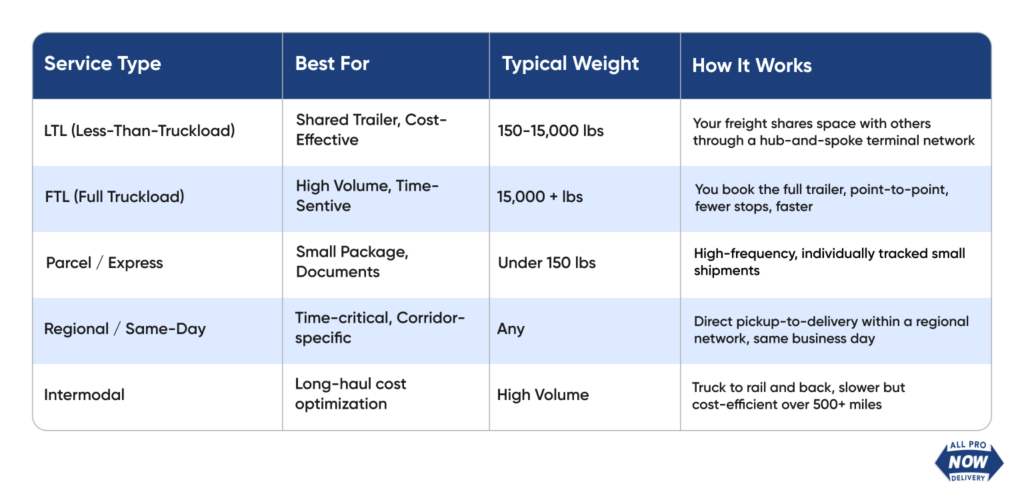
Knowing which row your freight falls in eliminates most of the noise immediately. The top 10 shipping companies in the USA look completely different depending on which category matters to your operation.
What Are the Best Freight Shipping Companies in the US? The Honest Breakdown
National LTL Carriers
National LTL carriers operate hub-and-spoke terminal networks spanning all 48 contiguous states. They’re the right answer when you ship moderate-weight freight across multiple regions on predictable schedules. Their strength is geographic breadth. Their limitation, especially for mid-size shippers, is pricing complexity, terminal delay risk, and limited responsiveness outside key accounts.
What to know about pricing in 2026: Both FedEx Freight and UPS implemented a 5.9% General Rate Increase in early 2026, the third consecutive year at that figure (Supply Chain Dive, FedEx Rate Announcement). But the headline number understates the real cost impact.
According to carrier analysis, surcharges now account for roughly 33% of the average package shipping cost, including fuel surcharges, residential delivery fees, additional handling charges, oversize fees, and delivery area surcharges. For shippers with bulkier or more complex freight, the actual cost increase routinely exceeds the advertised GRI.
| Carrier | Annual Revenue | Service Centers | Known For |
| FedEx Freight | ~$9.1 billion | 400+ | Largest LTL network by daily shipment volume (85,000/day) |
| Old Dominion (ODFL) | ~$5.8 billion | 260+ | Industry-leading 99% on-time rate; 0.1% cargo claims ratio |
| XPO Logistics | ~$4.9 billion | National | Technology-forward; AI routing and automated load planning |
| Estes Express Lines | ~$5.0 billion | 300+ | Strong Southeast/Mid-Atlantic coverage; privately held |
| TForce Freight (UPS) | Part of TFI International | National | UPS ecosystem integration; consistent domestic LTL tracking |
What to watch: Old Dominion has maintained the #1 National LTL Carrier for Quality ranking for 15 consecutive years, with a 99% on-time delivery rate and a cargo claims ratio of just 0.1%, both independently documented (ODFL operational data, UNIS Logistics). That level of cargo protection comes at a premium. Shippers who prioritize cost over reliability may find that premium difficult to justify on every lane.
Important for mid-size shippers: Unless your account represents meaningful volume to a national LTL carrier, you are not a priority account. Service responsiveness, exception handling, and dedicated support scale with revenue contribution to the carrier, not with your business’s own operational urgency.
Full Truckload (FTL) Carriers
Full truckload is the right service when you’re consistently shipping volumes that fill an entire trailer, or when your freight is time-sensitive enough that shared terminal routing is unacceptable. The US road freight market is valued at $583.65 billion in 2026, growing at a 3.78% CAGR through 2031, with full truckload capturing 63.6% of brokerage revenue, reflecting just how much freight still moves this way.
Key operators in this space handle long-haul, dedicated fleet, and consistent high-volume lanes nationally. Full truckload works best when you can fill the trailer regularly, irregular FTL usage rarely unlocks competitive pricing.
Freight Brokers vs. Direct Carriers
Freight brokers companies that connect shippers to carriers without operating their own trucks, represent a $21.28 billion market in 2026, growing at a 7.23% CAGR. The largest operate massive carrier networks and offer significant lane flexibility.
The critical distinction: a broker intermediates; a carrier owns the outcome. When something goes wrong, a missed pickup, a damaged shipment, a delivery exception, accountability with a broker is diluted across the carrier relationship. With a direct carrier, there is one phone number and one accountable party.
For businesses that need flexibility across many different lanes and commodities, brokers add real value. For businesses that need lane reliability, accountability, and consistent handling standards, direct carriers are the more defensible choice.
The Hidden Cost Reality: Why Your Quote Is Not Your Price
This is the section most freight guides skip, and it’s where the real money goes.
According to carrier analysis, surcharges have become a structural cost center, not an occasional exception. The breakdown is significant:
- Fuel surcharges fluctuate weekly and are calculated as a percentage of base rate
- Residential delivery surcharges have risen above inflation for three consecutive years
- Additional handling and oversize fees increased at a steeper rate than the 5.9% GRI for many shipment profiles
- Delivery area surcharges apply to a broad share of B2C and B2B regional shipments
- Liftgate and inside delivery fees are assessed after booking if not pre-specified
For a $77 shipment example analyzed by post-GRI, $36 of the cost was transportation, and $41 was surcharges. That’s a 53/47 split. That is not a fringe case. It is representative of what mid-size shippers are experiencing across national carrier invoices in 2026.
The businesses in Cleveland, Columbus, Indianapolis, Detroit, Pittsburgh, Tampa, and Miami that have moved freight to transparent, flat-rate regional carriers aren’t doing it because they’re dissatisfied with service. They’re doing it because they can’t build a freight budget around a number that changes every invoice.
The Case for Regional Freight Specialists
The US freight market consolidated significantly after Yellow Corp’s 2023 exit removed an estimated $5 billion in annual LTL capacity. That consolidation pushed more freight volume into fewer national carriers, increasing pricing power for the carriers and reducing leverage for shippers who don’t hit key-account thresholds.
Regional carriers didn’t disappear in that consolidation. They grew. Particularly for corridors where national terminal networks add transit time without adding value, the Midwest manufacturing belt, the Ohio-to-Florida healthcare corridor, the Pittsburgh-to-Detroit industrial lane, regional specialists with direct driver networks consistently outperform national LTL on the metrics that matter: on-time rate, cost predictability, and exception responsiveness.
The Midwest freight brokerage market commands 26.55% of national brokerage revenue, anchored by automotive, food processing, and diversified industrial production. That’s not a coincidence. It reflects the volume and frequency of freight moving between Ohio, Michigan, Indiana, and Pennsylvania, exactly the corridor where regional specialists operate at their highest efficiency.

AllProNow: Built for the Lanes That National Carriers Treat as Secondary
AllProNow is a technology-driven parcel, LTL, and same-day freight platform built on over 50 years of regional logistics experience through its parent company, All Pro Freight Systems founded in Cleveland, Ohio in 1990. It is not trying to compete on every lane in America. It is built to be the most reliable freight and delivery option on the specific lanes it serves.
Service area: Ohio, Michigan, Pennsylvania, Indiana, Kentucky, and Florida, 12+ metro areas
Cities and regions covered include:
- Ohio: Cleveland, Columbus, Toledo, Akron, Canton, Youngstown, Cincinnati
- Michigan: Detroit metro
- Indiana: Indianapolis
- Pennsylvania: Pittsburgh and Western PA
- Kentucky: Northern Kentucky / Greater Cincinnati corridor
- Florida: Miami, Tampa, Orlando, Jacksonville, Fort Lauderdale, West Palm Beach
What AllProNow Offers That National Carriers Don’t
Same-day delivery with 1–2 hour pickup. National LTL networks cannot offer same-day service. Their hub-and-spoke terminal model physically prevents it. AllProNow dispatches from a dedicated regional driver network, most shipments are picked up within 1–2 hours for rush orders and 2–3 hours for standard requests.
Flat-rate pricing. Zero hidden fees. No fuel surcharges. No residential delivery fees. No accessorial surprises post-booking. The rate you see before you confirm is the rate on your invoice. For businesses trying to build a predictable freight budget, especially in high-frequency industries like healthcare and manufacturing, this single feature changes the operational calculus entirely.
Real-time GPS tracking and digital proof of delivery. Every shipment is tracked live. Proof of delivery includes photo, signature, and timestamp, uploaded in real time and accessible through a single shipper portal alongside BOLs and full shipment documentation.
99% on-time delivery rate. Documented and publicly stated across AllProNow’s full service area. This is not a national average that smooths over regional underperformance. It is the performance standard on the specific lanes AllProNow operates.
On-demand driver matching. Post a load, get matched with an available driver in minutes. No phone trees, no batch scheduling, no waiting for the next terminal run.
Fleet and Capacity
| Vehicle | Cargo Space | Capacity | Best For |
| Cargo Van / Courier | 15.7′ × 4.4′ × 6′ | Up to 3,600 lbs | Parcel, small LTL, up to 4 skids |
| Straight Truck | 25.11′ × 8.1′ × 8.1′ | Up to 10,000 lbs | Larger LTL loads, up to 12 skids |
Industries Served Across the Six-State Corridor
| Industry | Example Routes | Why Regional Matters |
| Healthcare / Medical | Cleveland → Columbus, Detroit → Indianapolis, Tampa → Miami | Lab samples and medical equipment are time-critical, terminal delays are clinically unacceptable |
| Manufacturing / Automotive | Akron → Detroit, Toledo → Indianapolis, Pittsburgh → Cleveland | Idle production lines have a per-hour cost. Same-day parts delivery prevents it directly |
| Retail / E-Commerce | Columbus → Pittsburgh, Tampa → Orlando, Miami → Fort Lauderdale | Appointment-based B2B delivery with call-ahead service and documented proof of receipt |
| Aerospace | Cleveland → Detroit, Indianapolis → Pittsburgh | Precision handling, chain-of-custody documentation, and low damage rates are non-negotiable |
Manufacturing held 32.5% of US road freight revenue in 2025. Retail and e-commerce is the fastest-growing freight segment at a 5.43% CAGR through 2031. Both are densely concentrated in AllProNow’s six-state service corridor.
How to Choose the Right Freight Shipping Company in the US
This framework applies whether you’re evaluating AllProNow, a national LTL carrier, or any operator on a list of shipping companies in the USA.
Step 1: Define your freight profile. Weight, dimensions, commodity type, handling requirements. Fragile, temperature-sensitive, or oversized freight immediately narrows the field.
Step 2: Map your actual lanes. Not regions. Specific city pairs. Ask every carrier you evaluate for on-time delivery performance on those exact routes, not company-wide statistics, which obscure lane-level variance.
Step 3: Demand all-in pricing before you commit. Surcharges represent 33% of average shipping costs at national carriers. Fuel, residential, oversize, liftgate, and delivery area fees are where invoices diverge from quotes. Any carrier that cannot give you a complete, all-in rate upfront is passing cost uncertainty onto your budget.
Step 4: Match your scale to the carrier’s account model. National carriers allocate service resources proportionally to account revenue. If you’re not a key account, you will not receive key-account responsiveness. Regional specialists with focused networks serve mid-size businesses as primary customers, not as residual volume.
Step 5: Test exception handling, not just standard performance. Ask how each carrier handles a closed warehouse at delivery time. A rerouted shipment. A missed pickup window. The operational gap between good and great carriers shows up in exceptions, not in what happens when everything goes right.
Stop Choosing by Brand. Start Choosing by Fit.
Finding the answer for what are the best freight shipping companies in the US? isn’t about picking the biggest name on the list. It’s about matching your freight type, your lanes, your delivery urgency, and your operational expectations to a carrier that is actually built for that combination.
National LTL carriers serve a real purpose, when your freight moves across many regions, your volume qualifies you as a key account, and you can absorb the billing complexity that comes with surcharge-heavy pricing structures. For that profile, the major carriers provide the scale and infrastructure that regional operators can’t match coast-to-coast.
But most US businesses don’t fit that profile. They ship within defined corridors. They need cost predictability, not weekly fuel surcharge fluctuations. They need same-day capability when production lines are idle or medical supplies are time-critical. They need someone who picks up the phone and knows their account, not a call center queue.
That’s the gap AllProNow was built to close.
Backed by over 50 years of regional logistics experience and operating across Ohio, Michigan, Pennsylvania, Indiana, Kentucky, and Florida, AllProNow delivers parcel, LTL, and same-day freight with flat-rate pricing, real-time GPS tracking, digital proof of delivery, and a 99% on-time rate, on the specific lanes that matter to your business.
No hidden fees. No surcharge surprises. No waiting on hold to find out where your shipment is. Ready to see what your freight actually costs? Get an instant quote at allpronow.net; no phone calls, no commitments, no fine print.