Ecommerce shipping costs are the most common margin killer in online retail, and most sellers don’t catch it until the damage is done. A store can hit solid sales numbers month after month and still bleed money because nobody ran the numbers on shipping. The cost of postage, boxes, mailers, tape, and software gets treated as a background expense. It isn’t. For many online sellers, it’s the single largest variable cost in their business.
According to Opensend’s 2025 shipping cost analysis, the average ecommerce merchant pays $7.96 to ship each order. Multiply that across hundreds or thousands of orders, and the math gets uncomfortable fast. Add in packing materials, label software, and carrier surcharges, and total fulfillment can consume 12–20% of sales revenue. At the upper end of that range, you’re handing back a fifth of every dollar you earn just to get orders out the door.
This blog breaks down exactly what drives ecommerce shipping costs, how to calculate them correctly, and what practical moves you can make right now to protect your margins.
Key Takeaways
- Your total ecommerce shipping costs should stay below 15% of annual revenue. Above that, profitability becomes very difficult to sustain.
- 48% of online shoppers abandon their cart due to unexpected extra costs at checkout, with shipping fees as the top trigger.
- Dimensional weight, not actual weight, is the pricing trap that catches most sellers off guard. Carriers always charge whichever is higher.
- USPS Ground Advantage is typically the cheapest ecommerce shipping option for lightweight packages. UPS becomes more competitive as package weight climbs.
- Third-party shipping aggregators can reduce per-label costs by 20–40% compared to buying postage at retail.
- Free shipping only works if your product pricing already absorbs the cost. It is a fulfillment cost, not a marketing spend.
- A free shipping threshold set at your target average order value is one of the most effective ways to balance conversion rate and margin.
Why Ecommerce Shipping Costs Spiral Out of Control
Most sellers don’t track shipping as a unified cost. They see the postage charge on one screen, buy bubble mailers in bulk and forget about it, pay a monthly subscription for label software, and never add those numbers together. The result is a distorted picture of what orders actually cost to fulfill.
The formula that brings clarity is simple. Take your total annual shipping expenses, postage, packing materials, mailers, boxes, tape, and any shipping software, and divide by your total annual revenue. The resulting percentage is your shipping cost ratio. If it’s above 15%, you are almost certainly losing profitability you haven’t accounted for.
Here’s why the 15% benchmark matters. E-commerce margins are already thin. Product cost, platform fees, advertising, and returns all take their cut before you reach net profit. If shipping is consuming another 20–25% on top of all that, there is very little left over, and in some cases, nothing at all. Sellers in this position are subsidizing their customers’ shipping out of their own pocket without ever realizing it.
Fixing the problem starts with knowing what you’re actually spending.
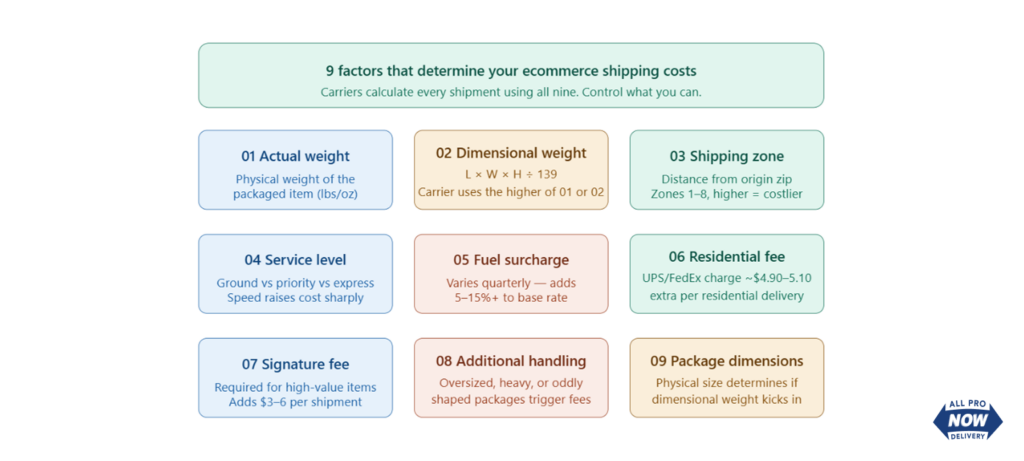
The 9 Factors That Determine Your Ecommerce Shipping Costs
Dimensional weight trap
A large, lightweight box can cost more to ship than a smaller, heavier one. Carriers always charge the higher of actual weight vs dimensional weight.
Fix: right-size your packaging to eliminate unnecessary air space.
What you CAN control:
- Package dimensions and weight
- Choice of carrier and service level
- Whether signature is required
- Packaging material and box size
- Free shipping threshold you set
- Rate aggregators you use
- Where your inventory is located
What you CANNOT control:
- Carrier base rate tables
- Fuel surcharge percentages
- Annual general rate increases
- Residential delivery fees (UPS/FedEx)
- Zone structure and boundaries
- Customer delivery address
- Carrier peak season surcharges
Carriers don’t use a single variable to price a shipment. Nine factors feed into that final rate on your label. Understanding each one is what separates sellers who ship at a profit from those who consistently don’t.
The one that catches sellers most off guard is dimensional weight. A large, lightweight box of clothing can cost more to ship than a smaller, heavier box of hardware, because the carrier is charging for the space the package takes up in their truck, not just what it weighs. The calculation: multiply length × width × height in inches, then divide by 139. If that number is higher than the actual weight, you pay the dimensional rate.
Fuel surcharges are another one that adds up invisibly. According to shipconsole, both UPS and FedEx implemented 5.9% rate increases in 2024. Those adjustments don’t show up as a line item most sellers notice, they simply make every shipment a little more expensive quarter over quarter.
How to Calculate Your Ecommerce Shipping Costs
There’s no single flat rate for shipping. The ecommerce shipping costs varies by package, carrier, zone, and service level. But the calculation always follows four steps.
Step 1 — Weigh the fully packaged item: Use the final packaged weight, not just the product weight. The box and materials add up.
Step 2 — Calculate dimensional weight: Measure the box: L × W × H ÷ 139. Compared to actual weight. Use whichever is greater.
Step 3 — Identify your shipping zone: Each carrier divides the U.S. into zones from your origin zip. A package going from Cleveland to Pittsburgh is Zone 2; the same package going to Miami is Zone 5 or above.
Step 4 — Add surcharges: Fuel adjustment, residential delivery fee, and any handling add-ons stack onto the base rate.
The total cost formula:
Shipping Cost = Packing materials + Carrier base rate (weight × zone) + Applicable surcharges
Here is what that looks like across realistic domestic package profiles:
Estimated Domestic Ecommerce Shipping Costs Ranges by Package Weight
| Package Weight | Typical Products | Estimated Ground Cost Range |
| Under 1 lb | Jewelry, accessories, small supplements | $3.50 – $5.50 |
| 1 – 3 lbs | Apparel, cosmetics, small electronics | $6.00 – $10.00 |
| 3 – 10 lbs | Footwear, home goods, multi-item orders | $9.00 – $18.00 |
| 10 – 20 lbs | Hardware, kitchen goods, auto parts | $15.00 – $30.00 |
| 20 lbs+ | Furniture components, heavy equipment | $28.00 – $60.00+ |
Ranges reflect typical U.S. domestic ground rates. Actual costs vary by carrier, zone, surcharges, and dimensional weight triggers.
These are estimates, not guarantees. The point of working through the formula is to stop guessing and start calculating before you price products or set your shipping rates.
Comparing Ecommerce Shipping Companies: Who Wins Where
Carrier choice is one of the highest-leverage decisions for any seller managing ecommerce shipping costs. The price difference between carriers for the same package is often significant, and consistently defaulting to the wrong one compounds into real money over a year’s worth of orders.
Carrier Comparison for Common Ecommerce Shipments
| Carrier | Best Fit | Approx. Rate (1 lb, domestic ground) | Residential Fee | Key Advantage |
| USPS Ground Advantage | Lightweight, residential deliveries | $3.50 – $5.50 | Included in base rate | Lowest rate for light packages, no residential surcharge |
| UPS Ground | Heavier packages (5+ lbs), B2B routes | $8.00 – $12.00 | ~$4.90 added | More competitive on heavy or bulky items |
| FedEx Ground | High-volume merchants, negotiated rates | $8.50 – $13.00 | ~$5.10 added | Strong express tiers, reliable commercial network |
| AllProNow | Same-day regional delivery; OH, MI, IN, KY, PA, NY, FL | Instant quote via platform | No hidden surcharges | Same-day fulfillment with live GPS tracking across 25+ metro areas |
For most lightweight packages going to residential addresses, which is the majority of direct-to-consumer ecommerce, USPS Ground Advantage is your cheapest option. There’s no residential delivery surcharge baked in, and base rates for packages under 2–3 lbs are consistently lower than the private carriers.
Once packages cross into heavier territory, 5 lbs and above, UPS becomes competitive. For bulky or heavy items like hardware, sports equipment, or furniture components, comparing UPS ground rates is worth the time before defaulting to USPS.
One note that applies to all three: don’t buy postage at retail if you can avoid it. Third-party aggregator platforms negotiate bulk pricing with carriers and extend those rates to any seller, regardless of volume. Per-label savings can bring a $7.00 USPS shipment down to under $4.50 on the same service level. Across a month of orders, that’s a meaningful cost reduction without changing anything else about your operation.
Free Shipping, Flat Rate, or Exact Cost, What Actually Works
This is the debate that runs through every ecommerce seller community, and the answer is that none of these is universally better. The right strategy depends on your margins, product weight, and average order value.
Free shipping increases conversions. Data shows that 47% of shoppers abandon carts due to unexpected costs at checkout, and shipping fees are the top driver. Eliminating the surprise helps. But free doesn’t mean the cost disappears. If your product pricing doesn’t absorb it, you’re losing money on every order. Sellers who raise prices to cover shipping often report making more money, not less, because the conversion improvement outweighs the higher price point.
Flat-rate shipping simplifies checkout and lets you average out real costs across your order mix. The risk is that a wide variation in product weights and sizes will make your flat rate either a loss on heavy orders or a customer complaint on light ones.
Real-time carrier rates at checkout are the most transparent option. Customers see exactly what their shipment costs. This eliminates margin guesswork but can feel cold to customers conditioned to free shipping by large retailers.
The free shipping threshold is the most consistently effective approach for growing stores. Set it at or just above your target average order value. If you need customers to spend $65 to hit your profitability target, put “Free shipping on orders over $65” in your header banner. It works as both a conversion tool, nudging customers to add one more item, and a margin protection mechanism. Orders below the threshold either generate a small shipping contribution or motivate a higher cart value.
Practical Steps to Reduce Your Ecommerce Shipping Costs Right Now
Cost Reduction Actions and Estimated Impact
| Action | Est. Savings per Package | Difficulty |
| Switch to USPS Ground Advantage from priority mail | $1.50 – $4.00 | Low |
| Use a third-party aggregator for discounted postage | $1.00 – $3.00 | Low |
| Replace branded boxes with kraft or poly mailers | $0.50 – $2.50 | Low |
| Right-size packaging to reduce dimensional weight | $0.50 – $3.00 | Medium |
| Use a thermal label printer (no ink costs) | $0.05 – $0.15 per label | Low |
| Set a free shipping threshold at your AOV | Reduces over-subsidized orders | Low |
| Monthly loss-order audit to fix unprofitable SKUs | Varies by volume | Medium |
Right-size your packaging: Oversized boxes trigger dimensional weight pricing. Switching from a box to a padded mailer for eligible products can drop a shipment into a lower pricing tier. Kraft bubble mailers cost $0.25–$0.40 each, weigh almost nothing, and reduce both material cost and postage.
Audit loss orders every month: Track every order where what you charged for shipping was less than what it actually cost. Identify the specific SKUs, box configurations, or destination zones driving consistent losses. Adjust packaging or pricing for those situations. Left unchecked, a handful of problematic shipping configurations can cancel out every efficiency gain you’ve made elsewhere.
Simplify your service levels: Offering multiple tiers, ground, priority, express, adds checkout complexity without always adding value. Many sellers do better with a single ground service: predictable cost, predictable delivery window, and no customer decision paralysis.
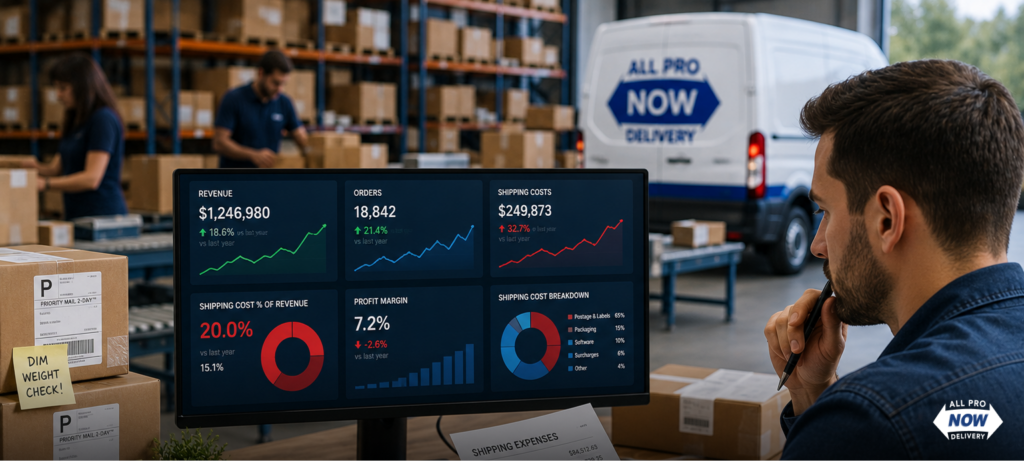
Regional Logistics for Ecommerce Shipping Costs: An Option Most Sellers Don’t Consider
For e-commerce businesses operating warehouses, fulfillment centers, or storefronts in the Midwest, Southeast, or Mid-Atlantic, particularly in Ohio, Michigan, Indiana, Kentucky, Pennsylvania, New York, or Florida, there’s a logistics option worth knowing about: regional same-day courier networks.
When your customers are in the same region as your inventory, you don’t always need a national carrier. A product in a Columbus warehouse going to a customer in Cleveland, Cincinnati, or Pittsburgh doesn’t need to travel through a national hub-and-spoke system. Regional courier networks can move that order same-day, with real-time tracking and often without the residential surcharges that inflate national carrier costs on local deliveries.
AllProNow is a freight management platform built for exactly this use case. Operating across seven states, Ohio, Michigan, Indiana, Kentucky, Pennsylvania, New York, and Florida, and serving 25+ metro areas including Cleveland, Columbus, Toledo, Detroit, Pittsburgh, Miami, and Orlando, AllProNow connects e-commerce businesses, retailers, and manufacturers with a dedicated driver network for same-day parcel delivery. Transparent per-shipment pricing, no hidden surcharges, and live GPS tracking on every order.
For time-sensitive or same-day orders within their service region, it’s a cost comparison worth making alongside your standard carrier quotes.
Get Your Ecommerce Shipping Costs Under Control
Ecommerce shipping costs don’t have to be a mystery or a margin drain. The 15% benchmark gives you a clear target. The dimensional weight formula tells you what you’re actually paying per package. Carrier comparison shows you where you’re overpaying. And a free shipping threshold aligned to your average order value turns a potential cost center into a conversion tool.
Start with math. Run your shipping cost ratio. Identify where individual orders lose money on shipping. Make one change at a time, right-size a box, switch a service level, set a threshold, and measure the impact. These aren’t complicated moves. They’re consistent ones. If you’re in Ohio, Michigan, Indiana, Kentucky, Pennsylvania, New York, or Florida and need a regional same-day delivery option with transparent ecommerce shipping costs, get an instant quote at AllProNow. No hidden fees, no surprises.