
Running an online store in America is exciting, until the first batch of orders arrives and the reality of ecommerce shipping sets in. Suddenly, you’re weighing packages, comparing carrier rates, printing labels, and watching margins shrink. Getting ecommerce shipping right isn’t optional. It’s the difference between a five-star review and a chargeback.
This blog breaks down everything, costs, packaging, carrier selection, tracking, fulfillment decisions, and last-mile logistics, so you can build a shipping strategy that actually works and scales with your business.
Key Takeaways
- Shipping costs should stay under 15% of total revenue, anything above that and your profits will bleed out slowly.
- 48% of online shoppers abandon their carts due to unexpected shipping fees. How you price shipping directly affects your conversion rate.
- USPS wins on lightweight parcels; UPS and FedEx win on heavy or time-critical shipments. There is no single best carrier, match the carrier to the shipment.
- Free shipping isn’t free; it’s either baked into your product price or absorbed by your margin. Know which one it is before you offer it.
- Ecommerce shipping tracking is not optional. WISMO (“where is my order”) queries make up 30–40% of all ecommerce support tickets.
- Same-day delivery is a $17.8 billion market, growing at over 20% per year. Regional speed is a competitive advantage, not a luxury.
Why Ecommerce Shipping Directly Affects Your Bottom Line
Shipping isn’t just a logistics function. It’s a sales tool, a brand touchpoint, and a major cost center, all at once.
Think about it from your customer’s perspective. They’ve browsed your store, read the product page, and loaded their cart. The last thing they see before clicking “Buy” is the shipping cost. A surprise $12 fee on a $35 item can kill the sale, even if your product is exactly what they needed.
According to Sellers Commerce’s cart abandonment research, the average cart abandonment rate across all online stores is 70.19%, and 48% of those abandonments are directly caused by unexpected shipping fees and taxes added at checkout. That’s nearly half of all lost sales, preventable with the right pricing strategy.
On the flip side, offering free shipping without running the numbers is equally dangerous. Experienced ecommerce operators are clear: if your total shipping spend, postage, packaging, label software, all of it, exceeds 15% of total revenue, you’re quietly losing money with every order you ship. Before you decide on a pricing strategy, get that number under control.
Step 1: Know Your True Ecommerce Shipping Cost Before You Price Anything
The most common mistake new sellers make is pricing shipping based on the carrier’s rate alone. Your real per-order shipping cost includes much more than the postage.
Add up: the carrier rate, the box or mailer, void fill (bubble wrap, air pillows, packing peanuts), the shipping label, and any software subscription used to generate it. Divide the total by your gross sales. That percentage is your shipping cost ratio, and it tells the truth.
Many small sellers from boutique apparel stores in Columbus to supplement brands in Tampa, discover they’re spending 20–25% of revenue on shipping without realizing it. They offered free shipping to compete, but never baked that cost into their product price. Sellers who have corrected this by raising prices or tightening their packaging consistently report maintaining revenue while recovering margin.
The average ecommerce order costs $7.96 to ship, according to Sales.so’s ecommerce shipping statistics. For lower-margin products, that number alone can wipe out profitability on smaller orders. Know it before you set your prices, not after.
Step 2: Choose Ecommerce Packaging That Protects Margins and Products
Packaging is the first physical impression your customer gets of your brand. It also directly drives your ecommerce shipping rates, every major carrier charges on weight and dimensional size.
The core rule: your box or mailer should fit your product snugly. Too small and the product gets crushed. Too large and you’re paying for dead air through dimensional weight surcharges, plus wasting money on void fill.
For lightweight items, apparel, accessories, cosmetics, printed goods, poly mailers or bubble mailers are your best move. They’re lighter than cardboard, come flat-packed, and cost as little as 25 cents each. A clothing retailer in Indianapolis or a gift shop in Jacksonville can cut packaging costs meaningfully just by making this one switch.
For heavier or fragile items, electronics, medical devices, auto components, ceramics, corrugated cardboard with proper cushioning is non-negotiable. Shake the sealed box before shipping. If you hear movement, add more padding. The cost of extra packing material is far less than the cost of a refund and a damaged-goods review.
A few tools worth investing in early: a digital postal scale (weigh packages after they’re packed, not before), a thermal label printer (faster, cleaner, and cheaper per label than inkjet), and a set of standardized box sizes so you’re not guessing dimensions on every order.
And don’t overlook the unboxing experience. A logo sticker, a thank-you note, or colored tissue paper costs almost nothing, but it creates a moment customers remember and sometimes share on social media. For growing brands, that kind of organic touchpoint is hard to buy.
Step 3: Match Your Carrier to Your Ecommerce Delivery Type
One of the most common and costly mistakes in ecommerce logistics is treating all carriers as interchangeable. Each major carrier has a specific sweet spot. Matching your shipment to the right carrier consistently saves real money across thousands of orders.
Carrier Comparison: Ecommerce Shipping Rates & Strengths

Rates are estimates for Zone 5 (600–1,000 miles). Actual rates vary by negotiated discounts, surcharges, and current carrier pricing. Source: GoBolt carrier comparison and Pitney Bowes USPS vs UPS vs FedEx guide.
USPS continues to lead on lightweight parcels under 2 lbs, Pitney Bowes notes it holds roughly one-third of all U.S. parcel deliveries in 2025 and charges no residential surcharges, a meaningful advantage over private carriers. Multi-carrier shipping platforms have negotiated USPS rates low enough that many sellers ship orders for under $4.
UPS pulls ahead as package weight climbs past 6 lbs. For sellers moving heavier goods, bulk retail inventory, industrial components, appliances, UPS frequently undercuts USPS on a per-pound basis and offers stronger commercial account pricing.
FedEx is the benchmark for speed. FedEx Priority Overnight reaches most business addresses by 10:30 AM the next day, the right call for time-sensitive B2B shipments from sellers in Cleveland, Detroit, or Philadelphia.
DHL is the clear choice for cross-border ecommerce delivery. If your store is based in New York or Miami and you’re fulfilling orders for international customers, DHL’s customs expertise and global infrastructure are hard to match.
The practical takeaway: don’t default to one carrier for every shipment. Use a multi-carrier rate comparison tool to automatically surface the cheapest option per package. This single operational change can reduce your total ecommerce shipping costs by a measurable percentage over the course of a year.
Step 4: Set Your Ecommerce Shipping Rates Strategically
Now that you understand costs and carriers, it’s time to decide what you charge customers. This is a strategic revenue decision, not just an operational one.
Ecommerce Shipping Pricing Model Comparison
| Pricing Model | How It Works | Best For | Watch Out For |
| Pass-through pricing | Customer pays exact carrier rate at checkout | Stores with wide product weight variance | High fees on small orders cause cart abandonment |
| Flat-rate shipping | Fixed fee (e.g., $5–$8) regardless of actual cost | Products with similar size/weight profiles | Can lose money on heavier/longer-distance orders |
| Free shipping (baked in) | Shipping cost built into product price | High-margin or lightweight products | Requires accurate cost modeling; raises listed price |
| Free shipping threshold | Free above a cart value (e.g., “Free over $60”) | Stores looking to increase average order value | Threshold must be set at or above your profitable AOV |
| Partially subsidized | Charge a flat $3–$5 that offsets (not covers) cost | Budget-conscious sellers not yet ready for full free shipping | Still requires shipping cost ratio monitoring |
There is no universal correct answer. A ceramics seller in Akron faces different math than a software accessories store in Jacksonville. A children’s apparel brand in Cincinnati has different margins than a furniture retailer in Detroit.
One figure worth anchoring on: Swell’s ecommerce statistics report notes that 88% of consumers prioritize free shipping over fast delivery when given a choice. That preference should inform how you structure your shipping tiers and minimum order thresholds. But it doesn’t mean you offer free shipping at any cost, it means you design your pricing so it feels free while protecting your margin.
One more rule: don’t offer expedited or next-day options unless your fulfillment infrastructure can reliably back them up. Complexity creates errors, and shipping errors are expensive in both refunds and reputation.
Step 5: Make Ecommerce Shipping Tracking a Default
Ecommerce shipping tracking is a baseline customer expectation, not a premium add-on.
Every order you ship needs a tracking number, and that number needs to reach your customer automatically within minutes of label generation. Most major ecommerce platforms handle this natively when you purchase labels through their integrated shipping tools.
Beyond the tracking number, proactive communication separates average sellers from excellent ones. Set up automated email or SMS notifications that trigger at key milestones: label created, package in transit, out for delivery, delivered. This matters more than most sellers realize.
According to Ringly.io’s 2026 shipping statistics, WISMO (“where is my order”) queries make up 30–40% of all ecommerce support tickets, and over 50% during peak seasons. Each one costs between $5 and $22 when handled by a human agent. Proactive tracking notifications eliminate most of these inquiries before they’re ever sent.
For businesses shipping higher volumes in markets like Columbus, Pittsburgh, or Indianapolis, tracking data also becomes a performance optimization tool over time. Which carriers have the most delays on your shipping lanes? Which zip codes see the most exceptions? That data shapes smarter carrier decisions.
Step 6: Decide Between In-House Fulfillment and a 3PL for Ecommerce Logistics
As order volumes grow, shipping from a spare room or a storeroom stops being sustainable. The two paths forward: build your own fulfillment operation, or outsource to a third-party logistics (3PL) provider.
In-House vs. 3PL: Ecommerce Logistics Trade-Offs
| Factor | In-House Fulfillment | Third-Party Logistics (3PL) |
| Control over packaging | Full control; custom inserts, branded experience | Limited; standard packaging unless negotiated |
| Per-order cost (single item) | Higher (your labor, space, supplies) | Often lower at high volume |
| Per-order cost (multi-item) | Lower; no per-item pick-and-pack fee | Can become cost-prohibitive (fee per item picked) |
| Scalability | Requires space, staff investment to scale | Scales easily; just keep warehouses stocked |
| Speed to customers | Depends on your location | Can place inventory near customers in multiple states |
| Startup friction | High, build process from scratch | Low, hand off to existing infrastructure |
| Best for | Brands with multi-item orders, personalized experience focus | High-volume, single-SKU, or fast-scaling stores |
In-house fulfillment gives you complete control over the customer experience. You can include handwritten notes, branded inserts, and small gifts for loyal customers. You control quality. You decide what leaves your facility. The tradeoff is time, space, and labor, especially as volume climbs.
3PLs handle storage, pick-and-pack, and ecommerce delivery on your behalf. They work well when you’re shipping large volumes of single-item orders, or when you want to store inventory closer to your customer base across multiple states, shortening transit times from Ohio to Southeast markets, for example.
The critical caveat: 3PLs charge a per-item pick-and-pack fee on top of storage costs. If your average order contains three or more items, those fees stack quickly. Model the per-order cost both ways before signing anything.
Step 7: Last-Mile Ecommerce Delivery
Standard national carriers are built for volume and consistency. For most consumer orders, 2–5 day ground shipping meets expectations. But a growing segment of ecommerce particularly in B2B, healthcare supply, retail replenishment, and high-value goods, needs same-day or next-day delivery to stay competitive.
The scale of this shift is real. Ringly.io’s 2026 data shows the same-day delivery market is valued at $17.8 billion in 2026, growing at over 20% annually. Last-mile delivery now accounts for 53% of total shipping costs, up from 41% in 2018. It’s the most operationally intensive, expensive, and customer-visible part of the entire shipping chain.
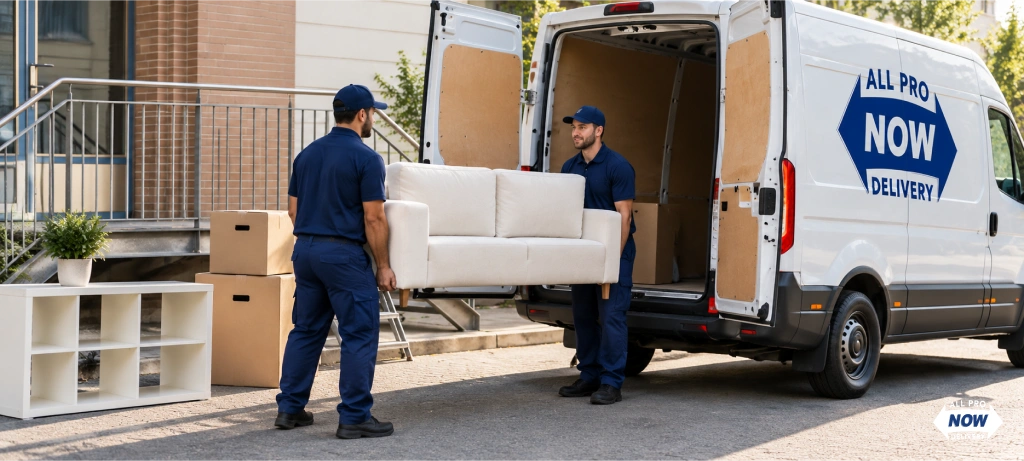
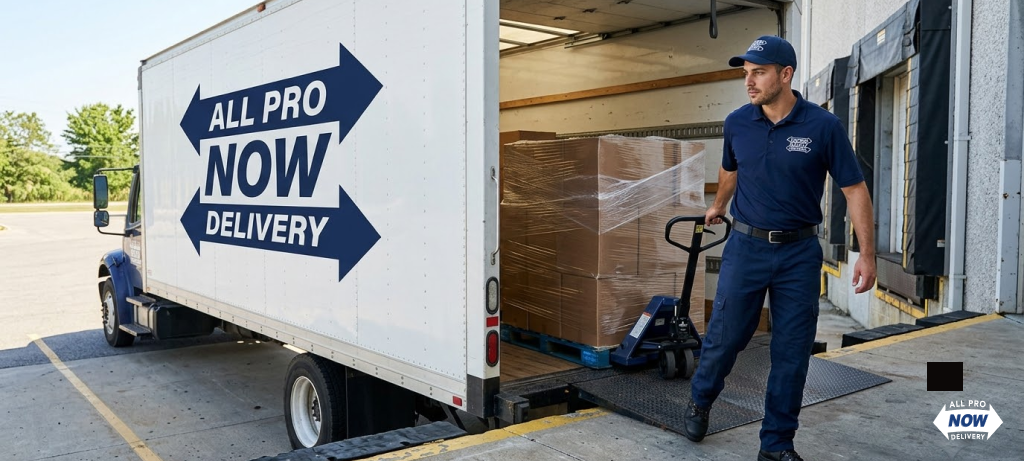
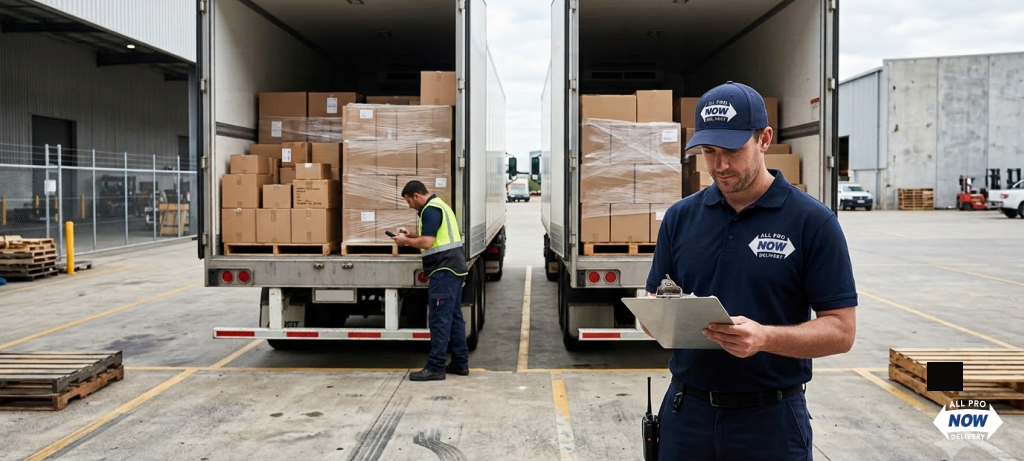
This is the gap that regional ecommerce logistics solutions are purpose-built to fill. AllProNow operates across seven states, Ohio, Florida, Michigan, Indiana, Kentucky, Pennsylvania, and New York, covering 25+ major cities. That includes Columbus, Cleveland, Toledo, Akron, Youngstown, Detroit, Indianapolis, Pittsburgh, Philadelphia, Allentown, Harrisburg, Miami, Orlando, Tampa, Jacksonville, and Fort Lauderdale.
With 50+ years of logistics experience and a dedicated professional driver network, AllProNow connects retailers and e-commerce businesses with same-day parcel delivery, LTL freight for larger loads, and managed logistics support.
The platform shows upfront, transparent pricing, no hidden fuel surcharges, no residential fees, no surprise charges at invoice time. Every shipment includes live GPS tracking, real-time ETAs, and digital proof of delivery with photo and signature.
For retailers managing urgent inventory replenishment, healthcare businesses moving lab samples or medical equipment, or manufacturers delivering time-sensitive parts, this kind of regional ecommerce logistics solution handles what national carriers aren’t designed to address.
If your business operates in any of these markets, having same-day delivery as part of your fulfillment toolkit gives you a genuine speed edge.

Ecommerce Shipping Best Practices
Building good shipping habits early saves serious headaches later. A few principles worth internalizing before you ship your first live order:
Always weigh and measure packages after they’re packed, not before. Carrier dimensional weight surcharges are real, and an underestimated weight on the label will cost you extra or get flagged in the system.
Build shipping costs into your product pricing before you launch, not after three months of eroding margin. Use carrier calculators to estimate your average shipping cost by product type and price accordingly.
Do trial runs. Create mock packages of similar size and weight to your actual products, print real labels, and ship them to yourself. You’ll find bottlenecks and hidden costs before real customer orders are at stake.
Handle returns professionally. Include a clear return policy in every package or on your website. When a return lands, inspect it quickly and issue the refund promptly. A smooth return experience turns a disappointed customer into a repeat buyer more reliably than any discount code.
Build an Ecommerce Shipping Strategy That Grows With You
Ecommerce shipping doesn’t have to be a profit-killer or a source of constant stress. With the right packaging, a smart carrier mix, a pricing model grounded in your actual numbers, and reliable ecommerce shipping tracking in place, it becomes an operational advantage, something customers notice and competitors find hard to replicate.
Whether you’re just launching your first store in Cincinnati, scaling a multi-SKU retail operation across the Midwest and Southeast, or managing time-sensitive B2B deliveries out of Pittsburgh or Miami, the fundamentals are consistent: know your true shipping cost, protect your margin, and deliver on your promise to customers every time.
For businesses in Ohio, Florida, Michigan, Indiana, Kentucky, Pennsylvania, or New York looking for a dependable regional ecommerce delivery partner, same-day courier, LTL freight, or fully managed logistics, AllProNow offers instant online quotes, transparent pricing, and live GPS tracking with zero hidden fees. Get your quote today at allpronow.net.