
A first-year truck driver in Texas can take home $50,000. After three years with a hazmat endorsement, that same driver can hit $90,000. The ceiling isn’t the job; it’s the choices made along the way.
Truck driving remains one of the highest-paying careers in the United States that doesn’t require a college degree. But the truck driver earnings range is wide from $40,000 for a new local driver to well over $100,000 for an experienced owner-operator on a specialized route.
If you’re exploring how much do truckers make, it’s important to understand that earnings vary based on experience, work hours, location, and specialization. From long-haul routes connecting Dallas to Los Angeles, to local delivery operations in Atlanta and Chicago, truck driver earnings are shaped by multiple factors that go beyond basic salary averages.
This blog breaks down exactly what drives those differences, with real numbers at every stage.
Truck driver earnings in the USA: the real numbers
Truck driver earnings in the United States are often presented as a single number, but the reality is more layered. According to the Bureau of Labor Statistics, the median annual wage for heavy and tractor-trailer truck drivers is about $57,000. Meanwhile, platforms like Indeed and ZipRecruiter report averages ranging between $60,000 and $75,000 depending on region and demand.
These numbers represent a midpoint, not the ceiling. Drivers working in high-demand freight corridors such as Texas, California, and the Midwest often exceed these averages due to consistent loads and longer routes. The average trucker income increases steadily with experience, making trucking a growth-oriented career rather than a fixed-income role.
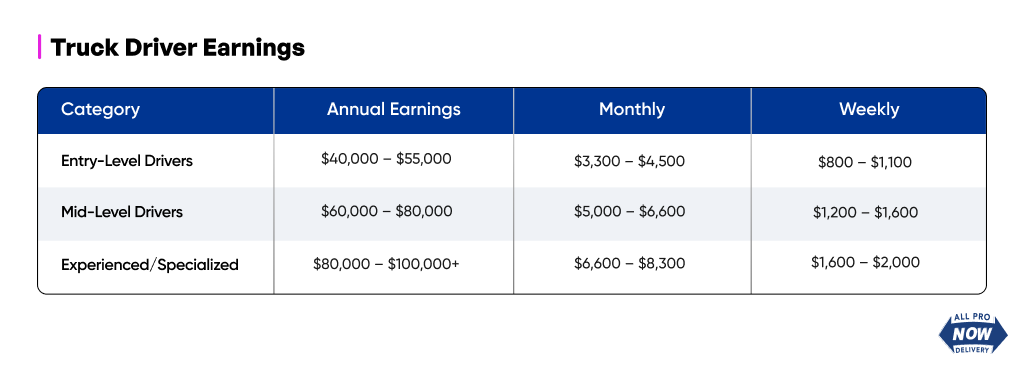
This table provides a realistic breakdown of truck driver earnings and helps answer how much do truck driver make at different career stages.
Understanding Truck Driver Earnings Per Hour and Time Breakdown
Trucking is not a traditional hourly job. Most drivers are paid by the mile or by the load, which means income depends on output rather than hours clocked. When you factor in all working time, driving, waiting at docks, loading, and paperwork, the effective hourly rate typically falls between $20 and $35.
Drivers working 60 to 70 hours per week often have strong annual incomes but modest effective hourly rates. Understanding this distinction matters when comparing trucking to other trades.
| Pay Metric | Typical Range |
| Truck driver earnings per hour | $20 – $35 |
| USA truck driver salary per day | $200 – $350 |
| USA truck driver salary per week | $1,000 – $1,800 |
| Truck driver earnings per month | $4,000 – $7,500 |
This breakdown helps clarify how much do truck drivers earn beyond headline salary numbers.
Truck Driver Earnings by Job Type and Route
Truck driver earnings vary significantly depending on the type of job and route structure. Each category offers a different balance between income, workload, and lifestyle, which directly impacts how much do truckers make in real-world conditions.
Over-the-road (OTR) drivers
OTR drivers cover long distances across multiple states, staying on the road for weeks at a time. Routes like Texas to California or Midwest to Southeast are common. Annual pay typically ranges from $60,000 to $80,000. The trade-off: extended time away from home and unpredictable schedules.
Regional drivers
Regional drivers operate within a specific geographic area, logistics hubs like Atlanta, Chicago, and Dallas are common bases. Pay ranges from $70,000 to $85,000 per year, with the added benefit of more consistent schedules and regular home time. For many experienced drivers, regional is the sweet spot.
Local drivers
Local drivers handle short-distance routes within cities like Los Angeles, Houston, and Miami. Pay ranges from $50,000 to $75,000. Lower than OTR, but you’re home every night and working predictable hours, a major lifestyle advantage.
Owner-operators
Owner-operators run their own trucking business. Gross revenue can exceed $120,000 annually, but expenses, fuel, maintenance, insurance, permits, can take $50,000 to $70,000 of that. Net income varies significantly based on how well costs are managed. When unexpected expenses or reduced income make it difficult to keep up with payments, some borrowers may explore debt relief options with High ceiling, high responsibility.
| Driver type | Annual earnings | Home time |
| Local | $50,000 – $75,000 | Daily |
| Regional | $70,000 – $85,000 | Weekly |
| OTR | $60,000 – $80,000 | Every few weeks |
| Owner-operator | $120,000+ (gross) | Flexible |
Truck Driver Earnings and Pay Structures Explained
Truck driver earnings are heavily influenced by pay structure, which determines how income is calculated and distributed. Understanding these models is key to evaluating how much do truck drivers earn in different roles.
CPM, or cents per mile, is the most common pay model and rewards drivers based on distance traveled. While this model offers high earning potential, it does not compensate for downtime, which can reduce total income.
Hourly pay provides stability by compensating drivers for all working hours, including waiting and loading time. However, it typically comes with a lower earning ceiling compared to mileage-based roles.
Load-based pay offers high potential for experienced drivers but introduces variability. Income depends on the number of loads completed and market demand, making it less predictable.
Key insight: CPM looks attractive on paper but hides the real cost of unpaid time. A driver earning $0.55/mile who waits 15 hours a week at loading docks is effectively losing $300–$500 in weekly income compared to what an hourly calculation would suggest.
Case Study: Real Truck Driver Earnings Journey
To understand truck driver earnings in a practical context, consider a typical career progression based on real driver experiences. A new driver starts with training and earns around $600–$800 per week, often working under supervision while learning routes and safety protocols.
After a few months, the driver moves into team driving or entry-level OTR work, earning lower CPM rates and dealing with inconsistent loads. During this phase, total earnings may remain modest, reflecting the learning curve and industry entry barriers.
By the end of the first year, with better routes and more experience, earnings improve to $60,000 or more annually. With endorsements and specialization, many drivers eventually reach $80,000–$90,000+, showing how truck driver earnings grow with time and strategy.
Hidden Factors That Impact Truck Driver Earnings
Salary averages don’t tell the whole story. Several factors quietly reduce take-home pay that never show up in job postings:
- Unpaid dock wait time: Drivers commonly report losing 10 to 20 hours per week waiting at loading docks with no compensation. At a $25 effective hourly rate, that’s $250–$500 in lost weekly income.
- Deadhead miles: Miles driven without a load, generate zero revenue but still burn fuel and wear the truck.
- Dispatcher efficiency: A poorly organized carrier can leave drivers sitting idle for days. Route and dispatch quality can swing annual income by $10,000 or more.
- Location: High-demand states like Texas and California offer better freight rates and more consistent loads. Lower-demand regions see more deadhead miles and longer gaps between jobs.
- Company practices: Some carriers offer mileage bonuses, safety bonuses, and fuel surcharge sharing. Others don’t. These extras can add $5,000–$15,000 per year for top performers.
First-Year Truck Driver Earnings: What to Expect
The first year is an investment, not a peak. Most new drivers earn between $40,000 and $55,000, with training periods often paying reduced weekly rates of $600–$800. This is normal, it reflects the learning curve, limited route access, and lower CPM rates given to newer drivers.
Realistic first-year progression
Months 1–3: CDL training and supervised driving. Weekly pay: $600–$800.
Months 4–8: Entry-level OTR or team driving. Inconsistent loads, lower CPM. Annual run rate: ~$45,000.
Months 9–12: Better routes, improved negotiating position. Annual run rate: $55,000–$65,000.
How to Increase Truck Driver Earnings Over Time
Increasing truck driver earnings requires a strategic approach that combines experience, certifications, and job selection. Drivers who focus on long-term growth can significantly improve their income potential over time.
Gaining at least one year of experience opens doors to better-paying opportunities. Adding endorsements such as hazmat or tanker certifications increases access to specialized freight, which pays more.
Choosing consistent routes and working with reliable staffing platforms like AllProNow’s workforce solutions helps drivers secure steady opportunities across key logistics markets and reduce downtime.
Truck Driver Earnings vs Other Careers
For workers without a four-year degree, trucking competes directly with skilled trades. Here’s how the pay stacks up:
| Career | Avg. annual pay | Degree required? | Years to peak pay |
| Truck driver (OTR/regional) | $65,000 – $85,000 | No (Commercial Driver’s License only) | 3–5 |
| Electrician | $60,000 – $90,000 | No (apprenticeship) | 4–6 |
| HVAC technician | $55,000 – $75,000 | No (certification) | 3–5 |
| Warehouse worker | $35,000 – $50,000 | No | 2–4 |
| Delivery driver (last mile) | $38,000 – $55,000 | No | 1–2 |
Trucking’s advantage over warehouse and delivery work is clear. Compared to trades like electrician or HVAC, the gap narrows, but trucking reaches solid pay faster and has a lower barrier to entry (no multi-year apprenticeship).
Regional Earnings: Where You Work Matters
The same CDL in different states can mean a $10,000+ difference in annual pay. Here’s a broad picture of how regions compare:
| Region / State | Avg. annual pay | Why |
| California (LA, Fresno) | $70,000 – $90,000 | High demand, ports, produce freight, but higher living costs |
| Texas (Dallas, Houston) | $65,000 – $85,000 | Strong freight volume, energy sector, major distribution hubs |
| Midwest (Chicago, Cincinnati) | $62,000 – $78,000 | Consistent manufacturing and retail freight year-round |
| Southeast (Atlanta, Charlotte) | $58,000 – $75,000 | Growing logistics infrastructure, lower cost of living |
| Northeast (NY, Boston) | $65,000 – $82,000 | High cost of living, but strong port and urban delivery demand |

How AllProNow Supports Truck Driver Earnings Growth in 2026 and Beyond
Truck driver earnings are expected to remain strong as demand continues to grow across logistics, construction, and supply chain industries. The rapid expansion of e-commerce has increased the need for regional and last-mile drivers, especially in high-demand markets like Texas, California, Illinois, and Georgia. This shift is creating more consistent opportunities for drivers who want stable and scalable income.
At the same time, specialized roles are seeing the highest pay growth. Drivers with endorsements or experience in niche freight are in high demand, and companies are actively competing to retain skilled talent. Despite advancements in automation, human drivers remain essential for complex logistics operations, ensuring long-term career stability.
This is where AllProNow plays a key role. By connecting drivers with reliable businesses across major U.S. markets, helps reduce downtime, improve route consistency, and match drivers with roles that align with their earning goals. Instead of relying on inconsistent loads or unpredictable dispatching, drivers can access structured opportunities that support long-term income growth.
For those exploring how much do truck drivers earn and looking to increase their truck driver earnings over time, having access to the right network makes a measurable difference. With the right placements and consistent demand, drivers can move beyond average trucker income and build a more stable and scalable career path.