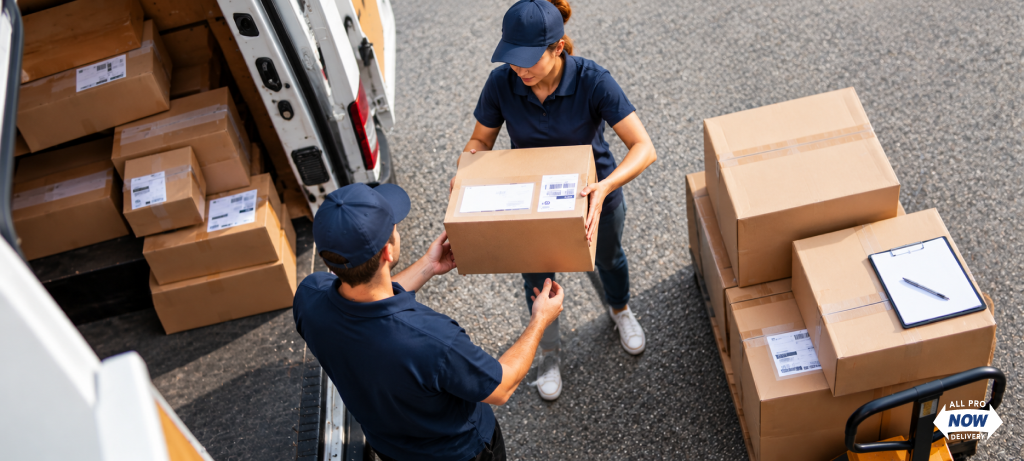
Shipments are moving. Nobody knows exactly where. And the status calls have started again.
That is the daily reality for thousands of operations teams across the United States: manufacturers in Toledo, retailers in Columbus, medical facilities in Pittsburgh, distributors in Detroit. Despite years of investment in freight technology, the GEODIS Supply Chain Worldwide Survey found that only 6% of companies have achieved true end-to-end visibility across their supply chain.
Meanwhile, 42% of executives cite a lack of real-time data as their primary limitation when responding to a disruption, according to Tradeverifyd’s 2026 industry report.
The question is no longer whether visibility matters. It is why most companies still cannot get it right, and what actually works in 2026.
This blog breaks down how to improve shipment visibility across multiple carriers with a practical, step-by-step approach that reduces firefighting, cuts costs, and gives operations teams information they can act on before problems become expensive.
Key Takeaways
- Only 6% of companies report full end-to-end supply chain visibility (GEODIS).
- 42% of executives say lack of real-time data limits their ability to respond to disruptions (Tradeverifyd, 2026).
- Supply chain disruptions cost companies an average of 6–10% of annual revenues.
- The biggest barriers to visibility are organizational silos, not technology gaps.
- Exception-based alerts on the 5% of at-risk shipments outperform tracking everything.
- Tying tracking data to purchase orders and SKUs, not just containers, is what makes visibility actionable.
- Small and mid-sized businesses can close visibility gaps fastest by working with the right regional logistics partner.
The Real Cost of Poor Shipment Visibility in 2026
Poor visibility is not an inconvenience. It is a financial drain that shows up across multiple line items, and most companies never connect the dots.
Supply chain disruptions now occur roughly every 3.7 years on average, according to the World Economic Forum, and each one can take two to three years to fully recover from. When visibility gaps leave teams unable to detect problems early, the costs compound quickly.
McKinsey research shows that manufacturers who improved supply chain visibility achieved 15–20% improvement in inventory turns and reduced expedited-service costs by 30–50%.
McKinsey also found that up to 50% of expedited shipments are preventable with better visibility, and expedited air freight can run three to five times the cost of standard ocean freight on the same lane.
The supply chain visibility software market reflects how seriously businesses are taking this. It was valued at $3.3 billion in 2025 and is projected to reach $10.9 billion by 2034, growing at 13.4% annually (Global Market Insights, 2026). Investment is accelerating because the cost of doing nothing is no longer acceptable.
The Financial Cost of Poor Shipment Visibility

Why Improving Shipment Visibility Across Multiple Carriers Is Still Hard
The technology exists. The platforms are widely available. Yet most operations teams are still spending hours every week reconciling spreadsheets and fielding “where is my shipment?” calls. The reason comes down to three core problems.
The silo problem: Brian Glick, CEO of Chain.io and a 25-year freight industry veteran, put it plainly in a recent industry podcast: “We work with large companies who have 10 to 12 different data analyst teams all going out and buying the same visibility data.” Sourcing teams and transportation teams are solving visibility independently, in separate systems, with separate budgets. The data exists inside the organization. Nobody has connected it.
The workflow problem: A visibility platform that nobody uses is not a visibility solution. Practitioners who have rolled out platforms like FourKites and project44 consistently identify the same failure pattern: teams keep calling carriers out of habit. The data is available. The behavior does not change.
One logistics manager in a Reddit supply chain forum described the fix that worked for his team: “We made the tracking platform the only source for status updates. No more ‘let me check with the carrier’ responses allowed. If it’s not in the system, it doesn’t exist.” The platform did not change. The workflow discipline did.
The last-mile problem: Ocean tracking and port-to-port visibility have improved meaningfully. But the moment freight shifts from a distribution hub to final delivery, especially across fragmented regional carriers, visibility frequently disappears. That is where status calls spike, SLA breaches occur, and customer trust erodes.
How to Improve Shipment Visibility Across Multiple Carriers: 7 Steps That Work
Step 1: Ask the Right Three Questions Before Buying Any Tool
Visibility tools fail most often because teams implement them before defining what they actually need to know. As Glick explains, data and information are not the same thing. Information is the answer to the question you are asking. Start there.
The three questions every business needs to answer are:
- When can I reliably promise delivery to my customer?
- Am I currently on track to meet that promise?
- Who in my organization needs to know, and how early?
Everything else, platforms, integrations, carrier APIs is in service of answering those questions consistently and early enough to act.
Step 2: Consolidate Multi-Carrier Data Into One Source of Truth
Working with multiple carriers creates fragmented tracking by default. Regional OTR carriers, intermodal providers, ocean freight partners, and last-mile couriers each operate separate systems with different data formats and milestone definitions.
The first infrastructure move is aggregating that data into a single view, whether through a Transportation Management System (TMS), a standalone visibility platform, or a managed logistics partner who maintains that infrastructure for you.
For businesses shipping across corridors like Cleveland to Detroit, Columbus to Pittsburgh, or across Florida’s distribution network, freight routinely crosses carrier boundaries within a single lane. That is exactly where blind spots live. Consolidation eliminates them.
Step 3: Tie Visibility to Purchase Orders and SKUs, Not Just Containers
This is the most overlooked step in most visibility programs, and the one that makes the biggest operational difference.
Knowing a container is delayed at a terminal is interesting. Knowing the specific SKUs in that container are tied to a promotional window closing in 12 days, and that your marketing team in Columbus has already staged campaign assets, is actionable intelligence.
Companies that link freight tracking data back to purchase order numbers and individual SKU inventory give their teams the ability to make real decisions: delay a promotion, reroute inventory, alert a customer 90 days early rather than two days late, or adjust a warehouse receipt schedule. Companies that track containers in isolation can only react after they have already lost control of the outcome.
Step 4: Build Exception-Based Alerts, Not Total Tracking
Monitoring every shipment status update across your entire carrier network generates noise, not intelligence. It burns team attention on the 95% of freight that is moving normally and still leaves the 5% that needs action buried in alerts.
The right approach is exception-based visibility: configure your system to surface only the shipments that deviate from plan, missed milestones, SLA breach risk, customs holds, or carrier-reported delays crossing a defined threshold. Flag those for action. Let everything else move.
One supply chain practitioner in a Reddit logistics thread put it simply: “Real improvement comes from exception-based alerts that flag the 5% of shipments actually failing, rather than forcing you to track everything.”
Exception-Based vs. Total Tracking, Operational Comparison
| Factor | Total Tracking Approach | Exception-Based Approach |
| Team attention load | High, reviewing all shipments daily | Focused, acting on flagged exceptions only |
| Alert volume | Dozens to hundreds per day | 5–10 actionable exceptions per day |
| Decision speed | Slow, manually finding at-risk freight | Fast, system surfaces what needs action |
| Missed SLAs | High, issues buried in data | Low, deviations caught before they escalate |
| Carrier call volume | Unchanged or increased | Significantly reduced |
| Best for | Basic location awareness | Operational control and cost reduction |
Step 5: Force the Workflow Change, Not Just the Tool Change
Platform adoption without workflow change is the most common and most expensive visibility mistake. Teams implement a new system and continue calling carriers, checking separate portals, and maintaining spreadsheets in parallel. The platform becomes another screen nobody trusts.
The implementations that work follow a clear rule: the visibility platform is the single authorized source for all shipment status information. No proactive carrier calls unless the system generates an exception alert. No manual status emails. If it is not in the system, it does not exist.
This discipline is uncomfortable for the first two to three weeks. It consistently produces results by week four. Operations teams that trust the system stop spending time generating information and start spending time responding to exceptions, which is the actual job.
Step 6: Close the Last-Mile Visibility Gap
Last-mile visibility is where most multi-carrier tracking programs break down. The handoff from line-haul to final delivery, especially across regional subcontractors or third-party brokers, is where GPS coverage goes dark, status updates stop, and customer-facing delivery commitments become guesswork.
The structural fix is carrier selection. Working with a logistics provider that operates its own driver network, rather than brokering freight to third parties, maintains tracking continuity through the full delivery journey. When a single provider controls pickup, transit, and final delivery, and equips drivers with GPS-enabled mobile technology, real-time tracking persists through to proof of delivery, complete with photos, signatures, and timestamps.
For manufacturers in Toledo and Akron, healthcare networks in Cleveland and Pittsburgh, retailers in Columbus, and distributors serving Detroit and Northern Kentucky, last-mile visibility is often the difference between a retained customer and a lost contract.
Step 7: Connect Visibility Data Across Internal Departments
Supply chain data locked inside the logistics team is only delivering a fraction of its potential value. When transportation tracking connects to marketing, finance, and procurement, the business gains decision-making capability it did not have before.
Marketing can plan promotional windows around confirmed inventory arrival dates, not assumed lead times. Finance can automate billing triggers against verified proof-of-delivery events. Procurement can replace static lead time estimates written in spreadsheets with real transit time distributions sourced from actual carrier data.
Gartner’s December 2024 survey of 506 supply chain leaders found that only 19% of organizations fully integrate scenario planning into their supply chain strategies. Cross-departmental data sharing is a major part of closing that gap, and it starts with treating supply chain data as a company asset, not a logistics department resource.
What the Right Visibility Baseline Looks Like in 2026
Before evaluating any carrier or platform, operations teams should define a non-negotiable visibility baseline. In 2026, these are the capabilities every regional logistics partner should be able to deliver as standard, not premium, service.
2026 Shipment Visibility Baseline, What to Expect from Every Logistics Partner
| Capability | Why It Matters | 2026 Standard? |
| Live GPS tracking | Real-time location, not periodic batch updates | Yes, required |
| Dynamic ETA recalculation | ETAs that update based on actual route progress | Yes, required |
| Driver status notifications | Pickup-in-progress alerts, not just completed events | Yes, required |
| Digital proof of delivery | Auto-uploaded photos, signatures, and timestamps | Yes, required |
| Shipper portal access | Manage shipments, pricing, and history without phone calls | Yes, required |
| Exception-based alerting | Proactive flags on at-risk shipments only | Yes, required |
| SKU/PO-level data linkage | Connecting freight status to inventory and order records | Best practice, adoption growing |
| Cross-department data sharing | Visibility data accessible beyond the logistics team | Best practice, limited adoption |
Partners who treat any item in the first six rows as an optional upgrade are not operating at the 2026 standard.
How Different Industries Are Applying Shipment Visibility in 2026
Across the industries that depend most heavily on reliable regional freight, the businesses pulling ahead share common visibility practices, applied to their specific operational realities.
Retail and e-commerce operations in Columbus and Cleveland are connecting shipment ETAs directly into inventory management systems so that promotional decisions update automatically when freight status changes. A delay caught 90 days early changes a marketing calendar. A delay caught two days before a sale launch creates a crisis.
Manufacturing facilities, automotive plants in Toledo, aerospace operations in Akron, plastics manufacturers across Northeast Ohio are replacing static “two-week” lead time assumptions with real transit time data pulled from carrier networks. The variability in that data is as valuable as the average. Knowing a lane runs 9 to 16 days, not a flat 14, changes production scheduling.
Healthcare networks across Cleveland, Detroit, Pittsburgh, and Florida treat every shipment as a chain-of-custody event. Digital proof of delivery with timestamps, photos, and signature capture — is not a feature for them. It is a compliance requirement. Providers who cannot deliver that automatically on every shipment are not viable partners for clinical logistics.
Construction and industrial firms moving materials between sites in Pennsylvania, Indiana, and Kentucky need delivery confirmation at specific job-site windows. They cannot absorb a two-hour delivery spread. Last-mile visibility with real-time ETA updates is what separates a reliable logistics partner from one that requires a dedicated person to manage.
How AllProNow Delivers Multi-Carrier Visibility Across Seven States
For businesses operating across the Midwest and Southeast, AllProNow was built around the visibility standard that regional operations actually need, not as an add-on, but as a core part of how every shipment moves.
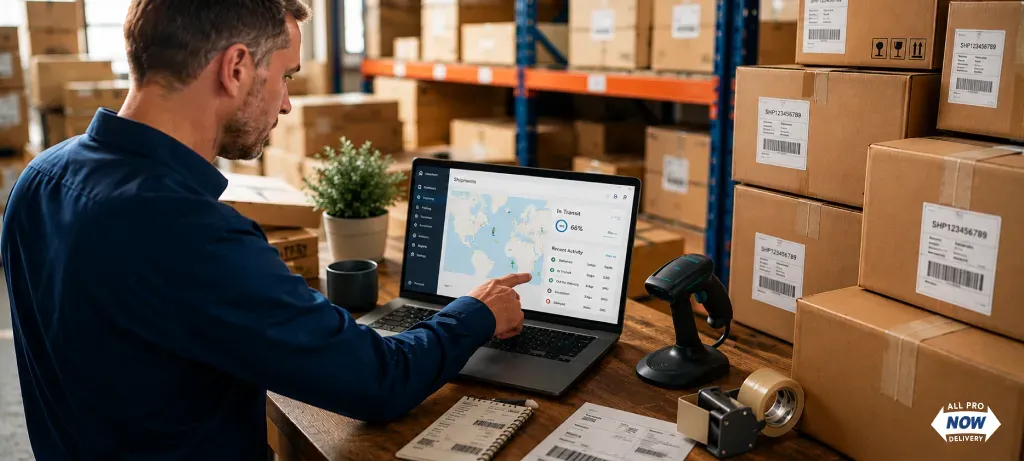
Every load on the AllProNow network includes live GPS tracking, real-time ETAs, driver status notifications, and digital proof of delivery with automatic photo and signature upload. The business portal gives shippers access to load management, transparent upfront pricing, active shipment tracking, and complete shipment history, without a single phone call required to get a status update.
AllProNow operates a dedicated driver network, not a gig marketplace or broker model, across seven states: Ohio (Cleveland, Columbus, Toledo, Akron, Canton, Youngstown), Michigan (Detroit), Pennsylvania (Pittsburgh), Indiana, Kentucky, New York, and Florida. That network structure matters for visibility.
When one provider controls pickup, line-haul, and final delivery across 25+ cities and surrounding metro corridors, the last-mile tracking gap that breaks most multi-carrier visibility programs does not exist.
Retailers, manufacturers, medical facilities, construction firms, and e-commerce businesses across these states rely on AllProNow for the same reason: the visibility they need to make decisions is built into the service, not something they have to configure or chase.
If you are ready to improve shipment visibility across multiple carriers without adding complexity to your team, get a freight quote from AllProNow and see what real-time tracking looks like as a standard feature, not a premium tier.
Conclusion: Visibility That Drives Decisions, Not Just Dashboards
The goal of learning how to improve shipment visibility across multiple carriers is not to build a better map. It is to make better decisions earlier, with more confidence, and with less manual effort to get there.
Start by defining the three business questions your visibility program needs to answer. Consolidate carrier data into one source of truth. Link that data to purchase orders and SKUs.
Configure exception-based alerts that surface the 5% of shipments actually at risk. Build workflow discipline that treats the platform as the single source of truth. And close the last-mile gap by working with a logistics partner whose tracking does not stop at the dock.
Businesses across Ohio, Michigan, Pennsylvania, Indiana, Kentucky, New York, and Florida that have implemented this approach are spending less time chasing freight and more time serving customers. That is what visibility is actually for.
Connect with AllProNow to start shipping with real-time visibility built in from day one.