

Freight doesn’t wait. On any given morning across Ohio, Michigan, Indiana, Pennsylvania, and Florida, thousands of businesses are counting on a driver to show up on time, or their production line stalls, their hospital supply window closes, or their retail shelves sit empty. Logistics driver jobs are one of the most in-demand roles in American commerce right now, and they’re not going anywhere.
This blog breaks down everything a working driver, or someone considering the career, actually needs to know: what the job looks like day-to-day, what you’ll earn, what licenses matter, and why regional driver logistics roles are attracting experienced drivers away from long-haul trucking in growing numbers.
Key Takeaways
- The U.S. Bureau of Labor Statistics projects 237,600 annual openings for heavy and tractor-trailer truck drivers through 2034, one of the highest volumes of any skilled trade.
- The American Trucking Associations (ATA) puts the current driver shortfall at approximately 82,000 in 2026, with projections reaching 160,000 by 2031.
- The BLS median annual wage for heavy truck drivers is $57,440, but experienced regional drivers in the Midwest regularly earn $70,000–$85,000.
- Regional logistics driver roles, home daily or weekly, have significantly lower turnover than long-haul OTR positions, where annual churn runs 90–95% at large carriers.
- Ohio, Indiana, and Michigan are among the most freight-intensive states in the country, driven by manufacturing, healthcare, and retail distribution demand.
- Non-CDL logistics delivery jobs exist and are a practical entry point for drivers without commercial licenses.
What Logistics Driver Jobs Actually Involve
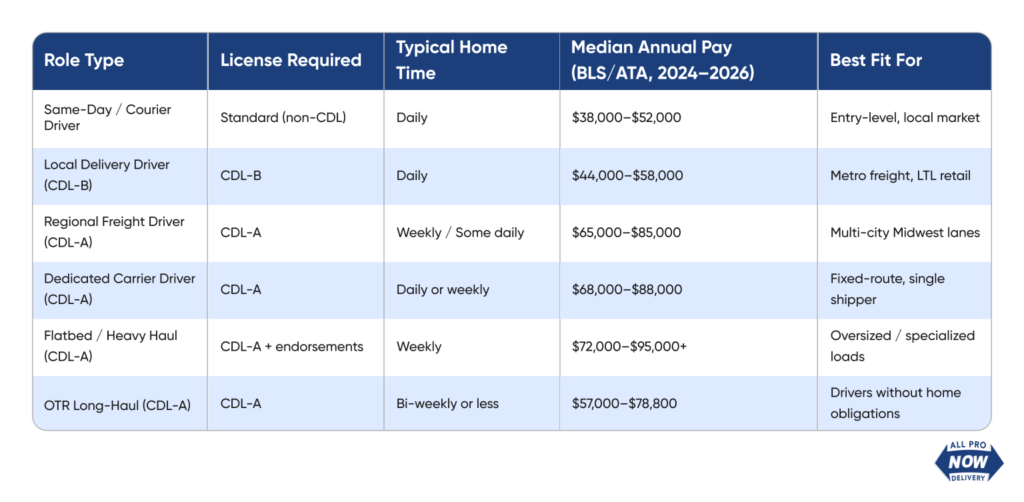
The term “logistics driver” covers more ground than most people expect. Depending on the employer and freight type, it could mean same-day courier runs inside a metro area, dedicated lanes between manufacturing facilities, or scheduled LTL freight across a multi-state region.
Here’s how the logistics driver jobs type break down in practice:
Same-day and on-demand delivery drivers handle time-sensitive freight, medical specimens, automotive components, and commercial packages. Dispatch happens within minutes of a booking. Routes change daily. The premium is entirely on being on time, every time.
Regional freight drivers run predictable lanes: Cleveland to Columbus, Toledo to Detroit, Indianapolis to Pittsburgh, Columbus to Tampa. Schedule consistency is the main benefit. Drivers are generally home weekly, or even daily on shorter lanes. This is where experienced OTR drivers often land when they’re done trading home time for mileage pay.
Dedicated carrier drivers run fixed routes for a single shipper, a manufacturer, retailer, or hospital network. The work is repetitive in the best way: same freight, same routes, same dispatch relationship. For drivers with families or roots in a specific metro, dedicated carrier roles deliver a quality-of-life that OTR simply can’t match.
Flatbed and heavy haul specialists move oversized equipment, cranes, modular structures, and construction machinery. It’s specialized, it pays well, and it requires a particular set of skills around load securement and route planning.
Logistics Driver Jobs Comparison; At a Glance
The Driver Shortage Is Real, and It Works in Your Favor
The numbers from credible sources are unambiguous. The BLS projects approximately 237,600 openings for heavy and tractor-trailer truck drivers every year through 2034. The ATA’s workforce report puts the 2026 driver shortage at approximately 82,000, a number that has been climbing steadily since the pandemic disruption.
The structural cause matters here. The average age of a U.S. truck driver is approximately 46, and the ATA projects the industry will need to hire 1.2 million new drivers over the next decade, roughly 120,000 per year, just to replace retirees and keep pace with freight demand.
But it’s more nuanced than a simple headcount problem. The shortage hits hardest in long-haul truckload, specialized flatbed, and heavy haul routes that require extended time away from home. Large truckload carriers experience annual driver turnover rates of 90–95%. Smaller carriers fare somewhat better at 60–75%, but the numbers are still staggering, 35% of newly hired drivers quit within 90 days, and 55% leave within 6 months. The primary reasons drivers leave are inadequate home time, pay dissatisfaction, poor equipment quality, and dispatcher conflicts.
For drivers evaluating logistics driver jobs right now, the takeaway is practical: the leverage is on your side. Carriers are competing to retain good drivers, not the other way around.
What Logistics Driver Jobs Pay in the Midwest
Pay varies significantly by role, state, and freight specialization. Here’s where the data actually lands, sourced from federal and industry benchmarks.
The median annual wage for heavy and tractor-trailer truck drivers was $57,440 in May 2024, according to the BLS, with the bottom 10% earning under $38,640 and the top 10% exceeding $78,800. For light truck and delivery drivers, the BLS median sits at $44,140, with overall employment in this category projected to grow 8% from 2024 to 2034, much faster than the average for all occupations.
Regional roles in freight-heavy Midwest states tend to pay above those national medians. Ohio, Michigan, Indiana, and Pennsylvania sit at the center of U.S. manufacturing and distribution corridors, which creates consistent freight volume, and consistent demand for experienced drivers who know their lanes.
Indeed ranked truck driving among its best jobs of 2026, with owner-operator median annual earnings reaching $160,000 and job postings for the position up 34% since 2023. For company drivers in regional logistics delivery roles, realistic take-home sits in the $65,000–$85,000 range once experience and endorsements are factored in.
Driver Pay by License Type and Role, Midwest Context
| License Type | Entry-Level Pay | Experienced Pay | Top 10% (BLS) | Notes |
| No CDL (courier/delivery) | $32,000–$40,000 | $44,000–$55,000 | ~$59,730 | Fastest entry point; growing e-commerce demand |
| CDL-B (local freight) | $38,000–$48,000 | $52,000–$65,000 | ~$65,000+ | Common in retail, medical, LTL delivery |
| CDL-A (regional) | $50,000–$62,000 | $70,000–$85,000 | ~$78,800 | Highest demand in Midwest freight corridors |
| CDL-A + Hazmat / Tanker | $58,000–$70,000 | $78,000–$95,000 | $95,000+ | Premium freight; healthcare and chemical lanes |
CDL Requirements: What You Actually Need
Requirements differ by role type. Knowing which credential aligns with your target position saves time and training money.
Non-CDL logistics delivery jobs: A valid state license and a clean MVR are the baseline. Most same-day courier and last-mile delivery roles don’t require a CDL. Background checks and driving history reviews are standard. Vehicle inspection may be required if you’re operating your own.
CDL-B: Covers box trucks and straight trucks under 26,001 lbs. Common in local freight, medical courier work, and retail distribution. Training programs typically run two to four weeks.
CDL-A: Required for tractor-trailers, flatbeds, and low-boy haulers. Federal law requires drivers to be at least 21 for interstate hauling. CDL training programs typically run three to seven weeks, and the FMCSA Training Provider Registry currently lists approximately 28,326 federally registered in-person CDL training providers nationwide. Most regional carriers and logistics operators require two years of verifiable experience and a consistent work history on top of the license.
Endorsements that increase earning power: Adding endorsements expands what you can haul and directly raises your market value. Hazmat (H), tanker (N), and doubles/triples (T) are the most common. Drivers specializing in healthcare freight, where pharmaceutical and specimen transport commands premium rates, almost always need at least a hazmat endorsement.
Why Regional Logistics Driver Jobs Are Winning the Talent War
The math on OTR trucking has shifted for a lot of experienced drivers. Mileage pay looks competitive on paper. But when you account for irregular sleep, extended time away from family, and the physical toll of cross-country hauls, the all-in calculation changes.
Regional and dedicated logistics driver jobs offer something OTR doesn’t: structure. Predictable lanes. Consistent home time. Dispatcher relationships that are actual relationships, not a phone call with a stranger in a call center.
Workforce pressures continue to challenge the freight sector, as persistent hiring difficulties and increasing retirements are prompting employers to raise wages, particularly in regional and dedicated logistics roles where retention is more stable.
In the Midwest freight corridor, connecting Cleveland, Akron, Columbus, Toledo, Pittsburgh, Detroit, Indianapolis, and the Florida markets of Tampa, Orlando, and Miami, regional logistics delivery jobs carry the additional advantage of market familiarity. Drivers who know their lanes, their delivery contacts, and their freight type are genuinely more valuable to shippers than rotating OTR drivers who’ve never touched the region.
That’s the kind of work the regional driver network at AllProNow is built around, dedicated freight lanes across Ohio, Michigan, Indiana, Pennsylvania, Kentucky, and Florida, matched to drivers through a platform that dispatches digitally, tracks every shipment live, and delivers proof of delivery without the paperwork friction.
Industries Driving the Strongest Demand for Logistics Driver Jobs
Understanding where freight comes from, and why it’s time-critical, helps drivers position themselves in the highest-paying segments.
Manufacturing: Ohio ranks among the top manufacturing states in the nation. Automotive, aerospace, and machinery plants in Toledo, Akron, and Cleveland operate on just-in-time schedules where a four-hour freight delay can idle an entire production line. Drivers who specialize in manufacturing freight and build relationships with plant logistics teams become indispensable.
Healthcare: Hospital networks and lab systems across Cleveland, Detroit, Columbus, Indianapolis, and Tampa depend on driver logistics for specimen transport, medical equipment delivery, and pharmaceutical distribution. These are hard-deadline deliveries, a specimen delivered 40 minutes late misses the lab processing window entirely. That urgency commands premium rates and long-term contracts with reliable drivers.
Retail and e-commerce: General Warehousing and Storage is the largest logistics subsector, employing 1.8 million people in the U.S. as of 2024, reflecting 31% growth since 2020. The distribution networks behind retail and e-commerce fulfillment are expanding rapidly across Ohio, Michigan, Indiana, and Florida, creating consistent, year-round demand for regional logistics delivery drivers.
Construction and heavy equipment: Flatbed and low-boy drivers move oversized loads, excavators, cranes, modular building components, across construction corridors in the Midwest and Florida. Specialized, physical, and well-compensated. The learning curve is steeper, but so is the pay ceiling.
Freight Industry Demand by Sector, Midwest and Florida Focus
| Industry | Key Markets | Freight Type | Delivery Urgency | Driver Specialization Needed |
| Automotive / Manufacturing | Toledo, Akron, Detroit, Indianapolis | Parts, components, machinery | High (just-in-time) | CDL-A, flatbed, route familiarity |
| Healthcare / Medical | Cleveland, Columbus, Tampa, Indianapolis | Specimens, pharma, equipment | Critical (hard deadlines) | Hazmat endorsement, temperature-sensitive |
| Retail / E-commerce | Columbus, Cleveland, Miami, Orlando | Parcels, pallets, LTL | Moderate–High | CDL-B or A, multi-stop efficiency |
| Construction / Heavy Haul | Toledo, Pittsburgh, Tampa, Youngstown | Oversized equipment, materials | Moderate | CDL-A, flatbed, low-boy experience |
| Food & Beverage Distribution | Columbus, Detroit, Indianapolis, Miami | Refrigerated, dry goods | High (shelf-life sensitive) | Reefer endorsement, food safety |

How to Get Started as a Logistics Driver Jobs: A Practical Roadmap
You don’t need to have everything sorted before you take the first step. Here’s a realistic sequence.
1. Identify the right role tier: No CDL? Same-day courier and logistics delivery jobs are a legitimate entry point. You build route experience, develop a clean driving record, and earn while you figure out whether trucking is the right long-term path. Most regional platforms accept drivers at this level and match loads to the vehicle and license you already have.
2. Get your record in order: Most platforms and carriers run MVR checks three to five years back. Moving violations and at-fault accidents matter. Address anything that can be addressed before you apply, a clean record is one of the most controllable advantages you have as a driver.
3. Choose a CDL class that matches your target freight: CDL-B covers local and metro delivery in box trucks. CDL-A opens regional freight, dedicated carrier roles, and any truck transport jobs crossing state lines. Don’t overbuy; but don’t underbuy either. Match the credential to the freight you actually want to run.
4. Add endorsements early, not when you need them: Hazmat and tanker endorsements expand your options significantly in healthcare and industrial freight. Drivers waiting until they’re competing for a specific load often miss the window. Add them during a slower stretch and you’ll have options others don’t.
5. Apply to a platform where the freight matches your lanes: This is where most drivers make the wrong call. National job boards show job listings. What matters is consistent freight in the lanes you already operate, and a dispatch system that actually works. If you’re running in Ohio, Michigan, Indiana, Pennsylvania, Kentucky, or Florida, AllProNow’s driver network is worth a direct look.
The platform is built for regional drivers: you see your earnings before you accept any load, you choose shipments that match your vehicle and schedule, and all documentation, PODs, BOLs, delivery photos, is handled digitally through the app. No paperwork backlog at the end of a shift. And because AllProNow runs a vetted shipper network, manufacturing plants, healthcare facilities, retailers, and distributors across a seven-state footprint, the freight is consistent, not a roll of the dice on an open load board.
Joining is straightforward. Fill out the driver application, go through a standard vetting process, and start accepting loads matched to your capability. The platform handles dispatch, documentation, and payment, you focus on the drive.
If you’re ready to put your license and experience to work in one of the most freight-active regional corridors in the country, start here.
Logistics Driver Jobs Are a Career, Not a Stopgap
The demand data is clear. Overall employment of logistics driver jobs are projected to grow 8% from 2024 to 2034, much faster than the average for all occupations. The Midwest’s manufacturing, healthcare, and retail sectors are not slowing their freight volume. And the driver pool isn’t growing fast enough to meet it.
For drivers willing to build their credentials, pick their lanes, and align with platforms that treat them as long-term partners, not interchangeable labor, logistics driver jobs represent one of the most stable and accessible career paths in American skilled trades.
Whether you’re hauling medical freight in Columbus, delivering automotive components in Toledo, or running the Ohio-to-Tampa corridor, the work is there. The pay is real. And the drivers who take it seriously don’t struggle to find opportunities, they have employers competing to keep them.
If you’re ready to explore what logistics driver jobs look like in the regional Midwest and Florida freight market, AllProNow is a practical starting point for understanding current lane activity and driver network opportunities.