Shipping freight in the United States has never been more complicated, or more consequential. Whether you’re moving auto parts out of Toledo, medical supplies across Cleveland, or retail inventory into Tampa, the freight brokerage company handling your load is one of the most important decisions in your supply chain. The stakes are real: a bad broker can cost you thousands in missed appointments, hidden fees, and damaged carrier relationships. A good one keeps your operations moving without you thinking twice about it.
This blog breaks down how freight brokerage companies work, what separates good from great, what the industry’s red flags look like, and how to make a confident decision, regardless of where you’re shipping from or to.
Key Takeaways
- The U.S. freight brokerage market was valued at $19.01 billion in 2025 and is projected to nearly double to $39.93 billion by 2034.
- Approximately 74% of U.S. shippers depend on freight brokers for transportation management.
- Every licensed freight broker must carry a $75,000 surety bond and active FMCSA operating authority, verifiable via the FMCSA SAFER database.
- Digital freight brokerage is growing at 16.75% CAGR through 2031, driven by real-time tracking, automated matching, and transparent pricing.
- The Midwest commands 26.55% of U.S. freight brokerage revenue, the largest regional share in the country.
- Regional freight brokerage companies often outperform national players on dispatch speed, pricing consistency, and carrier accountability.
What Are Freight Brokerage Companies, and Why Do Shippers Need Them?
A freight broker is a federally licensed intermediary. They connect businesses that need to move freight (shippers) with the trucking companies that haul it (carriers). They don’t own trucks. They own relationships, market knowledge, and increasingly, technology.
Think of a truck broker the way you’d think of a mortgage broker. They don’t own the bank. But they know which lender will approve your deal at the best rate, and they handle the paperwork so you don’t have to.
The structural logic is simple: there are over 3.5 million truck drivers in the U.S. and a deeply fragmented carrier market. Most shippers, manufacturers, retailers, healthcare systems, construction firms, don’t have the bandwidth to manage hundreds of individual carrier relationships. Freight brokerage companies solve that problem by acting as the market’s connective tissue.
The industry reflects this demand. The U.S. freight brokerage market was valued at $3.53 billion in 2024 and is projected to reach $41.76 billion by 2032, growing at a compound annual growth rate of 36.20%. That growth is driven by supply chain complexity, e-commerce expansion, and the accelerating shift toward digital logistics platforms.
How Freight Brokerage Companies Actually Work: The Full Process
The core workflow is more straightforward than most shippers expect, but the details matter enormously.
Step 1 — Load tendering: You share shipment details: origin, destination, freight type, dimensions, weight, and required timeline.
Step 2 — Carrier sourcing: The broker identifies available capacity through their carrier network, dedicated relationships, or freight broker load boards.
Step 3 — Rate negotiation and confirmation: A rate is agreed upon and locked in writing via a rate confirmation document. This document is your legal record. Never let a truck move without it.
Step 4 — Transit and tracking: The freight moves. A good logistics broker provides real-time GPS updates, proactive exception management, and driver contact protocols throughout transit.
Step 5 — Delivery and documentation: Proof of delivery (POD) and bill of lading (BOL) are provided digitally, closing the transaction with a complete paper trail.
Modern freight brokerage companies have compressed this entire process. What once took hours of phone calls and faxed documents now happens in minutes on digital platforms, with instant rate visibility, automated carrier matching, and live shipment tracking accessible from a single dashboard.
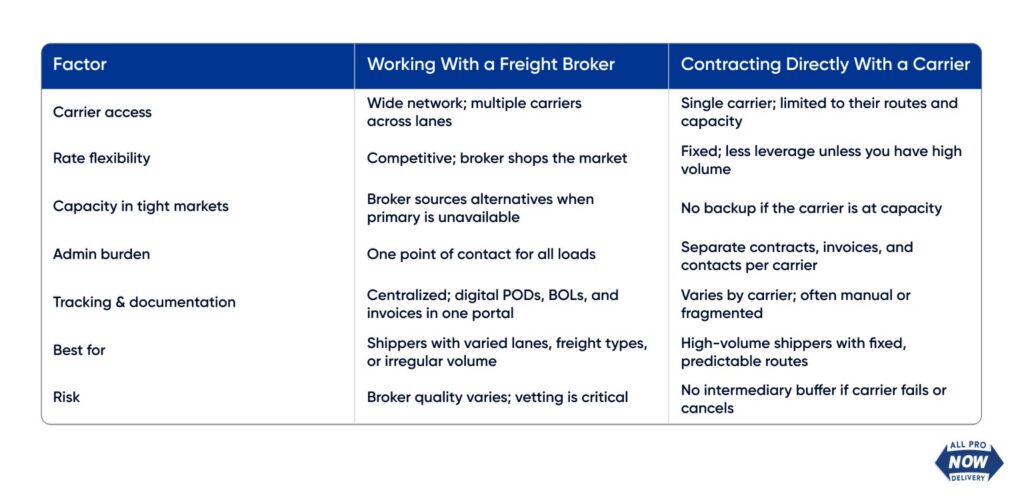
Freight Broker vs. Direct Carrier: How Shippers Should Choose
The Real Problem With Some Freight Brokerage Companies, And How to Protect Yourself
Here’s the part most broker websites won’t tell you. The U.S. freight brokerage industry has a well-documented trust problem, and shippers who don’t know the warning signs pay the price.
Carriers operating in the U.S. market have shared documented cases of brokers paying as little as $30–$35 per hour for driver detention time, rates that don’t cover driver wages, fuel, or truck overhead. That’s not a negotiating position. That’s a structural problem baked into some brokers’ terms and conditions.
Some brokers manipulate rate confirmations after verbal agreements are made, reducing agreed amounts by hundreds of dollars once the load is booked. Others build deduction clauses into contracts for tracking failures or missed calls, creating a legal mechanism to recover revenue from carriers who often can’t push back.
Why does this matter to shippers? Because carriers who get squeezed by brokers charge it back downstream, in rate increases, service degradation, or simply choosing not to work those lanes again. The top 1,000 freight brokerages represent just 3.5% of all active entities but account for 88% of gross revenue in a market now exceeding $135 billion. That concentration means the broker you choose has a massive effect on your access to quality capacity.
Rate confirmation manipulation, vague accessorial policies, and unverifiable carrier networks don’t just hurt carriers. They hurt the shippers those brokers are supposed to serve.
What to verify before you commit to any freight broker:
- Active FMCSA operating authority (USDOT number), verifiable at safer.fhwa.dot.gov
- $75,000 surety bond on file (required by federal law per FMCSA broker registration requirements)
- Written rate confirmation before the truck rolls, not after
- Clear, written detention, layover, and accessorial policies
- Real-time GPS tracking on every shipment
- All-inclusive, upfront pricing with no post-delivery fee additions
- Documented on-time delivery performance by lane, not national averages
Types of Freight Brokerage Services: Matching the Right Broker to Your Freight
Not all freight brokerage companies handle the same freight types, lanes, or service windows. Understanding these categories helps you find the right fit.
Full Truckload (FTL) Brokerage: One shipper. One truck. One destination. Best for shipments that fill a 48- or 53-foot trailer. Full truckload captured 63.63% of 2025 brokerage revenue, driven by manufacturing and retail shippers who prioritize dedicated capacity and predictable transit times. Common in high-volume corridors like Cleveland–Detroit and Toledo–Indianapolis.
LTL Freight Brokers: Less-than-truckload brokerage consolidates multiple shippers’ freight into one truck. Cost-effective for smaller shipments. The LTL segment is growing at an estimated CAGR of 14.3%, driven by e-commerce fulfillment models and the rise of mid-sized shippers seeking cost-efficient alternatives. LTL freight brokers are especially practical for businesses in Pittsburgh or Youngstown shipping partial loads on recurring lanes.
Intermodal Brokerage: Rail-plus-truck moves for long-haul distances. Common in Ohio-to-Florida corridors and cross-country lanes where cost efficiency outweighs speed requirements.
Expedited and Same-Day Freight: Time-sensitive moves that require immediate carrier dispatch. Critical for just-in-time manufacturers, healthcare operations, and construction sites where a missed delivery shuts down an entire crew or production line.
Specialized Freight: Oversized, flatbed, hazmat, temperature-controlled, or high-value cargo requiring specific carrier certifications and equipment. Medical facilities in Cleveland and Northern Kentucky rely on specialized freight brokerage for lab specimens and medical devices where chain-of-custody documentation is non-negotiable.
How to Vet a Freight Brokerage Companies Before You Commit
| What to Check | What a Reliable Broker Looks Like | Warning Sign |
| Licensing | Active FMCSA USDOT authority; $75,000 surety bond on file | Can’t provide authority number or bond documentation |
| Rate confirmation | Written rate confirmation issued before the truck is dispatched | Rates agreed verbally; confirmation sent after pickup |
| Pricing transparency | All-in rate with no fuel surcharges or hidden accessorial fees | Rate subject to post-delivery deductions or surcharges |
| Detention policy | Clear written terms for detention time; fair hourly rate disclosed upfront | Vague or buried terms; low flat cap that doesn’t cover carrier costs |
| Tracking capability | Real-time GPS on every shipment; shipper portal access | Updates available only on request; no live visibility |
| Proof of delivery | Digital POD uploaded and available within hours of delivery | PODs emailed days later or unavailable on demand |
| Carrier vetting | Verified FMCSA-registered carriers with insurance confirmed | Open load board sourcing with no carrier quality filter |
| Performance data | On-time delivery rate documented by lane, not just nationally | Only national averages available; no lane-level reporting |
Why Regional Freight Brokerage Companies Often Outperform National Players
A manufacturer in Youngstown shipping to Pittsburgh or Cincinnati doesn’t need a broker optimizing freight across 50 states. They need a broker who knows the I-76 corridor, understands local carrier availability by day of week, and can get a driver dispatched when a load needs to move this afternoon.
The Midwest commanded 26.55% of 2025 U.S. freight brokerage revenue, the largest regional share nationally, while regional lanes are projected to grow at an 8.14% CAGR through 2031. That growth reflects a market shift: shippers are prioritizing lane-specific performance and carrier consistency over the promise of national coverage they rarely need.
Regional freight brokerage companies consistently outperform national players in four areas: dispatch speed (minutes vs. hours), carrier familiarity (vetted local drivers vs. anonymous load board capacity), pricing consistency (flat regional rates vs. national spot market volatility), and accountability (a local contact you can reach vs. a call center that escalates to a ticket).
This is the operating model that matters for businesses in Northeast Ohio, the Detroit–Indianapolis corridor, Western Pennsylvania, Northern Kentucky, and Florida’s freight-intensive markets in Tampa, Miami, and Orlando.
Industries That Rely Most on Freight Brokerage Companies
Manufacturing: Ohio ranks among the top manufacturing states in the nation. Automotive, aerospace, and machinery plants in Toledo, Akron, and Cleveland operate on just-in-time schedules where a four-hour freight delay can idle an entire production line. A reliable logistics broker isn’t a convenience, it’s a production dependency.
Healthcare: Hospital networks and lab systems across Cleveland, Detroit, Columbus, Indianapolis, and Tampa use freight brokerage for specimen transport, medical equipment delivery, and pharmaceutical distribution. Clinical delivery windows are non-negotiable. A specimen delivered 40 minutes late to a Cleveland reference lab misses the processing window entirely.
Retail and E-Commerce: Retail, FMCG, and wholesale distribution represented 29.54% of 2025 U.S. freight brokerage demand. Retailers in Columbus, Cincinnati, and Tampa rely on freight brokerage companies to manage B2B inventory replenishment across regional distribution networks. On-time delivery is directly tied to shelf availability.
Construction: Firms across Pittsburgh, Cincinnati, and Detroit use freight brokerage for flatbed loads, oversized materials, and time-sensitive equipment delivery. A missed load on a jobsite shuts down crews and triggers contract penalties.
Legal and Professional Services: Law firms and financial institutions in Cleveland, Columbus, and Indianapolis depend on freight brokerage for document delivery, evidence transport, and time-sensitive business records, where chain of custody matters as much as speed.
Regional Freight Brokerage Companies vs. National Brokers: A Practical Comparison
| Performance Factor | Regional Freight Broker | National Freight Broker |
| Dispatch speed | Minutes; local carrier relationships and lane familiarity | Hours; load board sourcing and call center routing |
| Lane knowledge | Deep; knows specific corridors, seasonal patterns, and local carrier behavior | Broad but shallow; national coverage, limited local context |
| Carrier consistency | Same vetted carrier pool across repeat lanes | Variable, changes with load board availability and spot market |
| Pricing model | Flat-rate, all-in, what you see at booking is what you pay | Complex, base rate plus fuel surcharges, accessorial fees, and volume thresholds |
| Accountability | Direct contact; a person familiar with your account | Tiered support; escalation-dependent resolution |
| Flexibility for urgent loads | High, local drivers available for same-day dispatch | Moderate to low, dependent on national carrier network response time |
| Best fit | Businesses with regional lanes, time-sensitive freight, or recurring volume | Businesses shipping nationally across 30+ states with high FTL volume |
What a Freight Shipping Broker Should Deliver: Minimum Standards
Before you sign with any freight shipping broker, hold them to these documented benchmarks:
- On-time delivery rate above 95% — ask for lane-specific data, not national averages
- Real-time GPS tracking — every shipment, every leg, visible to you
- Digital proof of delivery — PODs available on demand, not two days later
- All-inclusive pricing — rate confirmed before dispatch; no post-delivery fuel surcharges or surprise accessorial fees
- Responsive support — a human reachable during your operating hours
- FMCSA-verified carriers — every carrier in the network checked for active operating authority and insurance
The 2026 freight market has made these standards more important, not less. Spot van rates in the Midwest hit $2.58 per mile in early 2026, $0.19 above the national average, and the load-to-truck ratio has reached a four-year high. In a tightening market, brokers with weak carrier networks and variable pricing are the first to fail their customers.

How to Switch Freight Brokerage Companies Without Disrupting Operations
Switching brokers mid-cycle is one of the most common operational concerns, and one of the most manageable with the right approach.
Step 1: Audit your current freight lanes, origin/destination pairs, freight types, volume, and timing requirements. Know what you’re moving before you shop for who moves it.
Step 2: Get quotes on your highest-volume lanes from the new broker before giving notice on the old contracts.
Step 3: Run a parallel test. Move two or three loads through the new broker while existing carrier relationships stay intact.
Step 4: Evaluate documentation quality, rate confirmations, PODs, invoices. Are they accurate, clean, and delivered fast?
Step 5: Transition fully once performance is confirmed across at least three to five shipments.
The transition risk is real but manageable. The risk of staying with a broker who’s costing you money on accessory fees, detention disputes, and inconsistent carrier performance is a larger problem that compounds monthly.
AllProNow: Regional Freight Brokerage
AllProNow is a technology-driven freight and logistics platform, when Freight Systems was founded in Cleveland, Ohio as a truckload services company. Over five decades, the business evolved to match how shippers’ needs evolved, from truckload-only operations to a full-service regional platform covering same-day freight, LTL coordination, managed logistics, and dedicated carrier capacity.
The service footprint covers Northeast Ohio (Cleveland, Akron, Canton, Youngstown), Columbus, Toledo, Pittsburgh, Detroit, Indianapolis, Northern Kentucky, Tampa, Miami, and Orlando, across Ohio, Michigan, Indiana, Western Pennsylvania, Northern Kentucky, and Florida.
What makes AllProNow a practical alternative to the national brokers is the combination of regional depth and digital convenience. Instant rate quotes with no hidden fees. Real-time GPS on every shipment. Digital PODs on demand. A vetted driver network, not just open load board access, across a seven-state footprint.
Retailers, manufacturers, medical facilities, and construction firms across the region rely on AllProNow because the performance is documented: 80,000+ shipments delivered, 99% on-time performance, and flat-rate all-inclusive pricing that means the number you see at booking is the number on the invoice.
Choosing the Right Freight Brokerage Company in 2026 Is a Business Decision
The freight market in 2026 is tighter, more volatile, and more consequential than it’s been in years. Around 74% of U.S. shippers now depend on freight brokerage companies for transportation management, and the gap between a well-run broker relationship and a poorly managed one shows up directly in your cost per shipment, on-time performance, and carrier availability.
The right freight brokerage company brings transparent pricing, a verified carrier network, real-time visibility, and genuine accountability. The wrong one costs you money you didn’t budget for and service failures you can’t explain to your customers.
Evaluate carefully. Verify licensing. Get everything in writing. And measure performance by lane, not by marketing claims. Get an instant quote at AllProNow.net. No calls. No hidden fees. A rate, a driver, and a delivery that shows up when it’s supposed to.