Most people have no idea the driver at their door doesn’t work for the company whose logo is on the van. That gap between perception and reality is where the entire delivery service partner model lives, and it’s reshaping how American businesses move freight at the regional level.
Understanding how the delivery service partner model works, structurally, financially, and operationally, matters whether you’re a business choosing a freight partner or an entrepreneur building one.
The last-mile delivery market grew from $184.2 billion in 2025 to $199.68 billion in 2026, driven by e-commerce growth, rising consumer demand for fast deliveries, and the expansion of urban distribution networks. The delivery service partner is the human infrastructure behind those numbers.
What a Delivery Service Partner Is (and Isn’t)
A delivery service partner is an independently owned logistics company that contracts with a larger retailer, platform, or shipper to execute deliveries on their behalf. The DSP owner hires drivers, manages vehicles, builds operational systems, and executes routes, all under the contracting company’s brand standards and technology infrastructure.
Here’s what a DSP is not: an employee of the contracting company, a subsidiary, or a franchisee in the legal sense. The DSP owner carries their own payroll, their own insurance, their own HR headaches, and their own liability. The branded uniform on the driver and the logo on the van don’t change any of that.
Reddit’s driver community puts it plainly. As one longtime DSP driver noted: the branding, the warehouse location, the uniforms, all of it creates the impression that drivers work for the retailer. In practice, “none of us actually work for them.” The DSP program exists precisely to separate the contracting company from the operational complexity of managing thousands of drivers across hundreds of markets.
That separation has real consequences for anyone interacting with this model, as a shipper choosing a delivery partner, as a job seeker evaluating delivery service partner jobs, or as an entrepreneur building a DSP from scratch.
Why the DSP Model Dominates Last-Mile Logistics in 2026
The delivery service partner model didn’t grow because it was convenient. It grew because it solved a real structural problem: how do you deliver freight into hundreds of distinct regional markets, each with different geography, traffic patterns, and labor pools, without building an internal operation in every one of them?
The answer is to contract people who already live and operate there.
In 2026, approximately 66.8 million packages were delivered each day in the United States, 773 parcels every single second. No single centralized operation moves all of that. It moves through a distributed network of delivery service partners, regional couriers, and independent fleet operators who know their markets and have the infrastructure to serve them.
Consumer expectations have compounded the pressure on that network. Surveys show 90% of U.S. online shoppers expect delivery within 2–3 days, and 28% of buyers have abandoned purchases when the estimated delivery time was longer than they needed. Meanwhile, 98% say the delivery experience directly affects their brand loyalty.
Those expectations don’t care about your carrier’s hub-and-spoke model. They care about whether the package arrived. That’s the DSP’s job.
What It Actually Takes to Run a Delivery Service Partner Business
The pitch for running a delivery service partner business sounds straightforward: contract volume, hire drivers, deliver packages, collect revenue. The operational reality is more demanding.
People management is the job. Experienced DSP operators across markets from Buffalo to Tampa consistently identify team quality as the primary variable in their success or failure. Driver turnover is structural in this industry, not exceptional. The DSPs that scale and stabilize are the ones that build repeatable hiring and training processes, not the ones that depend on finding perfect people. One DSP owner who built his operation in upstate New York described rebuilding a 20-route operation after losing half his team almost overnight. He was back at capacity within weeks, not because of luck, but because his processes were documented and his remaining team knew exactly what to do.
Technology determines your cost floor. Manual route planning, paper logs, and phone-based dispatch are expensive at scale. AI-powered route optimization is cutting delivery times by 25% and fuel consumption by 20% for operators that implement it properly. Digital proof of delivery, photo, signature, timestamp, eliminates disputes and creates the accountability record that professional logistics operations depend on. In 2026, these are not premium features. They are baseline table stakes.
Capital requirements are real. Formal delivery service partner DSP programs generally require applicants to demonstrate $10,000 to $30,000 in liquid assets just to qualify. That’s before driver wages, fuel, insurance, vehicle leasing, and software. Anyone approaching this model without a clear financial plan for the first 90 days of operations is setting themselves up for a painful education.
Location strategy changes your odds. The DSP opportunity is not evenly distributed. Markets that other applicants avoid, smaller cities, colder climates, less glamorous regions, often have shorter approval timelines, less competition for routes, and faster paths to stable volume. The operators who chose Buffalo over Miami, or Youngstown over Austin, didn’t make that choice reluctantly. They made it strategically.
Delivery Service Partner Pay: What the Numbers Show in 2026
Earnings in the DSP space are real but widely misunderstood. The gross revenue figures sound impressive. The net margins require a clearer explanation.
DSP Owner Earnings by Fleet Size (2026)
| Fleet Size | Annual Revenue Range | Estimated Net Profit | Margin |
| 5–10 vans | $500K – $1M | $35K – $100K | 7–10% |
| 10–20 vans | $1M – $2.5M | $75K – $175K | 7–10% |
| 20–40 vans | $2.5M – $4.5M | $175K – $300K | 7–10% |
| 40+ vans | $4.5M+ | $300K+ | Variable |
Net profit margins for delivery service partner businesses typically run between 7–10%, depending on how efficiently the business is managed. Fuel, driver wages, insurance, and vehicle maintenance are the cost categories that separate profitable DSPs from breakeven ones. The operators who run lean on routing software, tight on scheduling, and proactive on vehicle maintenance are the ones whose margins hold.
At the driver level, delivery service partner jobs pay varies significantly by geography and DSP owner.
Delivery Service Partner Driver Pay by Market (2026)
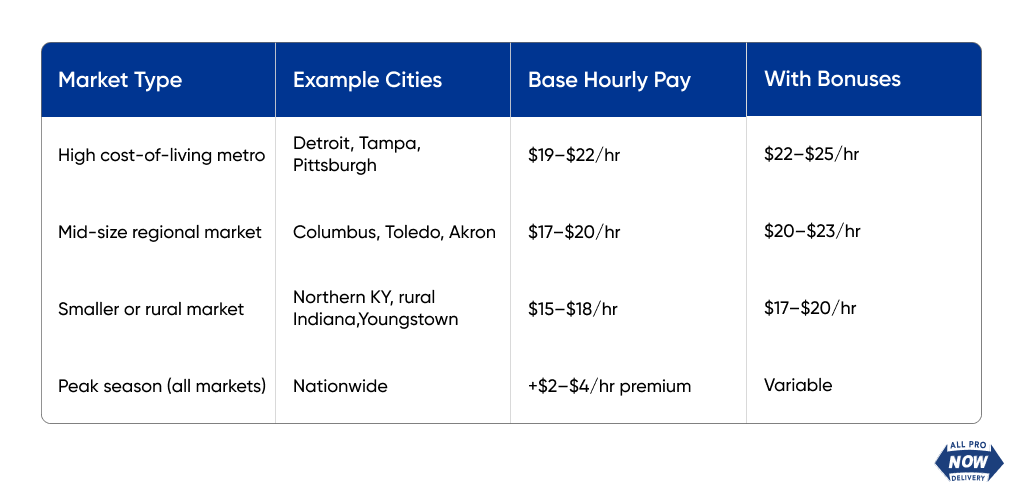
Many DSPs provide additional incentives for hitting specific targets or working during peak periods, with some also offering benefits including medical coverage, paid leave, and retirement savings programs. The benefit package varies entirely by DSP owner, drivers are employed by the delivery service partner, not the contracting platform.
Industries That Need Delivery Service Partner the Most
This is where the DSP model’s value becomes concrete. It isn’t just about consumer packages. Across AllProNow’s service territory, from Cleveland and Columbus to Detroit and Indianapolis to Tampa and Miami, delivery service partners move the freight that keeps industries operational.
Industry Reliance on Delivery Service Partners (2026)
| Industry | Freight Type | Consequence of a Missed Delivery | Key Markets Served |
| Healthcare | Specimens, pharmaceuticals, medical devices | Delayed diagnoses, compliance violations, clinical disruption | Cleveland, Columbus, Detroit, Pittsburgh, Tampa, Miami |
| Manufacturing | Just-in-time components, replacement parts | Production line stoppages, contract penalties | Toledo, Detroit, Youngstown, Indianapolis |
| Retail & E-commerce | Store inventory, B2B replenishment, last-mile parcels | Empty shelves, missed SLAs, customer churn | Columbus, Cincinnati, Tampa, Orlando, Miami |
| Construction | Materials, oversized freight, time-critical tools | Project delays, labor standing idle, penalty clauses | Pittsburgh, Cleveland, Fort Lauderdale |
| Legal & Professional Services | Documents, evidence, filings | Court deadlines, legal consequences | All major metros |
Healthcare is worth dwelling on because the stakes are the highest. A hospital network in Columbus managing specimen transport across satellite collection sites cannot use a standard freight carrier that optimizes for volume over timing. A pharmaceutical distributor running the Ohio-to-Florida corridor needs chain-of-custody documentation and compliant handling, not just a driver and a van.
The delivery service partner that understands those requirements and has built the systems to meet them earns the relationship. The one that doesn’t lose it after the first failure.
For manufacturers in Toledo or Detroit managing just-in-time supply chains, the calculus is equally direct. A missed component delivery doesn’t create a scheduling inconvenience. It stops a production line. The cost of that stoppage dwarfs the cost of any freight invoice.
Selecting a Delivery Service Partner: What the Evaluation Should Actually Cover
Most businesses evaluate delivery partners on price first and find out about everything else after the first missed delivery. The better approach is to treat partner selection as a capability audit.
On-time performance record, not on-time claims. A provider quoting a 99% on-time rate should be able to show you the data behind that number, by lane, by market, by freight type. National averages obscure what matters: whether they consistently deliver on the specific routes you need.
Pricing structure transparency. Fuel surcharges and hidden fees can inflate shipping costs by 30–50% on major carrier networks. Flat-rate pricing with no residential fees, no fuel surcharges, and no accessorial surprises is the operational standard that professional regional delivery partners offer. If a quote has more line items than a lease agreement, that’s a signal worth noticing.
Coverage that matches your actual network. A delivery partner that covers your primary city but not the suburb 30 miles out isn’t solving your problem. It’s solving part of your problem while creating a secondary logistics gap. Verify coverage at the zip-code level, not the metro level.
Technology that creates accountability. Real-time order tracking is considered essential by 90% of customers in 2026. Live GPS visibility, accurate ETAs, and digital proof of delivery are not premium add-ons, they are the evidence trail that allows businesses to manage their supply chains proactively rather than reactively.
Industry-specific experience. A delivery partner that handles healthcare freight knows what a Business Associate Agreement is and why it’s non-negotiable. One that handles manufacturing freight understands what “no-substitution, no-delay” actually means on a production floor. Generic logistics capacity and industry-specific capability are not the same thing.
How AllProNow Functions as a Delivery Partner Across Seven States
AllProNow was built for the specific gaps that regional businesses run into with national carriers and general freight brokers. It operates a dedicated driver network, not a broker marketplace, across Ohio, Michigan, Indiana, Pennsylvania, Kentucky, Florida, and New York, covering 25+ cities including Cleveland, Columbus, Toledo, Detroit, Pittsburgh, Indianapolis, Cincinnati, Tampa, Miami, and Orlando.
Same-day delivery with 1–2 hour pickup. Live GPS tracking from dispatch to delivery confirmation. Digital proof of delivery including photo, signature, and timestamp. Flat-rate pricing with no fuel surcharges, no residential fees, and no hidden line items. A 99% on-time record maintained across parcel, LTL, and medical courier freight categories.
For businesses that have been burned by carriers who promise regional coverage but deliver inconsistent service, AllProNow’s managed logistics offering goes further: acting as an outsourced logistics department, handling carrier and vendor management, lane planning, KPI reporting, and cost optimization without the overhead of building that function internally. If your operation runs across the Midwest or Southeast, and your freight needs a delivery service partner that can actually cover it, get an instant quote at allpronow.net.