

Freight invoices rarely match the original quote, and the fuel surcharge is usually why. That mysterious “FSC” line item can add anywhere from 5% to 30% to your base freight cost, yet most shippers never receive a clear explanation of where it comes from or how it moves. For businesses shipping across Ohio, Michigan, Indiana, Pennsylvania, Kentucky, Florida, and New York, that lack of clarity creates real budget problems.
At AllProNow, a technology-driven freight management platform serving businesses across seven states, understanding what is a fuel surcharge in shipping and how is it calculated is the first step toward accurate forecasting and zero invoice surprises. This blog explains everything plainly and practically.
Key Takeaways
- A fuel surcharge (FSC) is a variable fee added to your base freight rate to offset diesel price volatility.
- The most accurate calculation method is cents-per-mile, anchored to the U.S. Department of Energy’s weekly diesel index.
- Diesel represents 21% to 40% of total trucking operating costs, according to the American Transportation Research Institute (ATRI) and industry benchmarks.
- FSC is updated weekly by most carriers based on DOE/EIA data, and typically adds $0.10 to $0.20+ per mile on top of base rates.
- Transparent FSC pricing, like AllProNow’s upfront rate model, protects shippers in Ohio, Florida, Michigan, and beyond from unexpected cost creep.
What Is a Fuel Surcharge in Shipping?
A fuel surcharge is an additional fee that carriers charge on top of the base freight rate to recover the cost of fuel price increases. It’s not a profit line. It’s a passthrough mechanism that protects carriers when diesel prices spike, while giving shippers a clear, auditable line item on their invoice.
The concept has been standard practice in American trucking since the 1973 oil embargo, when fuel costs first destabilized carrier margins at scale. Today, with diesel prices fluctuating 40% to 60% annually in some cycles, the fuel surcharge is one of the most consequential numbers on any freight bill.
Think of it this way: when you book a shipment from Columbus to Tampa, the carrier quotes you a base rate assuming a certain fuel cost. If diesel prices jump between quote and delivery, the FSC absorbs that gap. Without it, carriers would either lose margin or embed a huge buffer into every quoted rate, neither outcome benefits the shipper.
Fuel surcharge example: A Chicago-to-Dallas lane, 950 miles, carries a base freight rate of $1,850. At a fuel surcharge rate of 11.54 cents per mile, the FSC adds $109.63, bringing the all-in cost to $1,959.62, a 6% increase.
Why Diesel Drives the Number (Not Gasoline)
Most shippers think of fuel as a generic concept. In trucking, it’s almost entirely a diesel story.
According to the Engine Technology Forum, diesel powers 97% of Class 8 trucks on American roads. The U.S. Energy Information Administration (EIA), part of the Department of Energy, publishes national average on-highway diesel prices every Tuesday. That number is the baseline for virtually every fuel surcharge calculation in the industry.
According to ATRI’s 2024 industry cost report, fuel fell from 28% to 21% of total trucking operating costs between 2022 and 2024, driven largely by price normalization. But the numbers can swing sharply. When hurricanes Helene and Milton disrupted supply lines in late 2024, diesel jumped roughly nine cents per gallon almost overnight. Businesses shipping from Cleveland to Miami or from Indianapolis to Orlando felt that in their freight bill within days.
That volatility is exactly why a standardized, transparent fuel surcharge system matters.
The Three Ways Fuel Surcharges Are Calculated
Not every carrier uses the same formula. Here are the three primary methods, and why one clearly leads.
Fuel Surcharge Calculation Methods Compared
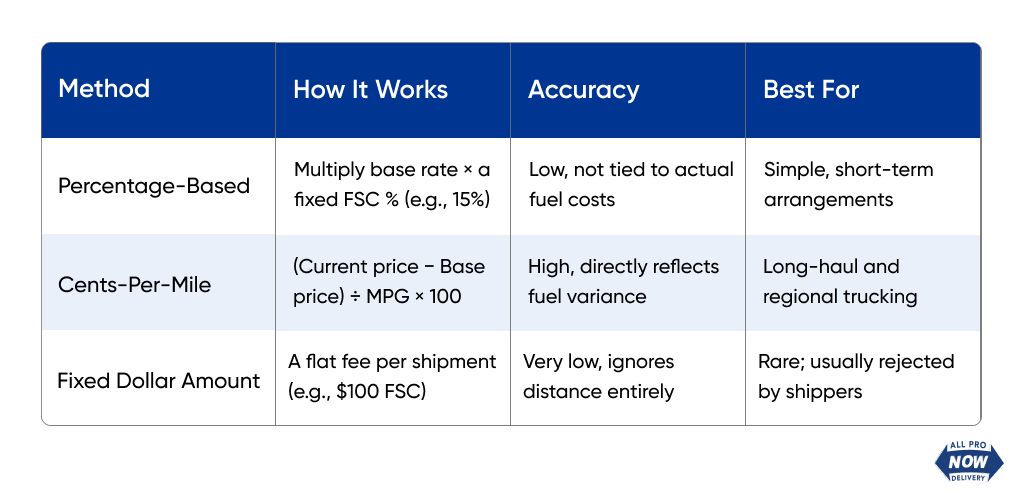
Cents-per-mile is the industry standard for a reason. It ties the surcharge directly to what the carrier actually spends on fuel. It adjusts automatically as prices change. And it scales with distance, so a 200-mile run from Cleveland to Pittsburgh doesn’t carry the same FSC as a 1,200-mile run from Detroit to Orlando.
How the Cents-Per-Mile Fuel Surcharge Is Calculated: Step by Step
Here’s the exact formula used by most carriers, including those whose rates feed into tools like a diesel fuel surcharge calculator:
Step 1: Establish your base fuel price. This is the price per gallon at which the carrier originally built their rate structure. It’s typically tied to a historical DOE average, often somewhere between $2.50 and $3.50 per gallon depending on when the contract was set.
Step 2: Pull the current fuel price. Carriers reference the EIA’s weekly U.S. Average On-Highway Diesel Price, updated every Tuesday. This is the national fuel surcharge anchor used across the industry.
Step 3: Calculate the fuel price variance. Subtract the base price from the current price. Example: $4.25 current − $3.50 base = $0.75 variance
Step 4: Apply miles per gallon. For a fully loaded Class 8 truck, average fuel efficiency is 6 to 7 miles per gallon. Most carriers use 6.5 MPG as a standard figure.
Step 5: Calculate cents per mile. Divide the variance by MPG, then multiply by 100. $0.75 ÷ 6.5 × 100 = 11.54 cents per mile
Step 6: Apply to shipment distance. Multiply the cents-per-mile rate by total miles. 950 miles × 11.54¢ = $109.63 FSC
This is the number that appears as a separate line on your freight invoice. According to the Owner-Operator Independent Drivers Association (OOIDA), carriers typically increase their surcharge by one cent for every six-cent increase in diesel price above their baseline.
What Does a Fuel Surcharge Chart Look Like?
A fuel surcharge chart maps specific diesel price ranges to corresponding surcharge percentages or per-mile rates. Carriers publish these tables, updated weekly, so shippers can see exactly what FSC applies at any given diesel price.
Here’s a simplified illustration of how a national fuel surcharge for diesel typically works in LTL shipping:
Sample Fuel Surcharge Chart (LTL Reference Model)
| DOE National Average Diesel Price | FSC % (LTL) | Approx. Cents Per Mile |
| $3.00 – $3.20 | 10.0% – 11.0% | ~7–8¢ |
| $3.20 – $3.60 | 12.0% – 14.0% | ~9–11¢ |
| $3.60 – $4.00 | 15.0% – 18.0% | ~11–14¢ |
| $4.00 – $4.40 | 19.0% – 22.0% | ~15–17¢ |
| $4.40 – $5.00 | 23.0% – 28.0% | ~18–22¢ |
Note: Actual rates vary by carrier. Always verify against the carrier’s published FSC matrix or the DOE weekly index.
Major carriers like Estes Express publish their FSC tables publicly. For LTL shipments under DOE’s rate matrix, surcharge adjustments move in 0.1% increments for every two-cent change in the national diesel price below $3.61/gallon, and in 0.2% increments above that threshold.
Real-World Case Study: How FSC Impacts a Shipper Across Multiple Lanes
Consider a mid-size manufacturer in Toledo, Ohio shipping components to customers in Pittsburgh, Cincinnati, Indianapolis, and Tampa on a weekly basis. Their base freight spend is approximately $9,200 per month across all lanes.
When diesel rises from $3.50 to $4.25 per gallon, a $0.75 variance, the FSC at 6.5 MPG adds approximately 11.5 cents per mile across all shipments. For a monthly total of around 6,100 miles, that’s roughly $700 in additional fuel surcharges.
Without visibility into the national fuel surcharge for diesel, this shows up as an unexplained invoice increase. With a transparent FSC model, the shipper can:
- Budget accurately for fuel-driven cost increases
- Show customers why freight costs have shifted
- Evaluate carrier contracts more competitively
- Plan shipment batches to optimize lane efficiency
This is precisely the kind of cost clarity that AllProNow’s managed logistics service is built to provide. Businesses in Cleveland, Columbus, Detroit, Pittsburgh, Indianapolis, Northern Kentucky, Tampa, Miami, and Orlando rely on AllProNow’s upfront pricing model, no surprise surcharge lines, no hidden fees.

How Frequently Is the Fuel Surcharge Updated?
Fuel surcharges are typically recalculated weekly. The EIA updates the U.S. Average On-Highway Diesel Price every Tuesday. Most carriers apply the new FSC rate starting the following Wednesday, running through the next Tuesday.
Where to track it every week: Shippers can monitor the current national diesel price directly from two authoritative government sources:
- EIA Weekly Retail Diesel Prices — eia.gov/petroleum/gasdiesel — Updated every Tuesday; this is the exact number carriers use to reset FSC rates each week.
- DOE Fuel Surcharge Matrix — atlas.doe.gov/FuelSurcharge.aspx — Publishes the official LTL, truckload, and household goods FSC percentages tied to each weekly diesel price. Historical matrices going back to 2013 are available here too.
Bookmarking both takes 30 seconds and saves you from being blindsided by FSC changes on your next invoice.
For LTL shipments, the applicable surcharge is determined by the diesel price on the day of pickup, not the day of quote. This means a shipment booked Monday at one rate could carry a slightly different FSC if diesel prices shift before Wednesday delivery. Knowing this cadence is critical for accurate freight cost forecasting.
For household goods and drayage, FSC is determined on the first Monday of each month and runs for 30 days, a slightly different schedule than LTL and truckload.
Fuel Surcharge vs. Base Freight Rate: What’s Included?
Shippers sometimes try to negotiate fuel surcharges into the base rate for simplicity. There’s logic to it, fewer line items, easier budgeting. But it comes with a tradeoff: if diesel prices drop, you’ve locked in costs that should have decreased.
The two-component model (base rate + FSC) is more transparent and more financially sound for both parties.
Base Rate vs. Fuel Surcharge: Key Differences
| Factor | Base Freight Rate | Fuel Surcharge (FSC) |
| What it covers | Labor, equipment, overhead, margin | Fuel cost variance above baseline |
| How often it changes | Annually or per contract | Weekly (tied to DOE/EIA) |
| Negotiability | Yes, at contract stage | Limited, tied to market prices |
| Transparency | Fixed per lane | Variable but fully auditable |
| Industry standard | Always present | Standard since early 1970s |
Common Industries That Feel FSC Most Acutely
Fuel surcharges hit hardest in industries that ship frequently, over long distances, or with time-critical requirements. In AllProNow’s service footprint across Ohio, Indiana, Michigan, Pennsylvania, Kentucky, Florida, and New York, the industries most affected include:
Healthcare and medical delivery: Hospitals and pharmaceutical distributors running the Ohio-to-Florida corridor deal with weekly FSC variability on temperature-sensitive and time-critical shipments.
Manufacturing and industrial: Facilities in Toledo, Detroit, and Indianapolis moving just-in-time components can’t absorb unpredictable surcharge spikes without destabilizing their production cost models.
Retail and e-commerce: Businesses shipping bulk inventory between fulfillment centers in Columbus, Cleveland, Pittsburgh, and Tampa see FSC compound across high shipment volumes.
Construction: Oversized and heavy freight moving between job sites across the Midwest and Southeast is particularly distance-sensitive, making the cents-per-mile FSC model directly impactful.
Legal and document delivery: Even small parcel and courier runs from Akron to Pittsburgh or Cincinnati to Louisville carry an FSC component when fuel prices are elevated.
How AllProNow Handles Fuel Surcharges
Most shippers don’t realize how much FSC variance differs from carrier to carrier. Two carriers quoting the same base rate on the same lane can produce very different all-in totals, purely because of how aggressively each applies their fuel surcharge.
That gap is where businesses lose money quietly, shipment after shipment.
AllProNow operates on an upfront pricing model. When you enter your pickup and delivery ZIP codes, whether you’re shipping from Youngstown to Jacksonville or from Detroit to Miami, the rate you see includes fuel-related costs. There’s no base rate that looks clean until the FSC lands on your invoice.
Fuel surcharges at AllProNow are kept at significantly lower, single-digit rates. Pricing is clear and predictable with no hidden markups layered on after booking. That means businesses across Ohio, Michigan, Indiana, Pennsylvania, Kentucky, Florida, and New York get real control over their delivery costs, not just a quote they can’t rely on.
Why This Matters for Your Bottom Line
Even a small difference in fuel surcharge percentage compounds fast across high-volume shipping. Here’s what that looks like in practice:
AllProNow vs. Typical Carrier: FSC Cost Comparison
| Cost Component | Typical Carrier | AllProNow |
| Base rate | $100 | $100 |
| Fuel surcharge | $30 – $50 (30–50%) | $5 – $10 (5–10%) |
| Total cost per shipment | $130 – $150 | $105 – $110 |
| Monthly cost (100 shipments) | $13,000 – $15,000 | $10,500 – $11,000 |
| Potential monthly savings | — | $2,000 – $4,500 |
Figures are illustrative based on industry FSC benchmarks. Actual rates vary by lane, distance, and shipment type.
For a retailer in Columbus managing 100 deliveries a month, or a medical supplier running routes between Cleveland and Tampa, that difference isn’t marginal, it’s a meaningful line item in the operating budget.
AllProNow’s managed logistics service goes further. For businesses that need carrier management, lane planning, and KPI reporting, AllProNow acts as an embedded logistics department, one that builds FSC variability into your operating plan so you’re never caught off-guard at month-end. If you’re moving freight across the Midwest and Southeast and want transparent, all-in pricing, request a quote from AllProNow.
The Bottom Line: What Is a Fuel Surcharge in Shipping and How Is It Calculated?
A fuel surcharge in shipping is a variable, distance-based fee that carriers add to your base freight rate to offset diesel price volatility. It’s calculated weekly using the DOE/EIA national diesel price, a carrier-defined base price, and average truck fuel efficiency, typically producing a cents-per-mile rate that gets multiplied by your shipment distance.
It’s not optional. It’s not arbitrary. And when it’s calculated and communicated transparently, it actually protects shippers just as much as carriers, because it separates the cost of moving freight from the cost of fueling it.
For businesses across Ohio, Michigan, Indiana, Pennsylvania, Kentucky, Florida, and New York, understanding what is a fuel surcharge in shipping and how is it calculated means better budgets, cleaner carrier conversations, and fewer invoice surprises.
AllProNow builds that transparency into every shipment. Get a quote today and see the full cost, upfront, every time.