
Transportation management in logistics coordinates the physical movement of goods from warehouses to customers. It handles carrier selection, route planning, freight cost management, and shipment tracking. While logistics encompasses the entire supply chain including inventory and warehousing, transportation management focuses specifically on moving products efficiently.
All Pro Now provides transportation management services across Ohio and Florida, helping businesses in Cleveland, Columbus, Toledo, Tampa, Miami, and Orlando move freight reliably. Our same-day delivery, LTL shipping, and courier services handle the transportation layer of logistics operations. We select optimal routes, track shipments in real-time, and manage carrier coordination so businesses can focus on their core operations.
This guide explains how transportation management in logistics works, the technologies enabling it, and practical considerations for businesses selecting transportation partners.
What Transportation Management in Logistics Actually Means
Transportation management represents one component of the broader logistics function. Logistics covers demand forecasting, inventory management, warehousing, order fulfillment, and distribution. Transportation management handles the specific task of moving goods between locations.
Think of logistics as planning what needs to move, when, and how much. Transportation management executes the physical movement. A Columbus manufacturer needs 500 units delivered to a Tampa retailer. Logistics determines order quantity and timing based on demand forecasts and inventory levels. Transportation management selects the carrier, books the shipment, optimizes the route, and tracks progress until delivery.
The process includes several interconnected activities. Route planning determines the most efficient path considering distance, traffic, delivery windows, and vehicle capacity. Carrier selection evaluates transportation providers based on cost, service quality, geographic coverage, and specialized capabilities. Freight cost management negotiates rates, audits invoices, and tracks spending. Shipment tracking monitors real-time progress providing visibility to customers and stakeholders.
This operational focus differentiates transportation management from broader supply chain strategy. Supply chain management coordinates suppliers, manufacturers, distributors, and retailers end-to-end. Logistics ensures products flow smoothly through this network. Transportation management moves the actual freight.
Core Functions of Transportation Management
Transportation management encompasses multiple functions working together to move goods efficiently. Each function addresses specific operational challenges businesses face when shipping products.
Route Planning and Optimization
Route planning calculates optimal paths between origin and destination considering multiple variables. Distance affects fuel costs and transit time. Traffic patterns vary by time of day and day of week. Delivery windows constrain when shipments can arrive. Vehicle capacity limits how much fits on each truck.
Manual route planning becomes impractical beyond simple point-to-point moves. A delivery vehicle making 10 stops has millions of possible route sequences. Software determines efficient sequences reducing total miles driven while meeting all delivery constraints.
A Cleveland distributor ships to 8 retail locations across Northeast Ohio daily. Manual routing typically resulted in 180 miles total driving. Route optimization software reduced this to 135 miles—25% less driving covering the same stops. Annual fuel savings exceeded $12,000 for one vehicle.
Weather conditions affect route planning significantly. Winter storms impact Ohio routes November through March. Summer hurricanes threaten Florida deliveries June through November. Transportation management incorporates weather forecasts triggering route adjustments or delivery reschedules when conditions warrant.
Carrier Selection and Management
Carrier selection matches transportation requirements with appropriate providers. Different carriers excel in different areas. Regional carriers understand local markets better than national providers. Specialized carriers handle temperature-controlled freight or oversized loads. LTL carriers consolidate smaller shipments economically.
Businesses evaluate carriers across multiple criteria. Service quality measures on-time delivery percentages, damage rates, and customer service responsiveness. Geographic coverage determines which carriers can serve specific lanes. Pricing structures affect total delivered cost including base rates and accessorial charges. Technology capabilities enable integration, tracking, and exception management.
Carrier relationships require ongoing management beyond initial selection. Performance monitoring tracks metrics against service agreements. Regular communication addresses operational issues before they escalate. Contract negotiations occur periodically adjusting rates and service levels based on volume and market conditions.
All Pro Now handles carrier coordination for Ohio and Florida customers. Businesses submit shipment details through our platform. We select appropriate vehicles and drivers based on freight type, destination, and timing requirements. Real-time tracking provides visibility without customers managing multiple carrier relationships.
Freight Cost Management
Transportation costs include multiple components beyond basic freight charges. Base rates reflect distance and weight. Fuel surcharges fluctuate with diesel prices. Accessorial charges cover special services like liftgate delivery, residential pickup, inside delivery, or limited access locations. Detention fees apply when drivers wait excessively at pickup or delivery locations.
Understanding total landed cost requires analyzing all these components. A quote showing $500 base rate might actually cost $725 after fuel surcharge ($75), residential delivery ($100), and liftgate service ($50). Transportation management tracks these details enabling accurate cost forecasting and budget planning.
Volume commitments often reduce costs through negotiated discounts. A manufacturer shipping 100 loads monthly negotiates better rates than one shipping 10 loads. Transportation management aggregates volumes across business units or time periods qualifying for volume-based pricing tiers.
Invoice auditing verifies charges match negotiated rates and actual services rendered. Freight bills sometimes contain errors—incorrect weights, unauthorized accessorial charges, or wrong freight classifications. Systematic auditing recovers overcharges while ensuring carriers receive appropriate compensation.
Shipment Tracking and Visibility
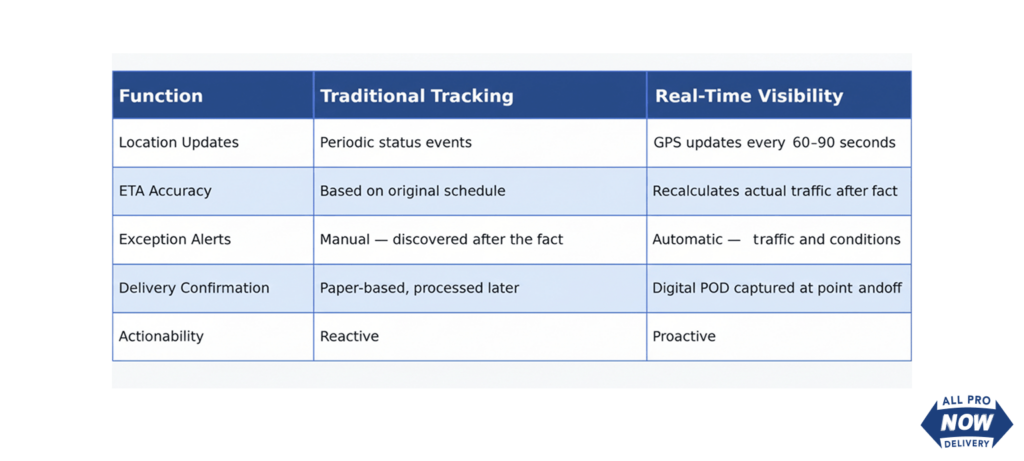
Real-time shipment visibility answers the fundamental question: where is my freight? Traditional transportation operated on periodic status updates. Drivers called dispatch from truck stops reporting progress. Customers received departure and arrival notices days apart with minimal information in between.
Modern transportation management provides continuous tracking through GPS technology and mobile applications. Businesses monitor shipment locations, estimated arrival times, and route progress in real-time. Automated notifications alert stakeholders when pickups complete, deliveries approach, or exceptions occur.
This visibility benefits multiple parties. Customers can plan receiving operations knowing when freight will arrive. Sales teams answer customer questions about order status without calling dispatch. Transportation managers identify delays early taking corrective action before service failures occur.
All Pro Now provides complete tracking for Ohio and Florida deliveries. Customers receive tracking links when shipments depart. GPS shows driver location and estimated arrival time. Digital proof of delivery confirms completion with timestamps, signatures, and photos.
Transportation Management Systems Technology
Transportation management systems (TMS) software centralize planning, execution, and analysis functions in unified platforms. These systems evolved from manual spreadsheets and phone-based coordination to sophisticated cloud-based applications.
Planning and Optimization Tools
TMS planning modules analyze shipment requirements recommending optimal transportation approaches. They evaluate factors including shipment size, destination, urgency, freight class, and special handling needs. The system suggests appropriate carriers, vehicle types, and routing based on these parameters.
Load consolidation identifies opportunities combining multiple smaller shipments into single vehicles. A Columbus warehouse ships three separate LTL orders to Tampa on Tuesday. TMS recognizes all three shipments can be consolidated into one truckload, reducing costs 40% versus separate LTL charges.
Network modeling simulates different transportation strategies evaluating costs and service impacts. Should we ship direct from Ohio factories to Florida customers or route through a Tampa distribution center? TMS models both scenarios comparing transportation costs, transit times, and inventory implications.
Execution and Tracking Capabilities
Execution modules manage day-to-day transportation operations. Electronic tendering sends shipment details to carriers digitally replacing phone calls and faxed documents. Automated booking confirms capacity and schedules pickups. Mobile applications enable drivers to receive dispatch instructions, navigate routes, and confirm deliveries without manual paperwork.
Integration with carrier systems enables seamless information exchange. When carriers provide tracking updates, TMS captures this data automatically. Customers access current status without transportation managers manually requesting updates.
Exception management identifies and escalates problems requiring intervention. If a delivery runs late or a carrier cannot provide capacity, TMS alerts appropriate personnel. Automated workflows notify customers about delays and suggest alternative solutions.
Analytics and Reporting Functions
Analytics modules transform operational data into actionable insights. Transportation managers review carrier performance comparing on-time delivery percentages, damage rates, and service quality across providers. This analysis supports carrier selection decisions and contract negotiations.
Cost analysis identifies spending patterns and optimization opportunities. Which lanes generate the highest transportation costs? Where do accessorial charges occur most frequently? What seasonal variations affect freight spending? Answering these questions enables targeted improvement initiatives.
Freight auditing reports highlight billing discrepancies and recovery opportunities. The system flags charges exceeding negotiated rates, duplicate invoices, or services not actually provided. Systematic auditing recovers 2-5% of freight spend for many businesses.
Industry Applications of Transportation Management
Different industries use transportation management differently based on their specific product characteristics and customer requirements.
Manufacturing and Industrial Distribution
Manufacturing operations require precise transportation timing coordinating inbound materials with production schedules and outbound finished goods with customer orders. Just-in-time manufacturing depends on reliable parts delivery preventing production stoppages.
A Toledo automotive supplier receives components from 15 vendors supplying one assembly line. Each component must arrive exactly when needed—too early creates storage challenges, too late stops production. Transportation management coordinates inbound deliveries ensuring parts arrive sequenced to production requirements.
Outbound transportation moves finished products to customers on tight schedules. Automotive assemblies ship to manufacturers integrating them into vehicles. Delivery windows span 1-2 hours. Missing these windows forces expensive storage or production disruptions for receiving facilities.
Retail and E-Commerce Logistics
Retail distribution serves hundreds or thousands of store locations from regional distribution centers. Transportation management coordinates these complex multi-stop delivery routes ensuring products reach stores ready for customer purchase.
A Columbus retailer operates 50 Ohio stores replenished from one distribution center. Transportation management plans delivery routes visiting 10-15 stores daily. Routes balance even workload distribution across delivery days while ensuring every store receives products based on demand forecasts.
E-commerce fulfillment ships directly to consumer addresses requiring different transportation approaches. Individual parcels move via parcel carriers or courier services. Timing windows matter enormously—two-day delivery promises require precise transportation planning ensuring orders ship and deliver within promised timeframes.
Healthcare and Medical Supply Distribution
Healthcare transportation handles medications, medical devices, laboratory specimens, and supplies requiring special handling. Many products need temperature control. Some require chain of custody documentation. Others demand same-day delivery for urgent patient needs.
Cleveland hospitals receive pharmaceutical deliveries daily restocking medications for patient care. Transportation management ensures temperature-sensitive drugs maintain proper conditions throughout transit. Documentation proves regulatory compliance for controlled substances.
Laboratory specimen transportation connects physician offices with central testing facilities. Blood samples, biopsies, and diagnostic specimens require rapid transport and proper handling. Transportation management coordinates pickup routes collecting specimens from multiple offices delivering to labs within required timeframes for accurate testing.
Construction and Building Materials
Construction projects need materials delivered on specific schedules coordinating with contractor availability and project phases. A concrete pour requires cement arriving exactly when the crew is ready—too early and it starts hardening, too late and labor sits idle.
Cincinnati construction companies use transportation management coordinating deliveries across multiple job sites. A general contractor managing five projects needs different materials reaching each site on precise schedules. Transportation management tracks what goes where and when ensuring crews have required materials available when needed.
Oversized or overweight loads require specialized transportation and permitting. Steel beams, prefabricated building sections, and heavy equipment exceed standard truck dimensions. Transportation management coordinates specialized hauling securing necessary permits and planning routes avoiding low bridges or weight-restricted roads.
Regional Considerations for Ohio and Florida
Geography and infrastructure affect transportation management differently across regions. Ohio’s industrial economy creates different transportation patterns than Florida’s tourism and distribution focus.
Ohio Transportation Characteristics
Ohio’s manufacturing concentration generates substantial freight volume moving raw materials, components, and finished goods. Interstate highways—I-71, I-75, I-76, I-77, I-80, I-90—provide excellent connectivity. Cleveland, Columbus, and Cincinnati serve as major freight hubs with extensive warehouse and distribution infrastructure.
Winter weather significantly impacts transportation operations November through March. Snow reduces highway speeds. Ice makes loading and unloading hazardous. Accidents close routes requiring alternate routing. Transportation management builds weather contingencies into Ohio operations allowing additional transit time during winter months.
Rail and port access provide multimodal transportation options. Cleveland and Toledo ports handle Great Lakes shipping. Extensive rail networks connect Ohio manufacturers to national distribution. Transportation management leveraging multiple modes optimizes costs and service for different shipment types.
Florida Transportation Characteristics
Florida’s peninsula geography concentrates population along coasts with major markets in Miami, Tampa, Orlando, and Jacksonville. I-95, I-75, and I-4 handle enormous freight volumes. Long distances between cities affect transportation costs—Miami to Jacksonville spans 350 miles.
Tourism seasonality creates demand fluctuations. Winter months and holiday periods surge delivery volumes serving increased population and retail sales. Transportation management plans capacity and routing for these predictable seasonal patterns.
Hurricane season impacts transportation June through November. Major storms close roads, damage infrastructure, and disrupt operations. Transportation management monitors weather forecasts implementing contingency plans when storms threaten. This includes rerouting shipments, securing vehicles and freight, and communicating delays to customers.
Port infrastructure makes Florida a major import gateway. Miami, Jacksonville, Tampa, and Port Everglades handle container freight from Latin America, Caribbean, and Asia. Transportation management coordinates intermodal movements combining ocean freight with domestic trucking serving customers throughout the Southeast.
Selecting Transportation Management Partners
Businesses choosing transportation providers evaluate capabilities matching specific requirements. The decision involves multiple considerations beyond simple cost comparison.
Service Area Coverage
Verify providers serve required geographic areas. Regional carriers excel in specific markets but lack national coverage. National carriers provide broad geography but may offer less responsive service in secondary markets.
All Pro Now focuses on Ohio and Florida markets. Businesses shipping between Cleveland and Tampa, Columbus and Miami, or Toledo and Orlando receive specialized regional expertise rather than generic national service.
Technology and Integration Capabilities
Modern transportation requires digital integration. Can the provider’s systems connect to your order management or ERP platforms? Does tracking information flow automatically or require manual status requests? Can you access shipping history and analytics through online portals?
Evaluate tracking capabilities carefully. Real-time GPS tracking differs substantially from periodic status updates. Photo proof of delivery provides better documentation than signature-only confirmation. These technology differences affect operational visibility and exception management.
Industry-Specific Experience
Some shipments require specialized knowledge. Temperature-controlled pharmaceuticals need proper refrigeration and documentation. Hazardous materials demand certification and regulatory compliance. Oversized freight requires permitting expertise.
Choose providers demonstrating experience in your industry’s requirements. A transportation manager handling healthcare shipments understands HIPAA compliance and specimen handling protocols. A construction logistics provider knows permit requirements and route restrictions for oversized loads.
Performance Reliability
Request on-time delivery statistics and damage rate data. Reliable providers achieve 95%+ on-time delivery. Damage rates should remain under 1%. Service quality separates excellent providers from adequate ones—the difference matters when deliveries determine operational success.
Ask for customer references in similar industries or shipping similar products. A manufacturing company should request references from other manufacturers. An e-commerce business should speak with other retailers. These conversations reveal how providers handle challenges specific to your operational requirements.
All Pro Now Transportation Management Services
All Pro Now handles transportation management for Ohio and Florida businesses requiring reliable freight movement without managing complex carrier relationships. Our services cover same-day delivery, LTL shipping, courier services, and scheduled freight transportation.

We manage route planning considering traffic patterns, delivery windows, and vehicle capacity. Our Ohio routes account for winter weather and industrial congestion. Florida routes consider tourism traffic and seasonal demand variations.
Carrier coordination happens through our platform. Businesses submit shipment requirements specifying pickup location, delivery destination, freight details, and timing needs. We match appropriate vehicles to shipments and provide real-time tracking throughout transit.
Performance monitoring maintains 99% on-time delivery across Ohio and Florida markets. Our tracking systems capture pickup times, transit progress, and delivery completion. Customers access this information through web portals or mobile applications without calling dispatch for status updates.
Pricing includes all standard services—pickup within specified timeframes, optimized routing, real-time tracking, and digital proof of delivery. Our instant quote calculator shows exact costs before shipment commitment. No surprise fuel surcharges or hidden accessorial fees.
Ready to streamline transportation management in logistics for your Ohio and Florida operations? Visit AllProNow.net to get instant quotes, schedule shipments, and access real-time tracking. Our platform handles freight transportation across Cleveland, Columbus, Toledo, Tampa, Miami, and Orlando with transparent pricing and reliable service.