Supply chain logistics is the engine that moves products from suppliers to customers. It coordinates procurement, inventory management, warehousing, transportation, and delivery into one flowing system. When these pieces work together smoothly, businesses deliver products reliably, manage inventory efficiently, and serve customers well.
Modern supply chain logistics uses technology to connect different parts of the operation. Procurement systems communicate with inventory tracking. Warehouse management coordinates with transportation scheduling. The result: visibility across the entire product journey and the ability to make informed decisions quickly.
Companies implementing integrated supply chain logistics see measurable improvements. On-time delivery rates reach 95%+. Order fulfillment becomes 35% faster. Stockouts decrease by 65%. These improvements come from better coordination and real-time information flow.
At All Pro Now, we handle supply chain logistics across Ohio and Florida daily. Businesses in Cleveland, Columbus, Toledo, Tampa, Miami, and Orlando use our integrated platform for reliable delivery. Our experience spans manufacturing, retail, e-commerce, and distribution—each with unique logistics requirements.
This guide explains what supply chain logistics includes, how the components work together, and practical approaches that deliver consistent results.
What Supply Chain Logistics Actually Covers
Supply chain logistics encompasses every activity moving products from raw materials to customer delivery. It’s the coordination layer connecting suppliers, manufacturers, warehouses, carriers, and customers.
Think of it as a relay race. Each runner (procurement, warehousing, transportation) must perform well individually. But the handoffs between runners determine overall success. Supply chain logistics manages both individual performance and smooth handoffs.
Core components working together:
Procurement and supplier management handle vendor relationships and inbound materials. This includes selecting suppliers, negotiating contracts, placing orders, and tracking deliveries. A Cleveland manufacturer working with 50 suppliers needs systems tracking each vendor’s performance, lead times, and quality standards.
The key is maintaining reliable supplier relationships. When suppliers understand your needs and delivery requirements, they prioritize your orders appropriately. Regular communication and performance tracking build these relationships.
Inventory management balances stock levels against demand. The goal: have products available when needed without carrying excess stock. Supply chain logistics uses demand forecasting, safety stock calculations, and reorder point triggers to maintain optimal inventory levels.
Modern inventory systems track products in real-time. You know exactly what’s in each warehouse, what’s in transit, and what’s committed to customer orders. This visibility enables better decisions about purchasing, allocation, and fulfillment.
Warehousing and distribution store products strategically and prepare them for shipment. Location matters—warehouses positioned near customers enable faster delivery. Layout optimization helps workers pick orders efficiently. Material handling equipment moves products safely.
A Tampa retailer serving Florida customers benefits from warehouse space near major population centers. Products reach Miami, Orlando, and Jacksonville quickly. The warehouse layout guides workers along efficient picking routes, increasing productivity.
Transportation management coordinates freight movement across modes—trucks, trains, ships, planes. It handles carrier selection, route planning, freight consolidation, and shipment tracking. The objective: move products efficiently while meeting delivery commitments.
Technology plays a major role here. Transportation management systems compare carrier rates, optimize routes considering traffic and weather, and provide real-time shipment visibility. Customers track their orders from pickup through delivery.
Order fulfillment and delivery execute customer orders accurately and on time. Warehouse workers pick the correct items, packers secure them properly, and carriers deliver as promised. Each step requires precision and coordination.
All Pro Now specializes in this final delivery stage across Ohio and Florida. Our same-day delivery, courier services,LTL freight, and parcel delivery integrate with customer order systems. Real-time tracking keeps customers informed throughout delivery.
Reverse logistics handles returns, repairs, and recycling. Products sometimes flow backward from customers to facilities. Efficient reverse logistics processes returns quickly, recovers value from returned products, and maintains customer satisfaction during the return experience.
How Supply Chain Logistics Components Connect
The real power of supply chain logistics comes from integration. When components share information and coordinate activities, the whole system performs better than isolated parts.
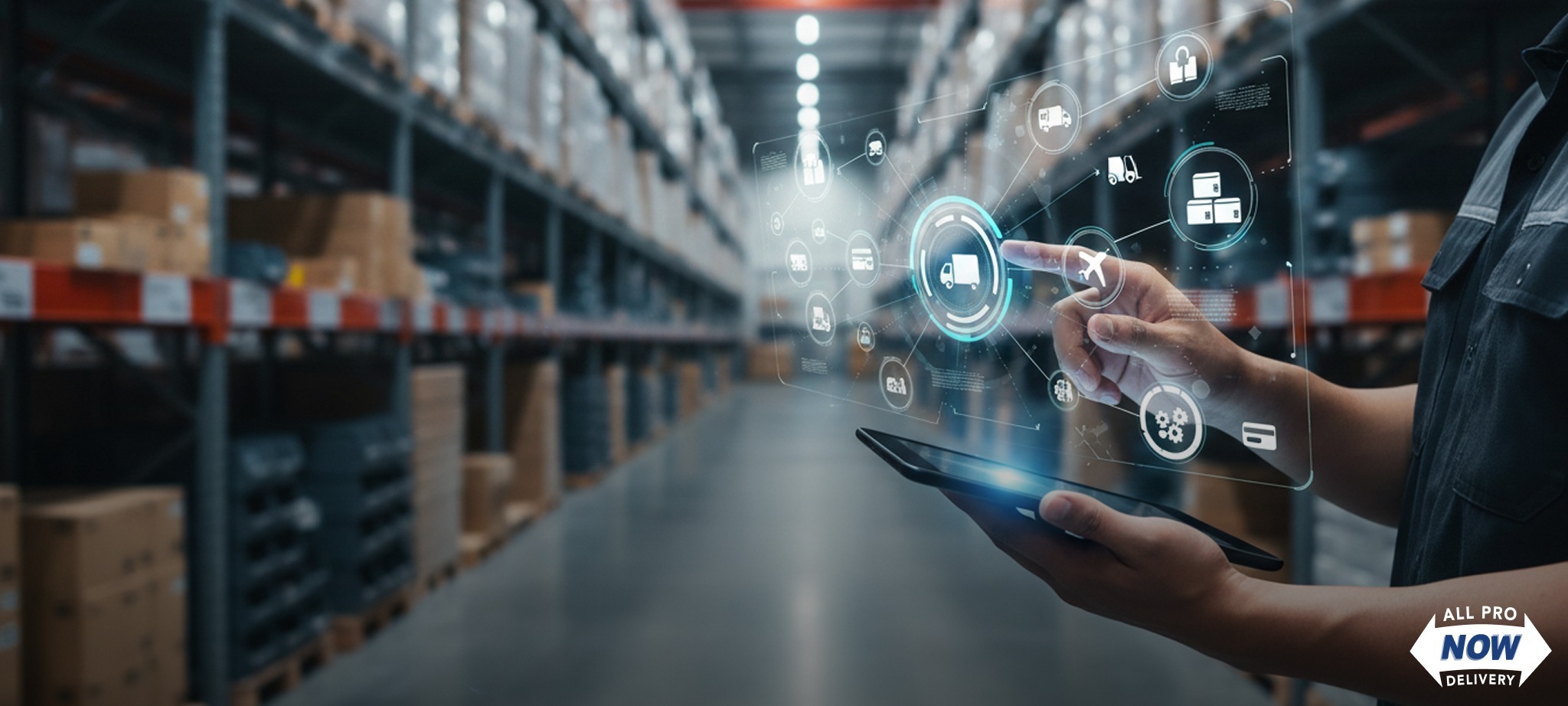
Information flows create visibility
Modern supply chain logistics operates on data. Procurement systems share supplier delivery schedules with inventory management. Inventory systems alert warehouses about incoming shipments. Warehouse systems notify transportation about orders ready to ship. Transportation updates order management with delivery confirmations.
This information flow creates visibility across the supply chain. Managers see inventory positions, shipment status, and delivery performance in real-time. They can identify issues early and respond proactively.
A Columbus manufacturer integrated their supplier portal with internal inventory systems. When suppliers confirm shipment dates, the inventory system automatically updates expected arrival times. Warehouse staff prepare receiving areas in advance. Production scheduling knows exactly when materials will be available.
Coordinated planning improves performance
When supply chain logistics components plan together, they make better decisions. Sales forecasts inform procurement about future material needs. Warehouse capacity planning considers incoming shipment volumes. Transportation scheduling accounts for order fulfillment timing.
This coordination prevents surprises. Warehouses aren’t caught off-guard by unexpected shipment volumes. Transportation has trucks available when orders need shipping. Procurement orders materials with sufficient lead time.
Technology enables integration
Cloud-based platforms connect different supply chain logistics systems. APIs enable real-time data exchange. Shared databases provide single sources of truth. Automated workflows trigger actions across systems.
A Toledo distributor uses integrated platforms connecting their order management, warehouse management, and transportation management systems. When customers place orders online, the warehouse system receives picking instructions automatically. Once orders are packed, the transportation system schedules pickups without manual intervention. Customers receive tracking information immediately.
Supply Chain Logistics Strategies That Work
Different businesses need different supply chain logistics approaches. Manufacturing operations require different strategies than retail distribution. Understanding your specific needs guides strategy development.
Just-in-Time Logistics
Just-in-time (JIT) logistics minimizes inventory by coordinating deliveries precisely with production or sales needs. Materials arrive exactly when needed, not days or weeks early. This approach reduces inventory carrying costs and warehouse space requirements.
JIT requires reliable suppliers and transportation. A Cleveland automotive manufacturer uses JIT for component deliveries. Suppliers deliver multiple times daily based on production schedules. Transportation must be precise—early deliveries create storage issues, late deliveries stop production.
All Pro Now supports JIT operations with same-day delivery and precise scheduling across Ohio. Manufacturers receive components exactly when production lines need them.
Cross-Docking Operations
Cross-docking moves products directly from inbound to outbound transportation with minimal warehouse storage. Products arrive at distribution centers, get sorted, and ship to final destinations within hours. This speeds delivery and reduces warehouse space needs.
Retail distribution centers often use cross-docking for store replenishment. Suppliers deliver full truckloads to the distribution center. Workers sort products by destination store. Outbound trucks depart the same day carrying mixed products for each store location.
A Tampa distribution center uses cross-docking for 60% of inventory. Products spend less than 12 hours in the facility. This approach serves 40 retail locations across Florida with faster replenishment than traditional warehousing.
Multi-Modal Transportation
Multi-modal transportation combines different shipping modes—truck, rail, ocean, air—to optimize cost and speed. Long-distance freight might travel by rail, then transfer to trucks for final delivery. International shipments combine ocean freight with domestic trucking.
Each mode has advantages. Rail handles large volumes cost-effectively over long distances. Trucks provide flexibility and door-to-door service. Ocean freight moves international cargo economically. Air freight delivers urgently when needed.
Supply chain logistics coordinates these mode changes efficiently. A Cleveland importer receives container freight through East Coast ports. Rail transports containers to Ohio. Local trucks deliver to warehouses and customers. The combination costs less than all-truck service while meeting delivery requirements.
Technology Powering Modern Supply Chain Logistics
Digital tools enable supply chain capabilities that manual processes can’t match. Real-time tracking, automated coordination, and predictive analytics transform how supply chains operate.
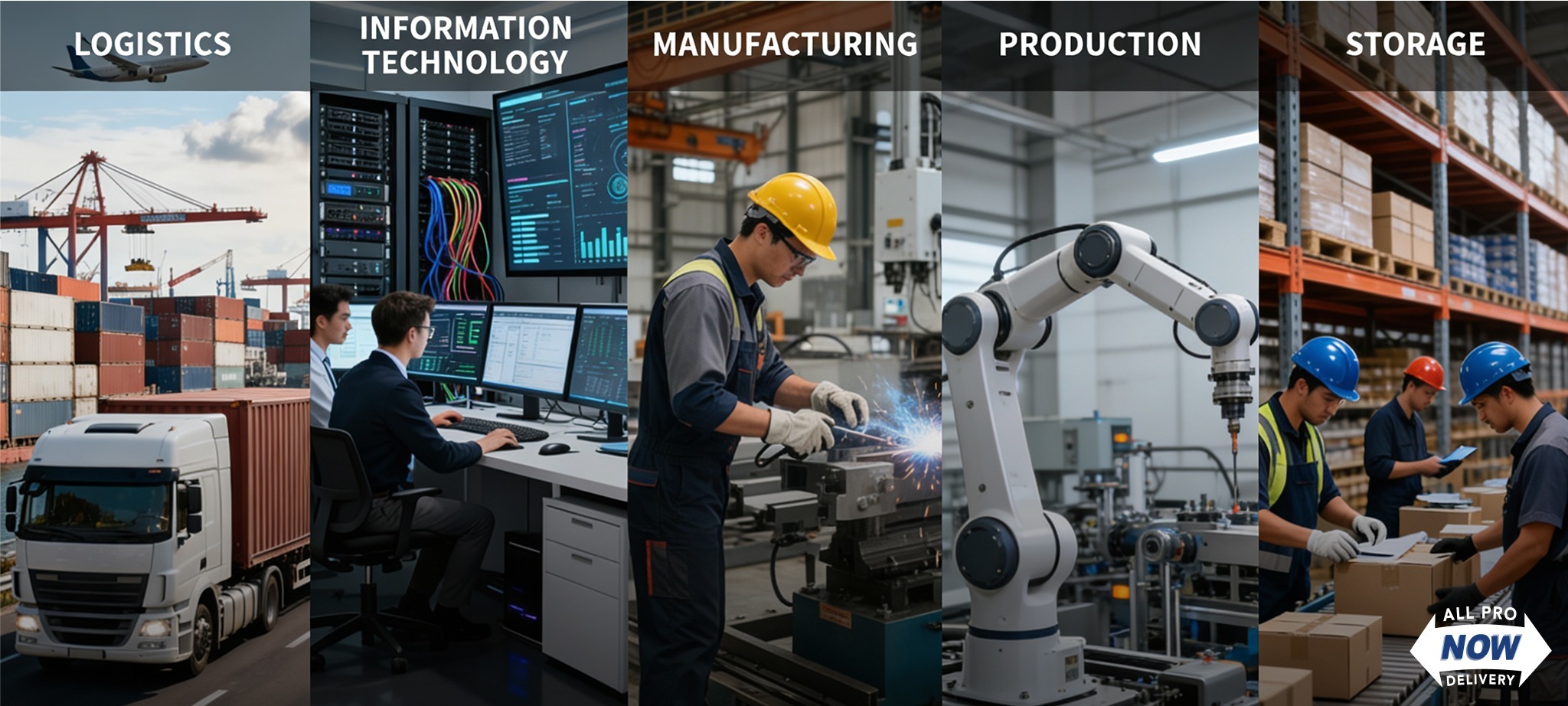
Transportation Management Systems (TMS)
TMS platforms optimize carrier selection, route planning, and freight auditing. They compare rates across carriers instantly, identify cost-effective options, and track shipments in real-time.
Modern TMS systems integrate with warehouse management and order management platforms. When orders are ready to ship, the TMS automatically selects carriers and schedules pickups. Tracking updates flow to customers without manual intervention.
All Pro Now’s transportation management integrates with customer systems across Ohio and Florida. Businesses schedule pickups, track deliveries, and access proof of delivery documentation through our platform.
Warehouse Management Systems (WMS)
WMS platforms optimize storage locations, picking routes, and labor allocation. They direct workers to exact product locations, suggest efficient picking paths, and manage inventory accuracy.
Modern WMS uses mobile devices and barcode scanning. Workers receive picking instructions on handheld devices. Scanning verifies correct items at each step. The system tracks inventory movements in real-time.
A Columbus distribution center implemented WMS and increased picking productivity 35%. Workers follow optimized routes through the warehouse. The system prevents picking errors through verification scanning.
Demand Forecasting Analytics
Predictive analytics improve demand forecasting accuracy. AI analyzes historical sales data, seasonal patterns, promotional impacts, and market trends. Forecasts become more accurate as systems learn from results.
Better forecasting enables optimal inventory positioning. You stock the right products in the right quantities at the right locations. Stockouts decrease while excess inventory reduces.
Demand Forecasting Accuracy Impact
| Forecasting Method | Typical Accuracy | Inventory Optimization | Service Level |
| Manual/Spreadsheet | 65-75% | Limited | 85-90% |
| Statistical Models | 75-85% | Good | 90-95% |
| AI/Machine Learning | 85-90% | Excellent | 95-98% |
| Integrated Real-Time | 90-95% | Optimal | 98%+ |
Internet of Things (IoT) Tracking
IoT sensors monitor products throughout supply chains. GPS trackers show real-time locations. Temperature sensors verify proper conditions for refrigerated goods. Shock sensors detect handling issues.
This monitoring enables proactive management. A Florida pharmaceutical distributor uses temperature sensors on all shipments. The system alerts teams if readings exceed safe ranges. They resolve issues before products are compromised.
Cloud-Based Integration Platforms
Cloud platforms connect different supply chain systems without expensive custom development. APIs enable real-time data exchange. Shared databases provide accurate information across the supply chain.
Implementation happens faster than traditional enterprise software. A Toledo manufacturer deployed cloud-based integration in six weeks. They connected order management, warehouse management, and transportation systems into unified visibility.
Supply Chain Logistics Components That Drive Results
Effective supply chain logistics requires multiple systems working in harmony. Each component plays a specific role, but the integration between them creates the real value.
Demand Forecasting and Planning
Accurate demand forecasting prevents both stockouts and overstock situations. Modern systems analyze historical sales data, seasonal patterns, market trends, and promotional calendars to predict future demand.
AI-powered forecasting reduces prediction errors by 30-50% compared to manual methods. A Columbus retailer reduced forecasting error from 28% to 12% after implementing predictive analytics. This accuracy eliminated $180,000 in excess inventory while cutting stockouts 65%.
Demand Forecasting Accuracy Impact
| Forecasting Method | Average Error Rate | Excess Inventory | Stockout Frequency | Annual Cost Impact |
| Manual/Spreadsheet | 25-35% | High | Frequent | Baseline |
| Statistical Models | 15-25% | Moderate | Occasional | 20% reduction |
| AI/Machine Learning | 10-15% | Low | Rare | 40% reduction |
| Integrated Real-Time | 5-10% | Minimal | Very Rare | 60% reduction |
Supplier Relationship Management
Strong supplier relationships reduce lead times, improve quality, and lower costs. Supply chain logistics systems track supplier performance across multiple metrics:
- On-time delivery percentage
- Order accuracy rates
- Quality defect rates
- Response time to issues
- Pricing competitiveness
- Innovation contribution
A Cleveland manufacturer working with 30 suppliers implemented supplier scorecards. They identified three suppliers consistently missing delivery windows. After switching to more reliable alternatives, their production delays dropped 40%. The cost of production disruptions fell from $35,000 monthly to $12,000.
Warehouse Management Systems
Modern warehouse management systems (WMS) optimize storage locations, picking routes, and labor allocation. They tell workers exactly where to find items, the fastest path through the warehouse, and how to pack orders efficiently.
Warehouse productivity improves 30-40% with proper WMS implementation. A Tampa distribution center increased picking rates from 80 units per hour to 115 units per hour. The same staff handled 43% more volume without overtime costs.
Transportation Management Systems
Transportation management systems (TMS) automate carrier selection, route optimization, and freight auditing. They compare rates across carriers instantly, identify the most cost-effective options, and track shipments in real-time.
TMS implementations typically reduce transportation costs 8-15%. A Toledo logistics company cut shipping expenses from $480,000 annually to $410,000 by optimizing carrier selection and route planning. The $70,000 savings came from eliminating rush fees and consolidating shipments.
Real-Time Visibility and Tracking
Supply chain visibility means knowing where products are at every moment. GPS tracking shows truck locations. Warehouse systems report inventory positions. Order management systems track fulfillment status.
This visibility enables proactive problem-solving. Instead of customers calling to ask “where’s my order,” systems automatically send updates. When delays occur, operations teams reroute shipments before customers notice problems.
All Pro Now provides complete visibility across our Ohio and Florida network. Customers track shipments from pickup through delivery. Real-time alerts notify them of exceptions before they become issues.
Regional Supply Chain Logistics Considerations
Geography and infrastructure affect supply chain strategies differently across regions. What works in Ohio’s industrial corridor needs adjustment for Florida’s tourism-driven economy.
Ohio Supply Chain Characteristics
Manufacturing density creates complex supply chains with multiple tiers of suppliers. Automotive, aerospace, and industrial equipment manufacturers coordinate hundreds of component deliveries daily. Just-in-time manufacturing demands precision timing—parts arrive exactly when production needs them.
Winter weather disrupts supply chains November through March. Snow closes highways. Ice delays deliveries. Road salt damages vehicles. Supply chain logistics systems must build weather contingency plans into Ohio operations.
A Youngstown manufacturer implemented weather-triggered inventory buffers. When forecasts predict major snow events, the system automatically increases safety stock for critical components. This eliminated three production shutdowns that previously cost $65,000 each.
Port access through Lake Erie and railroad connections enables international shipping. Supply chains move container freight from overseas suppliers through Cleveland and Toledo ports. Coordinating customs clearance, drayage, and inland transportation requires integrated logistics systems.
Florida Supply Chain Characteristics
Tourism seasonality creates dramatic demand swings. Orlando, Tampa, and Miami see population surges during winter months and holiday periods. Retail supply chains must stock up before peak seasons while avoiding excess inventory afterward.
A Jacksonville retailer implemented seasonal demand planning that increased pre-season inventory 40% while reducing post-season clearance merchandise 55%. This balance improved gross margin 8% annually.
Hurricane preparedness affects supply chain planning June through November. Smart logistics systems track storm predictions and trigger contingency plans automatically. This includes moving inventory inland, securing additional carrier capacity, and communicating with customers about potential delays.
Port infrastructure makes Florida a major import gateway. Miami, Jacksonville, and Tampa ports handle container freight from Latin America, Caribbean, and Asia. Supply chains leveraging these ports need customs expertise and multimodal transportation coordination.
Fresh produce and perishables flow through Florida supply chains year-round. Temperature-controlled warehousing and transportation require specialized handling. Time sensitivity increases—delays spoil products.
Supply Chain Logistics Integration Strategies
Moving from disconnected vendors to integrated supply chain logistics requires strategic planning. Companies that rush implementation often create more problems than they solve.
Start with visibility gaps
Identify where you currently lack information. Can you see real-time inventory levels across all locations? Do you know exact carrier locations for in-transit shipments? Can you predict stockouts before they happen?
Map information flows through your supply chain. Document where data gets entered manually, transferred between systems, or simply lost. These gaps represent integration opportunities.
A Columbus manufacturer mapped their order-to-cash process and discovered data got manually re-entered into systems six times. Each re-entry created error risk and consumed 4.5 hours daily. Integrating systems eliminated five re-entry points and recovered 25 hours weekly.
Connect procurement and inventory systems
When purchasing systems communicate with inventory management, reordering happens automatically at optimal times. Stock levels trigger purchase orders. Lead times factor into reorder calculations. Supplier delivery performance influences safety stock levels.
This integration eliminates the manual monitoring that causes stockouts. Systems work continuously while buyers focus on strategic vendor relationships instead of daily reorder decisions.
Integrate warehouse and transportation
Warehouse management systems should communicate directly with transportation management. When orders get picked and packed, the TMS receives immediate notification. Carriers get scheduled automatically. Tracking updates flow to customers without manual intervention.
A Tampa distribution center integrated their WMS and TMS, reducing average order processing time from 36 hours to 12 hours. The improvement came from eliminating manual data transfer between systems.
Build end-to-end visibility
Customer-facing systems should show order status from placement through delivery. Updates should flow automatically as products move through the supply chain. Customers see when orders are picked, packed, shipped, and delivered without asking.
All Pro Now’s platform provides this visibility for deliveries across Ohio and Florida. Customers track shipments in real-time. Automated alerts notify them of exceptions. Digital proof of delivery confirms completion.
Implement data analytics
Integrated supply chain logistics generates enormous data volumes. Analytics systems turn this data into actionable insights:
- Which suppliers consistently deliver late?
- Which products generate highest margins?
- Which routes cost most per mile?
- Which customers order most profitably?
- Which inventory turns fastest?
Supply Chain Performance Metrics Dashboard
| Metric | Current Performance | Industry Benchmark | Gap | Priority |
| On-Time Delivery | 87% | 95% | -8% | High |
| Order Accuracy | 94% | 98% | -4% | Medium |
| Inventory Turnover | 6.2x | 8.5x | -2.3x | High |
| Fill Rate | 91% | 96% | -5% | High |
| Perfect Order Rate | 82% | 92% | -10% | Critical |
| Days Sales Outstanding | 42 days | 35 days | +7 days | Medium |
| Transportation Cost % | 8.2% | 6.5% | +1.7% | High |
A Cincinnati company analyzed their supply chain data and discovered 15% of SKUs generated 60% of margin while consuming only 25% of inventory investment. They shifted inventory allocation toward these high-performing products, improving overall profitability 12%.
Technology Powering Modern Supply Chain Logistics
Digital transformation enables supply chain capabilities impossible with manual systems. Companies adopting these technologies gain competitive advantages that compound over time.
Cloud-Based Integration Platforms
Cloud platforms connect disparate systems without expensive custom coding. APIs enable real-time data exchange between procurement, warehouse, transportation, and order management systems.
Implementation happens faster than traditional enterprise software. A Toledo manufacturer deployed cloud-based integration in six weeks versus six months for on-premise systems. They connected five previously separate systems into unified supply chain visibility.
Internet of Things (IoT) Sensors
IoT sensors track conditions throughout supply chains. Temperature sensors monitor refrigerated shipments. Shock sensors detect handling damage. GPS trackers show real-time locations.
This monitoring enables proactive intervention. A Florida pharmaceutical distributor uses temperature sensors on all shipments. When readings exceed safe ranges, the system alerts operations teams immediately. They contact carriers to resolve issues before products spoil. This prevented $120,000 in product losses during the first year.
Artificial Intelligence and Machine Learning
AI optimizes supply chain decisions too complex for manual analysis. Machine learning identifies patterns in historical data, predicting future outcomes with increasing accuracy.
Route optimization AI processes real-time traffic, weather, and delivery window constraints. It recalculates optimal routes continuously as conditions change. A Miami delivery company reduced route miles 18% using AI optimization versus manual planning.
Demand forecasting AI analyzes seasonal patterns, promotional impacts, and market trends. Prediction accuracy improves continuously as models learn from results.
Blockchain for Supply Chain Transparency
Blockchain creates immutable records of transactions and movements. Every party in the supply chain can verify product authenticity, origin, and handling history.
This transparency matters enormously for high-value goods, regulated products, and international shipments. A Cleveland aerospace parts manufacturer uses blockchain to verify component origins and certifications. This eliminated documentation delays costing 2-3 days per shipment.
Robotic Process Automation
RPA handles repetitive tasks like data entry, invoice processing, and status updates. Bots work 24/7 without errors or breaks.
A Columbus logistics company automated their freight invoice auditing using RPA. The process previously required 15 hours weekly from an accounting clerk. The bots now process invoices continuously, flagging only exceptions for human review. This freed the clerk for higher-value work while improving audit accuracy.
Common Supply Chain Logistics Failures to Avoid
Even well-intentioned supply chain improvements can backfire without careful implementation. These mistakes appear repeatedly across industries.
Optimizing individual functions instead of the whole system
Companies often optimize procurement costs without considering inventory impacts. They negotiate bulk purchase discounts that require six months of inventory. The carrying costs exceed the purchase savings.
Warehouse managers minimize labor costs by reducing staff, increasing order processing time. Delayed fulfillment creates customer service problems that cost more than the labor savings.
Supply chain logistics requires system-level optimization. The goal isn’t the lowest procurement cost or warehouse expense—it’s the lowest total cost to serve customers profitably.
Ignoring lead time variability
Average lead times mislead. A supplier with 15-day average lead time might deliver in 10 days sometimes and 25 days other times. That variability forces higher safety stock than a supplier with consistent 18-day lead times.
Supply chain logistics systems should track lead time standard deviation, not just averages. Safety stock calculations must account for variability.
A Toledo manufacturer switched from a vendor with 12-day average lead time (8-day standard deviation) to one with 16-day average (2-day standard deviation). Despite longer average delivery, the consistency reduced safety stock requirements 30%.
Underinvesting in supply chain technology
Manual processes scale poorly. A company managing supply chains with spreadsheets and phone calls struggles when order volume doubles. Adding staff increases costs proportionally without improving accuracy or speed.
Technology investments scale efficiently. The same systems handle 10,000 orders as easily as 1,000 orders. Per-order costs decline as volume grows.
Companies that delay technology adoption find themselves squeezed between competitors with lower costs and customers demanding better service. The technology gap becomes competitive disadvantage.
Failing to measure supply chain performance
“You can’t improve what you don’t measure” applies directly to supply chain logistics. Without metrics, you can’t identify problems or verify improvements.
Track these critical KPIs:
- On-time delivery percentage
- Order accuracy rate
- Inventory turnover ratio
- Days sales outstanding
- Cash-to-cash cycle time
- Perfect order percentage
- Fill rate by SKU
- Transportation cost as percentage of sales
A Miami distributor started tracking perfect order rate—orders delivered complete, on-time, undamaged, with correct documentation. Their initial measurement: 78%. After implementing supply chain improvements targeted at root causes, perfect order rate reached 94%. Customer complaints dropped 65%.
Neglecting supplier relationships
Technology can’t replace strong vendor relationships. Suppliers who understand your business provide better service, faster problem resolution, and innovation collaboration.
Regular supplier performance reviews, collaborative planning sessions, and transparent communication build partnerships that survive disruptions. During COVID-19 shutdowns, manufacturers with strong supplier relationships got priority for limited capacity. Those treating suppliers purely transactionally got deprioritized.
How All Pro Now Supports Supply Chain Logistics
Integrated supply chain logistics requires reliable transportation and delivery partners. All Pro Now connects businesses across Ohio and Florida with delivery services that support efficient supply chain operations.
Our same-day delivery, courier services, LTL freight, and parcel delivery integrate seamlessly with customer supply chain systems. Real-time tracking provides visibility from pickup through delivery. Automated alerts notify customers of exceptions before they impact operations.
We understand regional supply chain requirements. Cleveland manufacturers need just-in-time delivery precision. Tampa retailers require seasonal capacity flexibility. Miami importers need customs coordination. Orlando distribution centers demand high-volume handling.
Our technology platform integrates with customer TMS and WMS systems. Pickup requests flow automatically from your systems to our dispatch. Delivery confirmations update your order management systems immediately. No manual data entry required.
Supply Chain Integration Benefits
Companies using All Pro Now for supply chain logistics report measurable improvements:
- 95%+ on-time delivery across Ohio and Florida markets
- 30% reduction in emergency freight costs through reliable service
- Real-time visibility eliminating “where’s my order” calls
- Flexible capacity handling seasonal volume surges
- Regional expertise navigating weather and traffic challenges
A Columbus manufacturer integrated All Pro Now into their supply chain for customer deliveries. Same-day delivery capability reduced their finished goods inventory 25%. Customers received orders faster while the manufacturer carried less stock. Working capital improved $340,000.
Get Instant Pricing with Our Online Calculator
All Pro Now offers an instant price calculator on our website. Enter your pickup location, delivery address, package details, and desired delivery speed to get accurate pricing in seconds.
The calculator shows exactly what your delivery will cost based on distance, service type, package size, and current demand. No hidden fees. No surprise charges. Book instantly or call our team for custom supply chain logistics partnerships.
Building Resilient Supply Chain Logistics
Supply chain disruptions will happen. COVID-19 proved this dramatically. Hurricanes, strikes, bankruptcies, and geopolitical events disrupt even well-managed supply chains.
Resilience comes from building flexibility into supply chain logistics:
Multiple suppliers for critical components prevent single points of failure. When one supplier faces problems, others absorb volume.
Geographic diversification reduces regional risk. A tornado affecting one warehouse doesn’t stop operations if inventory exists in multiple locations.
Excess capacity buffers allow handling demand surges without service failures. This costs more than running at maximum capacity constantly but prevents lost sales during peak periods.
Scenario planning prepares teams for disruptions before they occur. War-gaming supply chain failures identifies response strategies in advance.
A Jacksonville distributor developed hurricane response protocols after Hurricane Irma disrupted operations for 12 days. The protocols included:
- Inventory repositioning 72 hours before landfall predictions
- Generator fuel reserves for warehouse operations
- Alternative carrier relationships for flooded routes
- Customer communication templates for delivery delays
When Hurricane Ian hit, these protocols activated automatically. The company maintained operations throughout the storm while competitors shut down. Customers remembered this reliability during purchasing decisions the following year.
The Future of Supply Chain Logistics
Supply chain logistics continues evolving rapidly. Technology advances create new capabilities while global complexity demands better coordination.
Artificial intelligence will handle increasingly complex decisions. AI already optimizes routes and forecasts demand. Future applications include autonomous procurement, self-adjusting inventory policies, and predictive risk management.
Autonomous vehicles will transform last-mile delivery economics. Self-driving trucks reduce labor costs while enabling 24/7 operations. Delivery drones reach remote locations faster than ground transportation.
Sustainability requirements are reshaping supply chain strategies. Customers and regulations demand reduced carbon emissions. Electric vehicles, optimized routing, and freight consolidation minimize environmental impact while often reducing costs.
Nearshoring and reshoring are reversing decades of offshore manufacturing trends. Supply chains become shorter and more responsive but require different logistics infrastructure.
Real-time supply chain networks will replace batch-based operations. Instead of daily inventory updates, systems will track every unit continuously. Instead of weekly production schedules, manufacturing will respond to real-time demand signals.
These changes favor companies investing in integrated supply chain logistics now. The technology platforms, process improvements, and organizational capabilities developed today enable rapid adaptation to future innovations.
Take Control of Your Supply Chain Reliability
Supply chain logistics integration transforms unreliable operations into systems that consistently deliver on promises. Companies implementing coordinated procurement, warehousing, and delivery see on-time delivery rates improve from 80% to 95%+, stockouts drop 65%, and customer satisfaction scores climb significantly.
All Pro Now provides same-day delivery, courier services, LTL freight, and parcel delivery across Ohio and Florida. Our technology platform integrates with customer supply chain systems, providing real-time visibility and coordinated execution that keeps business commitments.
Whether you’re managing manufacturing supply chains in Cleveland, retail distribution in Tampa, or e-commerce fulfillment in Miami, reliable logistics determines whether you keep customer promises.
Ready to improve your supply chain reliability? VisitAllProNow.net to get instant quotes, book shipments, and learn how our supply chain logistics capabilities support consistent delivery performance. Use our instant price calculator for transparent pricing with no hidden fees. Let’s help you deliver on your promises.