
A delivery gets assigned. Then reassigned. The driver cancels. The replacement shows up with the wrong vehicle. Now the load doesn’t move. Your dock schedule slips. Your customer is waiting on an ETA you can’t confirm.
Supply chains across the U.S delays like this don’t stay contained. They trigger reschedules, idle labor, and missed delivery windows. In manufacturing environments, downtime can cost thousands of dollars per hour.
This is where the GoShare vs AllProNow decision stops being a platform comparison and becomes a question of execution reliability in modern last mile delivery services and B2B logistics operations.
Both services move freight. But they operate on fundamentally different service models, and that difference shows up immediately when shipments involve strict timelines, defined capacity, or time-sensitive delivery requirements.
This blog breaks down how each platform actually performs across service types, what you can expect in real operating conditions, and how to choose based on risk, not just availability.
GoShare vs AllProNow: Service Model Breakdown
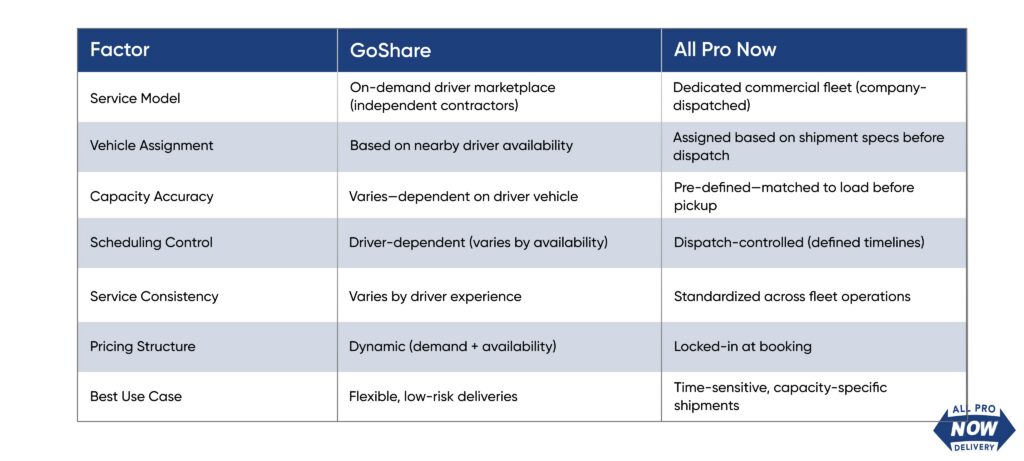
Interpretation:
This is not a feature of delivery service comparison. It’s a control vs flexibility decision. If your shipment has downstream dependencies, variability turns into operational risk.
Service Scope: Breadth vs Execution Discipline
AllProNow: Focused, Operational Execution
AllProNow operates as a dedicated fleet delivery service, designed for businesses that require consistent execution across time-sensitive and scheduled logistics operations.
Core services include:
- Same-day and time-critical delivery
- Scheduled route distribution for repeat lanes
- Direct, point-to-point freight movement
- B2B logistics across manufacturing, healthcare, and construction
Operational coverage spans:
- Ohio: Cleveland, Akron, Columbus, Cincinnati, Toledo
- Michigan: Detroit, Grand Rapids, Saginaw
- Indiana: Indianapolis
- Pennsylvania: Pittsburgh
- Florida: Jacksonville, Orlando, Tampa, Fort Myers, Miami
In these markets, delivery is often tied to:
- Production schedules
- Medical timelines
- Job site sequencing
This model prioritizes:
- Defined capacity before dispatch
- Direct routing without intermediate stops
- Consistent execution across shipments
The advantage is predictability. It’s built for operational reliability; not casual, one-off deliveries.
GoShare: Broad, On-Demand Coverage
GoShare operates as an on demand delivery service built on a driver marketplace model, connecting businesses with independent contractors based on availability. The platform connects users with independent drivers who can fulfill requests with minimal lead time.
Typical use cases include:
- Last-mile delivery for retail and furniture
- Store-to-customer or warehouse-to-store transfers
- Small business logistics support during demand spikes
- Light freight movement and courier-style runs
- Optional labor for loading and unloading
This model works best when requirements are not rigid. For example, a furniture retailer in Los Angeles managing overflow deliveries or a small warehouse in Dallas needing same-day movement of boxed inventory.
However, execution depends heavily on the driver:
- Vehicle type may vary
- Experience levels are inconsistent
- Handling standards are not uniform
The advantage is flexibility. The trade-off is control.
Availability and Coverage: Access vs Assurance
| Scenario | GoShare | AllProNow |
| Urban delivery during peak hours | High availability | High availability |
| Off-peak or late-day booking | Variable | Controlled dispatch |
| Industrial zones / job sites | Limited in some areas | Active fleet coverage |
| Repeat route consistency | Not guaranteed | Structured and repeatable |
What this means in practice:
GoShare performs well in dense metro areas where driver supply is high. If you’re booking mid-day in a major city, availability is usually strong.
That model starts to break when:
- Booking late in the day
- Operating outside city centers
- Requiring specific vehicle types
AllProNow approaches this differently. It doesn’t rely on available drivers; it deploys from an active fleet within defined regions.
In markets like Detroit, Cleveland, and Tampa, this matters.
A delayed parts delivery in Detroit can stop a production line.
A missed delivery window in Tampa can idle a full construction crew.
The difference is not access.
It’s whether the shipment moves as planned when timing matters.
Capacity and Load Handling: Variability vs Precision
| Requirement | GoShare | AllProNow |
| Small item / single-piece delivery | Strong fit | Supported |
| Furniture / appliances | Strong fit | Supported |
| Multi-pallet shipment | Inconsistent | Designed for it |
| Weight-specific freight | Depends on driver vehicle | Pre-defined capacity |
What this means in practice:
Most failures in freight delivery services don’t happen in transit. They happen at pickup.
With GoShare, capacity depends on the driver who accepts the job. That introduces variability at the exact point where precision matters most.
Common failure points include:
- Vehicle arriving under capacity
- Load dimensions exceeding available space
- Weight limits not matching requirements
When that happens, the shipment doesn’t get delayed; it gets reassigned or canceled.
AllProNow removes that variable by aligning the vehicle to the shipment before dispatch.
- Sprinter vans are deployed for smaller, urgent loads
- Straight trucks are assigned for multi-pallet or heavier freight
This reduces:
- Failed pickups
- Re-dispatch cycles
- Schedule breakdowns at the dock
In structured logistics, capacity mismatch doesn’t cause delays; it stops the shipment entirely.
Scheduling and Execution: Flexible Windows vs Defined Timelines
| Factor | GoShare | AllProNow |
| On-demand booking | Strong | Strong |
| Time-specific delivery | Limited control | High control |
| Multi-stop coordination | Driver-dependent | Planned routing |
| Deadline-sensitive delivery | Risk increases | Designed for it |
What this means in practice:
GoShare is optimized for flexibility. You can request deliveries quickly, but execution depends on driver response and availability.
This works when delivery windows are broad. It breaks down when delivery timing is tied to operations.
Challenges arise when:
- A facility has strict receiving hours
- A team is scheduled around delivery arrival
- Delays trigger operational impact
According to Baymard Institute, nearly 23% of online shoppers abandon purchases due to slow or unclear delivery timelines.
AllProNow operates against defined timelines. Dispatch aligns with delivery requirements, not just availability.
This ensures:
- Better adherence to time windows
- Fewer rescheduling events
- More reliable coordination with receiving teams
The difference becomes visible when timing is not negotiable.
Pricing Model: Market-Based vs Predictable
| Factor | GoShare | AllProNow |
| Pricing structure | Dynamic | Fixed at booking |
| Rate predictability | Variable | High |
| Best fit | One-off deliveries | Repeat or planned logistics |
What this means in practice:
GoShare pricing fluctuates based on:
- Demand levels
- Driver availability
- Time of booking
This can work for occasional deliveries where cost comparison is simple.
However, for businesses running repeat shipments, variability introduces planning challenges.
AllProNow offers pricing that is:
- Defined upfront
- Stable across similar shipments
- Easier to budget over time
This allows operations teams to:
- Forecast logistics costs
- Compare cost vs operational impact
- Avoid unexpected pricing shifts
The decision here is not just cost; it’s predictability.
Use Case Alignment: Matching the Model to the Situation
Choose GoShare When:
- Delivery timing is flexible
- Load size is small or variable
- You need occasional, on-demand support
- Cost sensitivity outweighs execution risk
Choose AllProNow When:
- Delivery timing affects operations
- Load capacity must be exact
- You need repeatable performance
- Delays create measurable business impact
Key insight:
Misalignment between use case and service model is the most common source of delivery failure.
Industry Fit: Where Each Model Performs Best
| Industry | GoShare Fit | AllProNow Fit |
| Retail & furniture | Strong for local delivery | Strong for inventory flow control |
| E-commerce | Flexible fulfillment | Priority and recovery shipments |
| Manufacturing | Limited reliability | Core use case |
| Healthcare | Basic courier tasks | Time-sensitive delivery |
| Construction | Small material runs | Scheduled and critical deliveries |
What this means in practice:
As operations become more structured, the need for control increases.
- Retail can tolerate flexibility
- Manufacturing cannot
- Healthcare requires traceability
- Construction depends on timing
This is why the comparison between the two models’ decision shifts depending on industry context.
Choosing the Right Model Based on Failure Impact
Choose GoShare when failure leads to:
- Minor delays
- Customer annoyance (no operational impact)
- Rescheduling without cost consequences
Example:
A delayed furniture delivery to a customer → inconvenient, but manageable
Choose AllProNow when failure leads to:
- Operational disruption
- Idle labor or halted workflows
- Missed production timelines
- Financial loss
Example:
A missing part in a Detroit plant → production line stops
A delayed delivery in Tampa → crew sits idle for the day
It’s not about how fast you need the delivery; it’s about what happens if it doesn’t show up.
Final Decision: Control or Flexibility
The GoShare vs AllProNow comparison is not about which platform offers more.
It’s about choosing a reliable delivery service for your business based on operational risk; not convenience.
- GoShare: flexible, accessible, suited for low-risk deliveries
- AllProNow: controlled, predictable, built for execution
If your shipment can tolerate variability, a flexible network works.
If your shipment is tied to schedules, labor, or customer commitments, variability becomes risk.
Choose based on what failure costs; not what the delivery costs.
If your shipments involve strict timelines, defined capacity, or operational dependencies, the delivery model you choose matters.
AllProNow operates a dedicated fleet across key U.S. markets, supporting time-sensitive and business-critical deliveries with consistent execution.
Get a real-time quote based on your pickup and delivery requirements at allpronow.net and move forward with a delivery model built for reliability.