A missed delivery doesn’t just delay a shipment. It stops a production line, fails a patient waiting on medical supplies, or leaves a construction crew without materials for the day’s pour. The phrase “expected delivery” carries real weight for businesses, yet most shippers treat it as a soft promise with no teeth.
Understanding what does expected delivery mean is the first step to building a freight strategy that actually holds. For manufacturers in Cleveland, healthcare facilities in Tampa, and construction crews in Pittsburgh, the gap between a carrier’s estimate and a real, scheduled delivery window can cost thousands in downtime.
This blog breaks it down completely, what the term means, why estimates shift, what the data says about carrier accuracy, and when a guaranteed same-day alternative makes more sense than guessing.

Key Takeaways
- Expected delivery is an estimate, not a guarantee, carriers use projection language deliberately; only premium services carry a money-back commitment.
- The formula is simple: Processing Time + Transit Time, both legs must run on schedule for the estimate to hold.
- “Expected Delivery by 9 PM” is a route window, not your delivery time, it means the driver aims to finish all stops by 9 PM, not that your package arrives at 9 PM.
- “Out for Delivery” is the real green flag, if that status isn’t showing, your package won’t arrive that day regardless of the stated window.
- Carrier on-time rates drop significantly during peak periods, USPS Ground Advantage fell to 90.4% OTP in December 2024, FedEx Ground to 91.8% (ShipMatrix).
- Estimated delivery and expected delivery are largely interchangeable, both are real-time projections, neither is a contractual commitment.
- Same-day dedicated freight is the only way to eliminate delivery uncertainty, a confirmed dispatch SLA replaces an estimate with a guarantee.
What Does “Expected Delivery” Actually Mean?
Every time a tracking portal displays a delivery date, it is making a projection, not a promise. Expected delivery is the carrier’s calculated estimate of when your package will reach its destination, based on two core variables:
Expected Delivery = Processing Time + Transit Time
Processing time covers how long the sender takes to prepare, pack, and hand the shipment off to a carrier. Transit time covers how long the carrier takes to move it from origin to destination. Both legs are subject to disruption.
Here’s what most businesses miss: only one major consumer service, USPS Priority Mail Express carries a money-back delivery guarantee. Every other standard service, whether USPS Ground Advantage, UPS Ground, or FedEx Ground, uses estimated language deliberately. There is no financial consequence to the carrier if the shipment arrives a day late.
That distinction is critical for any business running operations that depend on freight timing. An expected delivery date from a standard carrier is a probability forecast. When that forecast misses, the operational cost lands on you, not the carrier. Businesses that can’t absorb that risk need urgent shipping services built around confirmed dispatch windows, not carrier estimates.
The Real-World Accuracy Behind Carrier Estimates
This is where the numbers matter. According to ShipMatrix’s independent audit of millions of parcels during the 2024 peak shipping season:
- UPS Ground achieved 96.5% on-time delivery in December 2024, down from 98.7% in 2023
- FedEx Ground came in at 91.8% — a significant drop from 98.3% the prior year
- USPS Ground Advantage logged 90.4% on-time performance; excluding Parcel Select last-mile, it dropped to 84.7%
Performance improved across the board in the 2025 peak season, with UPS reaching 97.2%, FedEx Express at 95.3%, and USPS climbing back to 94.1%, according to ShipMatrix data published by FreightWaves. But peak season is exactly when freight matters most, and when carriers are most likely to miss.
For non-peak periods, carrier estimates are reasonably reliable. The problem for businesses is that operational urgency rarely aligns with low-volume shipping windows. Parts need to move on tight production timelines. Medical supplies don’t wait for clear weather. Construction materials have poured schedules.
| Carrier / Service | Peak 2024 OTP | Peak 2025 OTP | Delivery Guarantee? |
| UPS Ground | 96.5% | 97.2% | No |
| FedEx Ground | 91.8% | 95.3% | No |
| USPS Ground Advantage | 90.4% | 94.1% | No |
| USPS Priority Mail Express | ~98%+ | ~98%+ | Yes (money-back) |
| AllProNow Same-Day | 99% | 99% | Yes (operational SLA) |
Source: ShipMatrix (2025, 2026); AllProNow operational data
The takeaway is straightforward. Standard carrier estimates work well when a delayed shipment causes inconvenience. They fail businesses when a delayed shipment causes downtime.
The stakes are steep. According to Bringg’s 2026 Delivery Experience Study, 55% of shoppers stop buying from a brand after a single negative delivery experience. For B2B freight relationships, the consequences of a missed delivery are even more direct, chargebacks, production holds, and contract exposure.
What Does “Expected Delivery by 9 PM” Mean?
This is one of the most searched tracking questions in the country, and the answer is more nuanced than it appears.
When USPS (or a similar carrier) displays “Expected Delivery by 9:00 PM,” it means the carrier intends to complete all stops on that local delivery route before 9 PM. The message refers to the route’s completion window, not to your specific package’s arrival time.
In practice, the vast majority of residential deliveries on a typical route arrive between 10 AM and 5 PM. The 9 PM window exists to account for the worst-case scenario on high-volume or understaffed days. Here’s how to read it accurately:
If your tracking does not show “Out for Delivery”, the package has not reached your local distribution hub. It will almost certainly not arrive that day, regardless of the stated window.
If your tracking shows “Out for Delivery”, the package is loaded onto a vehicle and is on an active route. It should arrive before route completion, though that could be anywhere from mid-morning to late evening depending on where your stop falls on the driver’s sequence.
If it’s after 9 PM and the package hasn’t arrived, wait until midnight before taking action. Some routes run long. If the package shows no delivery scan by the following morning, contact the carrier directly and file a missing mail search request if USPS is involved.
For businesses managing freight in cities like Cleveland, Columbus, Indianapolis, or Tampa, this ambiguity is not a planning tool. “Expected delivery by 9 PM” tells you it will probably arrive today. It doesn’t tell you when, or with any contractual certainty that it will. That’s a meaningful operational limitation for time-sensitive freight. See how AllProNow’s same-day delivery eliminates that uncertainty with confirmed dispatch and real-time GPS tracking from pickup to drop.
What Does “Expected Delivery” Mean on Cash App?
The same phrase appears in a completely different context when you’re using financial apps. On Cash App, “expected delivery” refers to when a money transfer or direct deposit is projected to post to your account.
Standard Cash App transfers use ACH (Automated Clearing House) processing, the same banking infrastructure that governs most electronic fund transfers. ACH transactions typically clear in 1–3 business days, depending on your bank’s processing schedule, cutoff times, and whether the transfer spans a weekend or holiday.
“Expected delivery” on Cash App reflects the system’s forecast of when funds will clear, not when they were sent. Like physical freight estimates, it is subject to banking system variables, federal holidays, weekend processing delays, and your specific bank’s ACH acceptance windows. Instant transfers on Cash App bypass ACH by using card networks, which is why they clear in minutes but carry a fee.
The principle mirrors freight logistics exactly: an estimate is a calculated projection based on known variables, with no guarantee of exact timing.
What Does “Estimated Delivery Today” Mean?
When a tracker updates to “Estimated Delivery: Today,” it is the carrier’s strongest positive signal short of a delivery confirmation. It generally means one of two things:
Scenario A: The package has cleared the regional sorting facility and arrived at a local distribution hub. It is likely already assigned to a route for the day’s deliveries.
Scenario B: The carrier’s algorithm using real-time GPS and package scan data has calculated high confidence that the shipment will reach its destination within the current calendar day.
This is meaningfully different from a future-date estimate. “Estimated delivery today” usually means your package is physically close. Most deliveries with this status arrive that day.
However, it still is not a guarantee. Route disruptions, vehicle breakdowns, driver availability issues, and missed scan points at busy hubs can cause a same-day delay. For businesses awaiting time-critical freight at locations in Detroit, Grand Rapids, Pittsburgh, or Miami, “estimated delivery today” is encouraging, but it is not a confirmed delivery window.
If you’re managing B2B freight that has to arrive today, a same-day courier service with a confirmed scheduled pickup and real-time tracking is the only way to actually know.
Why Expected Delivery Dates Change, and What Causes It
Delivery estimates are dynamic. Carriers update them in real time as packages move through the network. Understanding the common causes of estimated changes helps businesses plan around them.
Weather Disruptions: Snowstorms hitting Cleveland or Toledo, ice events across Indiana and Kentucky, and hurricane seasons affecting Tampa, Miami, and Orlando can disrupt regional carrier networks for 24–72 hours at a time. The carrier’s estimate updates when the disruption impacts routing.
High-Volume Surge Periods: During peak seasons, the U.S. parcel network handles over 100 million packages per day. ShipMatrix reports the industry delivered over 2.3 billion parcels during the 2025 peak season, a 5% increase from the prior year. When volume exceeds capacity, estimates slip.
Staffing Shortages: Labor availability directly affects sort speeds and route completion times at regional facilities. Facilities in Akron, Youngstown, Dayton, and Cincinnati have all experienced labor-related delivery delays during high-demand periods.
Incorrect or Incomplete Address Data: A wrong ZIP code, missing apartment number, or incorrect state triggers a manual review. That adds 1–3 business days before the package is re-routed.
Customs Clearance: Cross-border shipments are subject to inspection timelines entirely outside the carrier’s control. These delays are common on international freight lanes and rarely predictable.
Facility Backlogs: When a sorting hub in Detroit, Pittsburgh, or Indianapolis processes more packages than its daily throughput capacity, overflow packages are held and rerouted into the next day’s sorting cycle. This is one of the most common reasons businesses switch to a dedicated last-mile delivery service that bypasses the national carrier network entirely.
Expected Delivery vs. Estimated Delivery vs. Scheduled Delivery
These three terms are used interchangeably by many shippers, but they signal meaningfully different things.
| Term | What It Signals | Based On | Level of Certainty |
| Estimated Delivery | Projection from historical transit data | Past averages + distance | Low–Moderate |
| Expected Delivery | Real-time projection from current package location | Live scan data + route modeling | Moderate |
| Scheduled Delivery | Confirmed commitment made at time of booking | Dedicated dispatch + SLA | High |
“Estimated delivery” uses statistical modeling. “Expected delivery” adds real-time location data. Neither is a commitment.
“Scheduled delivery”, the kind you get when you book an expedited freight shipment with a dedicated carrier, is a confirmed window backed by an operational agreement. That’s what manufacturers, healthcare operators, and construction businesses in Ohio, Florida, Michigan, Indiana, Kentucky, Pennsylvania, and New York actually need when the stakes are real.
The Business Cost of Getting Expected Delivery Wrong
The financial exposure from delivery estimate failures is well documented. According to the Bringg 2026 Delivery Experience Study, 62% of consumers blame the retailer when deliveries arrive late, even when the carrier is responsible. For B2B relationships, the equivalent is contractual: missed delivery windows trigger chargebacks, compliance penalties, and supply chain disruptions.
Grand View Research values the U.S. same-day delivery market at $13.9 billion in 2026, growing at a 20.6% CAGR toward $29.8 billion by 2030. B2B freight accounts for 61.5% of same-day delivery demand, the dominant share. That tells you what the market already knows: businesses cannot afford to operate on standard carrier estimates when their freight is time-critical.
For industries where delivery timing is tied to production continuity, automotive manufacturing in Michigan, healthcare logistics in Florida, construction materials in Pennsylvania, expected delivery estimates are not a logistics plan. They’re a starting point that requires a backup.
When to Stop Relying on Expected Delivery Estimates
Standard carrier estimates are a legitimate planning tool for non-urgent freight. They become a liability when:
- A missed delivery triggers a production hold, shutdown, or safety incident
- The freight is medical or clinical in nature, with patient care implications
- A construction project has time-sensitive scheduled trades or pours
- The shipment is a replacement part for equipment already down
- The client has been promised a delivery window in a B2B contract
- Weather or seasonal volume make standard carrier estimates unreliable for the lane
AllProNow was built for exactly these situations. Operating a dedicated driver network, not a broker marketplace, across Ohio, Florida, Michigan, Indiana, Kentucky, Pennsylvania, and New York, AllProNow serves businesses in 25+ cities with confirmed same-day freight service. For businesses managing recurring critical lanes, managed logistics services bring additional structure and cost control on top of same-day execution.
Coverage includes: Cleveland, Columbus, Toledo, Akron, Youngstown, Dayton, Cincinnati, Detroit, Grand Rapids, Indianapolis, Pittsburgh, Philadelphia, Harrisburg, Tampa, Orlando, Miami, Jacksonville, Fort Lauderdale, and additional metro corridors across the seven-state network.
Industries served include healthcare and medical logistics (lab samples, equipment, supplies), manufacturing and industrial freight, B2B delivery services, construction material transport, retail and wholesale distribution, and automotive parts supply.
Service specs that matter for business operations:
- Pickup within 1–2 hours for rush orders; 2–3 hours for standard same-day
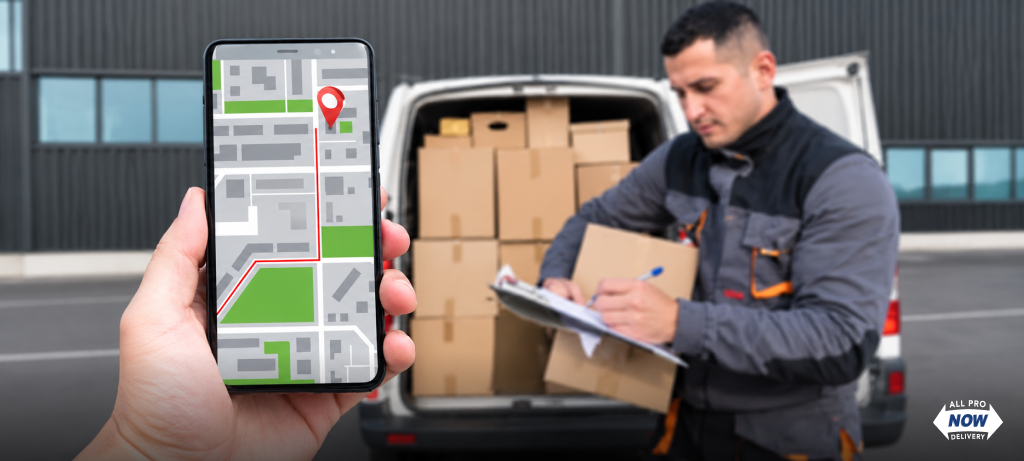
- Real-time GPS tracking with live ETA updates and driver status notifications
- Digital proof of delivery — photo, timestamp, and signature on every shipment
- 99% on-time performance across the seven-state network
- Flat-rate, transparent pricing — no hidden fees, no fuel surcharge surprises
What to Do When an Expected Delivery Doesn’t Arrive
Even reliable carriers miss their estimates. When a shipment is overdue, follow this sequence:
Step 1 — Check the tracking status: Confirm whether “Out for Delivery” ever appeared. If not, the package did not reach your local hub that day.
Step 2 — Wait 24 hours past the expected date: Some drivers complete routes after the stated window without updating tracking in real time. This is common on high-volume days.
Step 3 — Contact the carrier directly: Open a service inquiry with your tracking number. For USPS, submit a Missing Mail search request after 24 hours with no delivery scan.
Step 4 — Contact the sender: If the carrier cannot locate the package, the shipper must open a formal trace or claim. Most carriers require the shipper, not the recipient to initiate this process.
Step 5 — Assess your freight strategy: If this is a recurring issue on a specific lane, Cleveland to Detroit, Indianapolis to Cincinnati, Tampa to Orlando, that lane may need a dedicated same-day carrier instead of a standard estimate-based service. Learn more about AllProNow’s freight delivery services for these critical corridors.
Conclusion: What Does Expected Delivery Mean for Your Business?
Expected delivery means the carrier thinks your freight will arrive on a given date, under current conditions, based on historical data. It means nothing more than that.
For casual shipments, that’s fine. For freight tied to production schedules, patient care, construction timelines, or B2B contracts across Ohio, Florida, Michigan, Indiana, Kentucky, Pennsylvania, and New York, it is not enough.
The same-day delivery market is growing at over 20% annually because businesses have already figured this out. B2B freight accounts for the majority of that demand, driven by manufacturers, healthcare operators, and industrial supply chains that can no longer afford the variance of a standard carrier estimate.
AllProNow eliminates that variance. Pickup in 1–2 hours. Real-time GPS visibility. Digital proof of delivery. 99% on-time performance across 25+ cities in seven states. No estimates. No guessing. Just freight that arrives when you need it, from small parcel delivery to full LTL freight runs.
Get an instant quote or talk to the team about your critical freight lanes at AllProNow.