
Picking a warehouse partner is one of the biggest operational decisions a growing business makes. Get it wrong, and late orders pile up fast. That’s why knowing how to choose a 3PL provider matters more than most founders expect going in. The U.S. third-party logistics market reached $323.4 billion in gross revenue in 2025, according to supply chain research firm Armstrong & Associates, and 94% of domestic Fortune 500 companies now use at least one 3PL, up from just 46% in 2001. Outsourcing fulfillment isn’t a fringe strategy anymore. It’s the default.
At AllProNow, we don’t run warehouses ourselves, but we work every day alongside businesses that do, coordinating the freight, courier, and same-day delivery legs that connect a 3PL’s warehouse to the customer’s front door. That vantage point across seven states gives us a close-up view of what separates a 3PL that keeps promises from one that doesn’t. This blog turns that experience into a practical, step-by-step framework.
Key Takeaways
- How to choose a 3PL provider starts with mapping your own requirements before you talk to a single vendor.
- Capabilities, technology, and pricing transparency matter more than a flashy sales pitch.
- References and independent reviews reveal patterns a marketing deck never will.
- Industry fit and cultural fit predict long-term success better than price alone.
- AllProNow’s managed logistics and same-day delivery services can support your operation while you finalize a warehousing 3PL, across Ohio, Florida, Michigan, Indiana, Kentucky, Pennsylvania, and New York.
What a 3PL Provider Actually Does
A third-party logistics provider, or 3PL, handles warehousing, inventory, and order fulfillment on your behalf. It sits in the middle of a broader logistics spectrum defined by the Council of Supply Chain Management Professionals (CSCMP) and widely used across the industry.
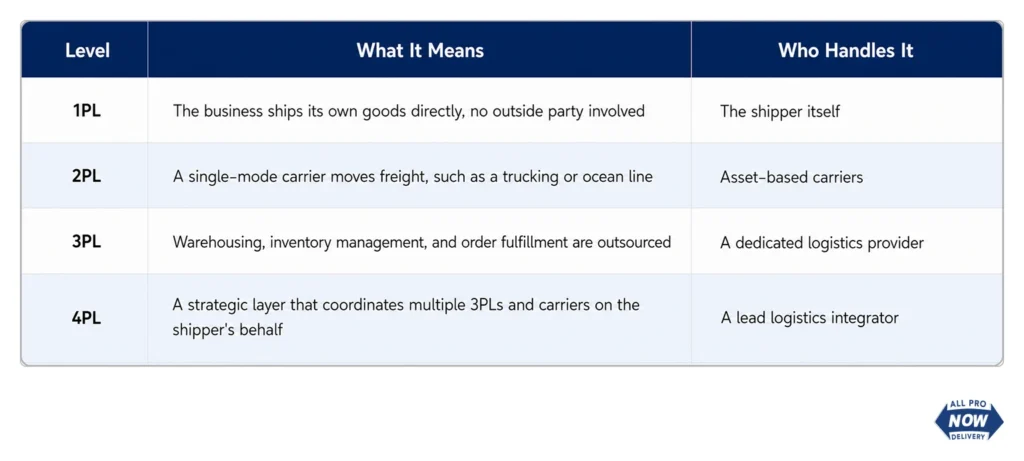
Understanding where a 3PL sits in that chain sets realistic expectations. A 3PL executes. It doesn’t usually manage your entire supply chain strategy the way a 4PL might. That distinction shapes what to ask candidates during evaluation, and it’s the foundation for how to choose a 3PL provider that actually matches your stage of growth.
Step 1: Map Your Requirements Before You Start Shopping
Before requesting a single quote, write down what your operation actually needs. Order volume per month. SKU count. Storage requirements, including any temperature control or hazmat handling. Inbound supply frequency. Last-mile delivery expectations.
This step gets skipped constantly. Business owners get excited and jump straight into vendor calls. Then every conversation turns into re-explaining the basics. A clear requirements list saves hours and produces quotes you can actually compare apples to apples.
Include growth plans too. If you sell fitness apparel today but plan to add supplements next year, ask now whether a candidate supports lot tracking and temperature control. Knowing how to choose a 3PL provider means picking a partner who can grow with you, not one you’ll outgrow in eighteen months.
Step 2: Check Industry Fit and Track Record
Not every 3PL fits every business. A provider built around grocery and CPG fulfillment may struggle with oversized industrial equipment or fragile freight. A provider comfortable with LTL freight and heavy pallets may be overkill for a small parcel-only apparel brand.
The table below shows how fulfillment needs differ by industry, based on patterns AllProNow sees across the retail, healthcare, and manufacturing shippers it serves in Ohio, Michigan, Indiana, and neighboring states.
| Industry | Typical Fulfillment Need | Why It Matters |
| Healthcare & Medical Supply | Temperature control, precise lot and expiration tracking | A missed cold-chain window can ruin inventory |
| Retail & E-Commerce | Fast pick-and-pack, multi-channel inventory sync | Late orders directly hurt customer reviews |
| Manufacturing & Industrial | Palletized storage, LTL freight coordination | Production delays cascade downstream fast |
| Legal & Professional Services | Secure handling, documented chain-of-custody | Compliance requirements, not just speed |
Ask candidates directly which industries make up most of their current client base, and request examples close to your own vertical. A 3PL with real experience in your space already understands your compliance requirements, seasonal spikes, and common failure points.
Step 3: Ask About Capabilities, Not Just Storage Space
Capabilities go far beyond “we have warehouse space.” Ask what happens as your product line expands. Does the facility support kitting, bundling, or custom packaging? Can it handle returns and RMAs? Does it support multiple sales channels, including Shopify, Amazon, and wholesale orders, from the same inventory pool?
Also ask about technology and integrations directly. Does their warehouse management system connect to your sales channels natively, or does it require custom development? Is there an in-house tech team available if something breaks? A lot of businesses focus purely on core fulfillment and overlook the technology stack. That’s a mistake, since nearly every modern order flows through some kind of software integration.
Step 4: Understand Requirements and Onboarding
Every 3PL has expectations of its clients too. Ask what’s required for a smooth first shipment. Do you need specific barcodes or case marking? Is a purchase order required for inbound freight? How does order data get uploaded, EDI, API, or manual entry?
Skipping this conversation is one of the most common mistakes shippers make. They’re excited to start and assume onboarding will sort itself out. It rarely does. Get the onboarding checklist in writing before signing anything.
Step 5: Get Real Numbers on Pricing and Resources
Pricing structures vary widely between 3PLs. Some charge simple per-order fees. Others break costs into receiving, storage, picking, packing, and shipping, each billed separately. Ask for a full breakdown, not just a headline rate.
Look beneath the price too. What labor rates are baked into the quote? What happens to pricing if your volume drops or spikes? A 3PL that can’t explain its cost structure clearly is harder to trust long-term. Sanity-check every quote against your actual order profile, not a generic example the sales team provides.
Step 6: Verify Performance Metrics and References
Most 3PLs already track internal metrics: on-time shipping percentage, average transit time, and ticket response time. Reputable providers share this data without hesitation. If a candidate is cagey about performance numbers, treat that as a warning sign.
References matter here too. Ask for at least one or two current clients you can contact directly. If a provider can’t offer any, that’s not automatically disqualifying, but it should prompt a closer look at independent reviews on Google or the Better Business Bureau. Search for recurring themes. If multiple reviews mention late shipments, ask the provider directly how that issue has been addressed. If reviews consistently praise account managers and responsiveness, that’s a strong signal of day-to-day service quality.
Step 7: Weigh Cultural Fit and Long-Term Partnership Potential
This step gets overlooked constantly, but it shouldn’t. A 3PL relationship often lasts years. You’ll be on calls with this team regularly, resolving issues, planning peak season, and adjusting to growth. If the working relationship feels combative or slow from day one, that pattern rarely improves.
Solution fit matters here too. Does the proposed setup realistically match your requirements, or does it feel forced to fit their existing operation? A good 3PL partner builds a solution around your business, not the other way around.
How to Choose a 3PL Provider: The Full Framework at a Glance
Here’s the entire process condensed into one reference table. Run every candidate through all seven checkpoints before deciding, and narrow your list early. Evaluating a dozen 3PLs in parallel is exhausting and rarely produces a clearer answer than evaluating three or four qualified finalists.
| Step | What to Confirm | Red Flag to Watch For |
| 1. Requirements | Volume, SKUs, storage, growth plans | You’re guessing at your own numbers |
| 2. Industry Fit | Relevant client examples in your vertical | Only generic case studies offered |
| 3. Capabilities & Tech | WMS integrations, kitting, returns handling | No in-house tech support |
| 4. Onboarding | Barcode, PO, and data upload requirements | Vague or undocumented onboarding process |
| 5. Pricing | Itemized cost breakdown by activity | Only a single bundled rate, no detail |
| 6. Performance & References | On-time %, damage rate, live references | Refuses to share performance data |
| 7. Cultural Fit | Responsiveness, solution flexibility | Rigid process, slow communication |
A tight, structured comparison process like this is genuinely how to choose a 3PL provider without wasting months on back-and-forth calls that go nowhere.

Where AllProNow Fits Into the Picture
Choosing a warehousing 3PL takes time, and most businesses still need freight and delivery moving in the meantime. That’s where AllProNow comes in. AllProNow operates across Ohio, Florida, Michigan, Indiana, Kentucky, Pennsylvania, and New York, covering more than 25 major cities including Cleveland, Columbus, Cincinnati, Detroit, Pittsburgh, and Tampa.
For businesses in healthcare, retail, manufacturing, and legal services, AllProNow’s managed logistics service functions as an outsourced logistics department: carrier management, lane planning, KPI reporting, and same-day dispatch, without the overhead of building that function in-house.
It’s a practical way to keep last-mile delivery and LTL freight running smoothly while you complete the longer process of vetting a warehousing 3PL. For shippers still working through how to choose a 3PL provider, pairing that search with a dependable regional delivery partner keeps operations steady in the meantime.
Final Thoughts: Choose Deliberately, Not Quickly
Rushing this decision is the single biggest mistake businesses make. Take the time to map requirements, verify capabilities, check references, and confirm pricing transparency before signing a contract. Knowing how to choose a 3PL provider isn’t about finding the cheapest option. It’s about finding the partner who fits your industry, your growth plans, and your day-to-day working style.
If your business operates in Ohio, Michigan, Indiana, Kentucky, Pennsylvania, New York, or Florida and needs dependable freight, courier, or managed logistics support alongside your 3PL search, AllProNow is ready to help. Get a personalized quote at allpronow.net and see how a seven-state regional network keeps shipments moving on schedule.