
Late shipments. Unanswered calls at 6 AM. A tracking portal that hasn’t updated in 36 hours. For thousands of businesses across Ohio, Michigan, Pennsylvania, Indiana, Kentucky, New York, and Florida, these aren’t just frustrations, they’re symptoms of a wrong logistics partnership. And the cost of getting it wrong is steep.
According to a Voxware survey, 65% of customers stop purchasing from a retailer after just two to three late deliveries. Meanwhile, last-mile delivery now represents 53% of total shipping costs, up from 41% in 2018, making your logistics partner the single biggest variable in your profitability equation.
Knowing how to choose the right logistics partner isn’t optional anymore. It’s a competitive advantage. This blog gives you a clear, honest framework for making that decision grounded in what actually matters in 2026.
Key Takeaways
- The wrong logistics partner doesn’t just cost you money, it costs you customers. 65% of buyers abandon after just two or three bad deliveries.
- Last-mile delivery represents 53% of total shipping costs. Who handles it, and how defines your margins.
- Real-time tracking, dedicated drivers, and transparent pricing are non-negotiable baselines in 2026, not premium features.
- Size fit matters. A provider where your contract is a top priority outperforms one where you’re a footnote.
- Reference checks work. Verify performance claims with real customers in your industry and region before signing anything.
Why Getting This Decision Right Has Never Mattered More
The logistics landscape in 2026 is demanding. U.S. delivery costs jumped an average of 12% from 2024 to 2025 alone. Surcharges from national carriers, residential delivery fees, fuel surcharges, extended area fees, routinely add 30–40% on top of quoted base rates before you see the final invoice. Driver turnover in the trucking sector averages 94% annually, creating chronic instability in carrier networks.
At the same time, customer expectations are rising, not softening. 98% of consumers say delivery experience directly impacts brand loyalty, and 63% will choose a different vendor if shipping takes longer than two days. Your logistics partner’s performance is your brand’s performance. That’s the reality businesses are navigating right now.
The good news: a deliberate, criteria-based process for how to choose the right logistics partner removes most of the guesswork. Here’s exactly what that process looks like.
1. Map Your Lanes Before You Evaluate Any Provider
The first step in how to choose the right logistics partner has nothing to do with the carrier. It starts with your own shipping map.
Before calling a single provider, document every pickup location, every delivery destination, and every corridor you run regularly. Then ask one blunt question of every candidate: do you actually serve all of these ZIP codes with your own drivers, or do you sub out to a broker for the hard ones?
Subcontracting the last mile introduces a third party you haven’t vetted with different service standards, different accountability, and no direct relationship with your business. For companies shipping between Cleveland and Detroit, Columbus and Pittsburgh, or across Florida’s distribution corridors, that gap is where service failures live.
A provider’s footprint needs to match your real freight map, not just their marketing coverage page.
2. How to Choose the Right Logistics Partner Based on Industry Experience
Not all freight moves the same way. A carrier experienced in hauling dry goods isn’t automatically equipped for time-critical lab specimens, pharmaceutical equipment with chain-of-custody documentation requirements, or construction materials on a job-site deadline.
The right question isn’t “do you serve my industry?” It’s “show me who you’re serving right now and let me call them.”
Providers worth considering should be able to name specific verticals they operate in, explain the operational nuances of handling that freight, and connect you with current customers in your region. Weak references, or none at all, tell you everything.
For businesses in industries like healthcare, manufacturing, retail, and e-commerce, the operational stakes of a wrong logistics partner compound faster than in others. A medical facility in Columbus or a manufacturer in Toledo can’t absorb a 3-hour delay the way a casual shipper can.
3. The Technology Standard for 2026: What to Demand From Any Logistics Provider
Minimum Technology Requirements for a Logistics Partner in 2026
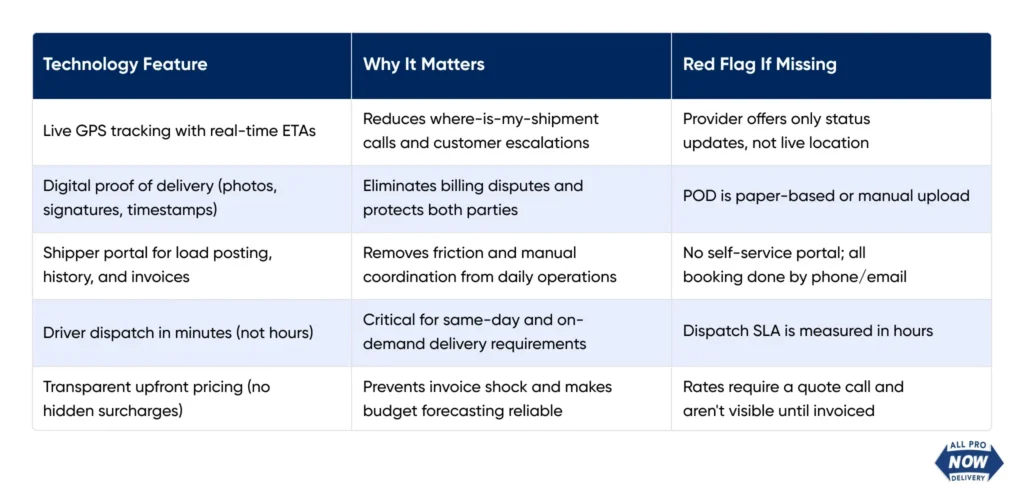
Technology is a signal about how a business is run, not just what it can do. A provider investing in a modern platform is a provider thinking about operational accountability. One that still runs on phone calls and paper manifests is carrying operational risk that will eventually become your problem.
AllProNow was built around this standard from day one, live GPS tracking, real-time ETAs, digital proof of delivery with automated uploads, and a shipper portal where businesses can post loads, view transparent pricing, and manage shipment history without making a single phone call.
4. Dedicated Driver Networks vs. Gig Platforms: A Distinction That Changes Everything
This is one of the most underappreciated factors when businesses evaluate how to choose the right logistics partner in 2026.
Gig-economy delivery platforms match loads to whoever is nearby and interested at that moment. Availability fluctuates with payout rates, platform competition, and individual driver schedules. The driver who handled a critical shipment last Tuesday may not be on the platform next Tuesday.
A dedicated driver network operates on a fundamentally different structure. Drivers are dispatched because it’s their job. Consistency, accountability, and route familiarity all compound over time, producing measurably better on-time rates and fewer exceptions.
Dedicated Driver Network vs. Gig Marketplace: Side-by-Side Comparison
| Evaluation Criteria | Dedicated Driver Network | Gig Marketplace |
| Driver availability consistency | High, drivers are committed employees or long-term contractors | Variable, depends on platform incentives that day |
| Route familiarity | Strong, repeat drivers know your lanes and facilities | Low, drivers may be unfamiliar with your pickup/delivery points |
| Accountability | Direct, one provider owns the outcome | Diluted, marketplace absorbs responsibility without guarantees |
| Performance tracking | Structured KPIs and reporting at the provider level | Difficult to measure across a rotating driver pool |
| Scalability at peak | Managed by provider with dedicated capacity | Dependent on marketplace supply at peak times |
| Best fit for | Time-sensitive, high-stakes, recurring freight | Occasional, low-stakes, flexible-timeline deliveries |
For retailers in Cleveland, healthcare operations in Columbus, and manufacturers in Pittsburgh, the consistency of a dedicated driver network translates directly into on-time metrics and customer satisfaction scores.
5. Pricing Transparency Is Not a Nice-to-Have: It’s a Red Flag Filter
National carrier surcharge inflation is real and accelerating in 2026. Residential delivery fees, dimensional weight penalties, fuel surcharges, extended area fees, and peak-season charges routinely add 30–50% on top of the base rate you’re quoted, a gap that surprises growing businesses every single invoice cycle.
When evaluating providers, ask for a fully loaded rate that includes all standard accessorials. If they can’t give you one upfront without a quote call, that’s meaningful data about how transparent the relationship will be.
For businesses operating consistent regional lanes, Cleveland to Detroit, Columbus to Pittsburgh, or across Florida’s Gulf and East Coast corridors, a provider with transparent, upfront pricing and no hidden fees isn’t just more convenient. It’s materially better for cash flow forecasting, margin planning, and operational trust.
6. How to Choose the Right Logistics Partner by Checking Performance, Not Pitches
Anyone can put strong numbers in a proposal. Your job during evaluation is to verify them, independently, before you sign.
Ask for the provider’s on-time delivery rate. Reliable regional carriers consistently achieve 95% or better. Ask about their freight damage claim rate. Ask for customer references specifically from your industry and your region. Then call those references and ask what happens when something goes wrong, not what happens when everything runs smoothly.
Questions worth asking reference customers directly:
- Has on-time performance improved, stayed flat, or declined over the past 12 months?
- How does the provider communicate when there’s a delay or exception?
- Is there a dedicated contact who knows your account, or do you work a general queue?
- Would you renew this contract without hesitation?
The answers reveal what a proposal never will.
7. Size Fit and Scalability: The Overlooked Variable
A national Tier 1 provider isn’t automatically the right answer, particularly for small and mid-sized regional businesses. Large carriers prioritize large customers. If your contract doesn’t rank near the top of their revenue concentration, your service levels may quietly reflect that reality.
The right partner is one where your business volume matters to them. Where feedback leads to changes. Where your dedicated contact knows your account before they pick up the phone.
At the same time, the provider needs real capacity to scale with you. Probe their fleet depth, their driver network size, and their ability to handle volume spikes without cannibalizing service on your regular lanes. Seasonal peaks, new product launches, and unexpected demand surges happen, your logistics partner needs a clear plan for absorbing them.
8. The Full Evaluation Checklist: How to Choose the Right Logistics Partner in 2026
Use this checklist across every provider you evaluate. The answers should be easy to get from any serious candidate. Difficulty or vagueness in answering is itself an answer.
Logistics Partner Evaluation Checklist
| Evaluation Area | What to Ask | What “Pass” Looks Like |
| Geographic Coverage | Do you own your drivers on all my lanes, or do you subcontract? | Direct coverage confirmed on all your active ZIP codes |
| Industry Experience | Who are your current clients in my industry and region? | Verifiable references you can call independently |
| Technology | Can I see a live demo of your platform and tracking system? | Self-service portal, live GPS, digital POD, real-time ETAs |
| Driver Model | Are your drivers employees/dedicated contractors or gig workers? | Dedicated network with consistent dispatch and accountability |
| Pricing Transparency | What is the all-in rate, including all surcharges? | Fully loaded rate available before signing, no hidden line items |
| Responsiveness | Who do I call if there’s a problem at 6 AM on a Saturday? | Named contact, not a general support queue or ticket system |
| On-Time Performance | What is your documented on-time delivery rate? | 95%+ supported by verifiable data, not just verbal claims |
| Scalability | How do you handle volume spikes during peak periods? | Clear capacity plan with documented backup protocols |
AllProNow: Built for Regional Businesses That Can’t Afford the Wrong Partner
AllProNow operates across a seven-state footprint, Ohio, Michigan, Pennsylvania, Indiana, Kentucky, New York, and Florida, covering 25+ major cities including Cleveland, Columbus, Toledo, Akron, Detroit, Pittsburgh, Louisville, and key metros across Florida. With over 50 years of logistics experience and 100,000+ shipments delivered, AllProNow serves retailers, manufacturers, medical facilities, construction firms, legal and financial services companies, and e-commerce businesses.
The model is built around what regional businesses actually need: a dedicated driver network, transparent upfront pricing, live GPS tracking, digital proof of delivery, and a shipper portal that puts control in your hands, not a hold queue. For businesses managing consistent freight lanes who need a logistics partner that takes accountability seriously, AllProNow is built for that relationship. Get a rate estimate directly at AllProNow.
How to Choose the Right Logistics Partner Comes Down to One Standard
Your logistics partner’s performance is your customers’ experience. Every shipment they handle either reinforces or undermines the promise you’ve made to the people and businesses that depend on you.
In 2026, with delivery costs rising, customer expectations tightening, and surcharge inflation compounding, the standard for how to choose the right logistics partner is clear: dedicated drivers, real-time visibility, transparent pricing, verified performance, and a size fit that means your business actually matters to them.
Don’t rush this decision because the pressure to move freight is real. Take the time to run the checklist, call the references, and demand a live platform demo. The right partner makes your entire operation more competitive. The wrong one shows up, quietly and expensively, in your on-time metrics, your customer churn rate, and your margin reports.
Ready to evaluate AllProNow for your lanes? Visit AllProNow to get a rate estimate or connect with the team.