
Millions of Americans are searching for stable, flexible work, and the delivery industry is one of the few sectors actively hiring at scale. With over 1.5 million delivery driver jobs already filled in the United States and more than 171,400 new openings projected annually through 2034, the path into this career is more accessible than most people realize. The challenge isn’t opportunity, it’s knowing exactly how to find delivery driver jobs that match your schedule, skills, and income goals.
This blog covers how to find delivery driver jobs from where to search and what employers actually look for, to realistic pay ranges and how to advance into local truck driving roles, every step is laid out clearly. Whether you’re in Cleveland, Detroit, Columbus, Pittsburgh, Tampa, or anywhere across the Midwest and beyond, the right delivery driver job is closer than you think.
Key Takeaways
- The U.S. Bureau of Labor Statistics projects 8% employment growth for delivery truck drivers from 2024 to 2034 much faster than the average for all occupations.
- The median annual wage for light truck drivers is $44,140 (BLS, May 2024). Driver/sales workers earn a median of $37,130.
- Nearly 21.7 billion parcels were shipped across the United States in 2023, creating sustained demand for last-mile drivers.
- The U.S. last-mile delivery market was valued at $32.61 billion in 2024, growing at a projected CAGR of 8.4% through 2030.
- A valid driver’s license and a clean driving record are the only hard requirements for most entry-level delivery driver jobs.
- Flexibility is a major benefit many drivers choose 3–4 day work weeks and build income around personal projects or second jobs.
Why Delivery Driver Demand Is Growing And Not Slowing Down
U.S. e-commerce sales reached approximately $1.1 trillion in 2023, a 7.6% increase year-over-year (U.S. Census Bureau). Every dollar spent online creates a delivery need, and human drivers handle the overwhelming majority of last-mile fulfillment. Autonomous vehicles are advancing, but industry experts from the Bureau of Labor Statistics confirm they will not displace human drivers in any meaningful way within the next decade.
What this means practically: driver shortages are real, and they’re consistent. In markets like northeast Ohio, Detroit, Pittsburgh, and across Florida, logistics companies actively compete for dependable drivers. Healthcare facilities need medical couriers daily. Manufacturers need same-day freight runs to keep production lines moving. Retailers need package delivery to fulfill online orders. These aren’t seasonal spikes, they’re structural demand patterns baked into the modern supply chain.
Driver salaries reflect this demand. Over the last five years, delivery driver wages have increased 21%. That trend is supported by both private industry data and BLS wage surveys, and it’s expected to continue as e-commerce volumes keep climbing.
Delivery Driver Job Types: Know What You’re Applying For
Before learning how to find delivery driver jobs, it helps to understand the different categories. Each has distinct requirements, pay structures, and daily realities.
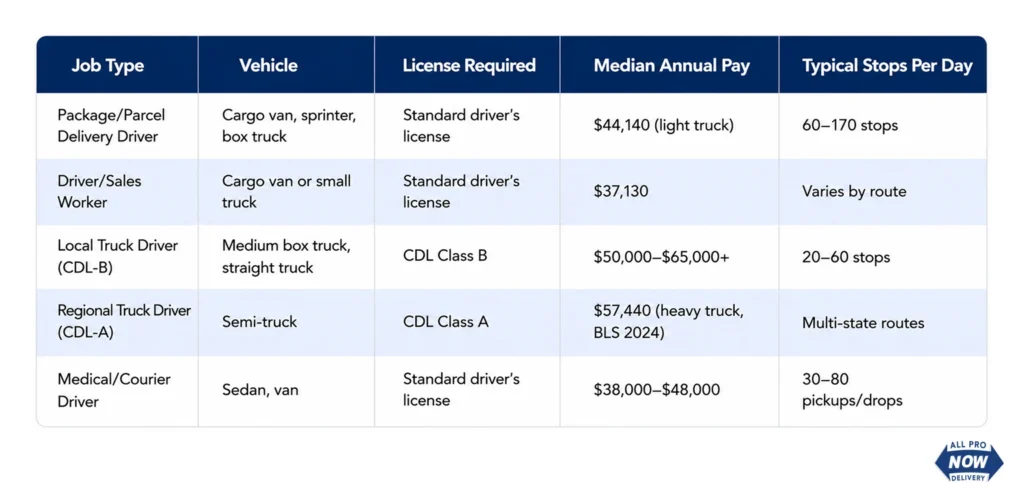
Sources: U.S. Bureau of Labor Statistics Occupational Outlook Handbook, May 2024 wage data.
Understanding which category aligns with your current license and experience sets the right expectations from the start. Most people entering the field begin with parcel delivery or courier roles, no CDL required, training is short, and routes are local.
How to Find Delivery Driver Jobs: Step-by-Step
Step 1: Pull Your Driving Record First
Before submitting a single application, request your driving record from your state’s DMV. Every employer in this industry runs a motor vehicle report (MVR) during onboarding. Knowing what’s on your record prevents surprises and lets you address anything in advance. Most carriers require no DUIs and no major violations within the past three to five years.
Step 2: Build a Minimal But Targeted Resume
A strong delivery driver resume doesn’t need to be long. Focus on driving experience (personal or professional), any time spent in physically demanding roles, familiarity with navigation or logistics apps, and customer interaction experience. Real drivers describe the ability to manage high stop counts and stay calm with difficult customers as qualities hiring managers value more than formal qualifications.
Step 3: Search the Right Channels
Knowing how to find delivery driver jobs efficiently means targeting the right sources.
National job boards: Search Indeed, ZipRecruiter, and LinkedIn using specific terms like “package delivery driver jobs near me,” “delivery driver jobs in Ohio,” or “delivery driver jobs in Florida.” Filter by full-time, part-time, or contract to match your availability.
Direct employer career portals: Large carriers and logistics companies maintain their own hiring pages. These often list openings before they surface on aggregators, giving early applicants an advantage. Check carrier career pages directly for the most current postings.
Regional and local DSP companies: Delivery Service Partners are independent businesses that contract with major logistics networks to fulfill last-mile delivery. Working for a DSP means you’re employed by a local company, which often results in more personal management and direct communication. DSPs in Ohio, Michigan, Indiana, and Pennsylvania are consistently hiring in the markets they serve.
Logistics and freight platforms: Companies like AllProNow operate as technology-driven freight management platforms, connecting shippers with drivers across a growing multi-state network. For drivers seeking consistent freight volume rather than unpredictable gig work, partnering with an established logistics platform offers real structural advantages: vetted shippers, technology-backed dispatch, real-time tracking, and route efficiency built in from the start.
Step 4: Understand the Full Pay Picture Before Accepting an Offer
This is where many new drivers make costly mistakes. A headline daily rate doesn’t tell the full story. Before signing anything, ask about all deductions, vehicle rental or fuel policies, and whether the role is W-2 or independent contractor.
| Pay Component | W-2 Driver | Independent Contractor |
| Base Pay | Hourly or salaried | Per route or per stop |
| Benefits | Typically included | Self-funded |
| Vehicle | Employer-provided | Often rented or personal |
| Fuel | Employer-covered | Driver-funded (deductible) |
| Flexibility | Set schedule | Choose your own hours |
| Tax Handling | Employer withholds | Driver pays self-employment tax |
| Seasonal Incentives | Common during peak periods | Common during peak periods |
| Income Stability | More predictable | Variable by market/demand |
W-2 positions at regional carriers tend to offer greater income stability. Independent contractor arrangements offer more schedule flexibility but require disciplined cost tracking. Experienced drivers on community forums consistently recommend understanding this distinction before day one take-home pay can differ significantly from the advertised rate depending on structure.
Step 5: Prepare for the Hiring Process
Most delivery driver hiring processes follow a similar sequence. After applying, expect a phone screen, a background check, and a drug and alcohol screening. Some employers require a ride-along or practical training day before putting you on solo routes.
Bring your driver’s license, Social Security number, and prior employer information to any in-person appointment. If you’re offered a training period, treat it seriously, this is where employers evaluate judgment and work ethic as much as driving ability.
Step 6: Start, Track, and Advance
Most entry-level routes start with lower stop counts, typically 60 to 80 stops per day as you get familiar with the system, the vehicle, and the territory. Route assignments often become more complex as you demonstrate reliability and efficiency. Drivers who deliver consistently and earn strong performance scores are typically offered higher-volume routes, additional days, or advancement into supervisor or dispatch roles.
Delivery Driver Pay: What the Data Actually Says
Pay is the most searched question for anyone trying to figure out how to find delivery driver jobs. Here’s what the most credible public data sources report.
| Role | Median Annual Salary | Bottom 10% | Top 10% | Source |
| Light Truck Delivery Driver | $44,140 | $29,580 | $79,630 | BLS, May 2024 |
| Driver/Sales Worker | $37,130 | $21,760 | $59,730 | BLS, May 2024 |
| Heavy & Tractor-Trailer Driver | $57,440 | $38,640 | $78,800 | BLS, May 2024 |
| Courier/Medical Driver (est.) | $38,000–$48,000 | — | — | Industry estimates |
Source: U.S. Bureau of Labor Statistics, Occupational Employment and Wage Statistics Survey, May 2024.
A few realities worth knowing beyond median figures. Seasonal incentive pay, especially during the fourth quarter, can add hundreds of dollars per week for full-time drivers. Peak periods drive meaningful bonuses on top of base pay. Drivers who work full-time routes in markets with strong demand, like Cleveland, Detroit, Pittsburgh, or Tampa, often reach the $40,000–$50,000 range when accounting for incentives. Salaries have increased 21% over the last five years. That upward trajectory is expected to continue.
How to Find Local Truck Driving Jobs: The CDL Path
For drivers looking to increase earning potential significantly, the next step beyond standard delivery is obtaining a Commercial Driver’s License. This is how to find local truck driving jobs with meaningfully higher pay floors.
A CDL Class B covers straight trucks, box trucks, and vehicles under 26,001 pounds common in regional delivery and medical freight. A CDL Class A covers semi-trucks and tractor-trailers, opening doors to regional and national routes paying $57,440 at the median and considerably more with experience.
CDL training programs are available at community colleges and licensed trade schools throughout Ohio, Michigan, Florida, and Pennsylvania. Most programs complete in four to eight weeks. Some regional carriers even offer tuition assistance or sponsored CDL training in exchange for a service commitment worth asking about when applying to any logistics company.
How to find delivery driver jobs with a CDL: search job boards using terms like “CDL Class B local delivery” or “Class A regional driver” filtered to your metro. Carriers actively recruit qualified CDL holders, and the supply of licensed drivers consistently runs below demand in most markets.
Top Markets for Delivery Driver Jobs Right Now
AllProNow serves seven states across the Midwest and Southeast, Ohio, Michigan, Indiana, Kentucky, Pennsylvania, New York, and Florida and driver demand in every one of these markets is active.
Ohio is one of the most logistics-dense states in the country. Cleveland, Columbus, Cincinnati, Toledo, Akron, Canton, and Youngstown all generate consistent delivery volume from manufacturing, healthcare, retail, and e-commerce. The density of distribution infrastructure in northeast Ohio alone makes it one of the most reliable markets for steady driver income.
Michigan, led by Detroit and Wayne County, has a deep-rooted freight culture tied to manufacturing and healthcare logistics. Driver openings in the Detroit metro remain consistently filled and refilled.
Pennsylvania, particularly Pittsburgh and the western part of the state, sees strong demand from healthcare networks and industrial suppliers. Hospital systems and specialty manufacturers both require daily courier and freight runs.
Indiana and Kentucky sit at the center of the Midwest’s logistics crossroads. Drivers in Indianapolis and northern Kentucky operate close to major distribution hubs, making these markets efficient for high-volume routes.
Florida is a high-growth market from every direction. Healthcare delivery, retail e-commerce, and direct-to-consumer fulfillment all drive sustained demand from Tampa to Orlando.
New York, including the New York City metro and Queens, generates some of the highest per-driver delivery volumes in the country. Urban density means more stops per route and consistently available work.
Common Mistakes to Avoid When Searching for Delivery Driver Jobs
Even with a clear process, some patterns trip up first-time applicants. Avoiding these saves time and frustration.
Not reading the full pay structure before accepting. Headline rates rarely reflect actual take-home pay. Always ask what deductions apply before signing.
Applying only to one channel. Job boards, direct portals, DSPs, and freight platforms each carry different openings. Covering multiple channels accelerates hiring timelines.
Underestimating the physical demand. Delivery driving is an active, outdoor job. Drivers report walking five to ten miles daily across a full route. Going in physically prepared, especially with appropriate footwear, makes a real difference in early performance.
Ignoring route geography. A company based in your city doesn’t always deliver locally. Some DSP routes travel 60 to 90 minutes from the warehouse before the first stop. Confirm the delivery territory before committing.
Skipping the training period mentally. Employers evaluate attitude and judgment during ride-alongs and training days as much as driving skill. Approaching the training period with full effort pays off in route assignments and advancement.
AllProNow: Same-Day Delivery and Logistics Across Seven States
For businesses that need reliable, technology-driven delivery across the Midwest and Florida, AllProNow provides same-day delivery, parcel courier services, and managed logistics support across Ohio, Michigan, Indiana, Kentucky, Pennsylvania, New York, and Florida. The platform serves retailers, manufacturers, medical facilities, construction firms, and e-commerce companies connecting shippers to a trusted driver network with real-time tracking and transparent pricing.
For drivers interested in consistent freight volume within an established platform, AllProNow represents a different kind of opportunity than unpredictable gig apps: vetted shippers, route technology, and a logistics network built over five decades of operational experience.
Visit AllProNow.net to get an instant quote, explore driver opportunities, or learn how the platform supports your freight needs.
Take the First Step Toward How to Find Delivery Driver Jobs
The delivery industry is growing fast, paying better than it did five years ago, and hiring constantly. Knowing how to find delivery driver jobs is about having the right information in the right order, pulling your record, targeting the right channels, understanding the pay structure, and approaching training seriously.
Over 1.5 million drivers are already working in this field. With 171,400 new openings projected annually and an 8% growth rate through 2034, there is no better time to enter or advance in this career. Take the practical steps outlined here, start with the markets most active in your region, and move forward with clear expectations.
If you’re a business that needs same-day delivery across the Midwest or Florida, AllProNow is ready to support your logistics operations. Visit AllProNow.net to get started.