Choosing the best LTL carriers is one of the most consequential freight decisions a business can make, and the numbers prove it. The global LTL freight market is projected to reach $254 billion in 2026 and is still growing. Yet in that same year, 1 in every 80 LTL shipments resulted in a damage or loss claim, costing shippers an average of $1,796 per incident, and the largest shippers absorbed up to $5.1 million in annual damage losses alone. That’s not a freight capacity problem. That’s a carrier selection problem, and most businesses don’t realize it until the claim is already filed.
Businesses across Ohio, Michigan, Pennsylvania, Indiana, Kentucky, and Florida are learning fast that picking the right carrier is only half the equation. The other half is knowing exactly where your freight is, when it moves, and when something goes wrong, before it’s too late to act. At AllProNow, we see this play out daily for manufacturers, distributors, healthcare providers, and retailers who depend on LTL freight to keep operations running.
This blog covers the best LTL carriers in the USA, what makes each one stand out, how to compare them honestly, and what to look for beyond price, especially if you’re shipping out of Cleveland, Columbus, Toledo, Pittsburgh, Detroit, Tampa, Miami, or Orlando.
How the Best LTL Carriers in the USA Actually Differ
LTL, or less-than-truckload, is how businesses ship freight that doesn’t fill an entire truck. Your pallet shares trailer space with other shippers’ goods. The carrier consolidates freight at terminals, moves it through a hub-and-spoke network, and delivers it at the other end.
The trade-off is more handling, more terminal touches, and more chances for damage or delay. Industry research shows 86% of LTL shippers experienced damage claims in one recent year, yet carriers covered only 66% of those costs. That gap comes directly out of shippers’ margins.
The best LTL carriers minimize that risk by investing in three things: cargo securement protocols, driver quality, and scan-based shipment tracking from pickup to delivery. As one Reddit commenter put it plainly: “The carrier that touches your freight the least number of times wins.” That single insight drives most of the differences between the best LTL carriers and the rest of the field.
The Best LTL Carriers in the USA for 2026
1. Old Dominion Freight Line: Best LTL Carriers for Low Damage Rates
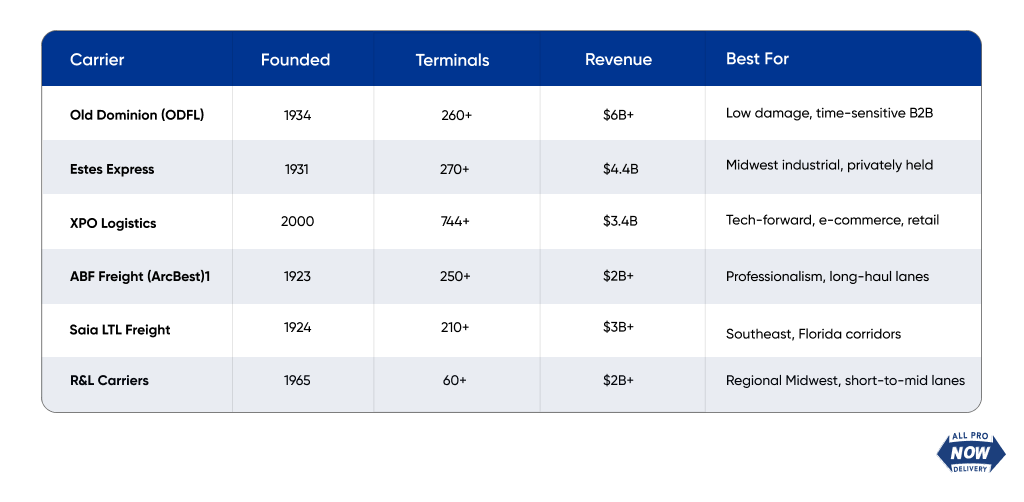
Old Dominion is the most consistently cited top performer in LTL for on-time delivery and cargo integrity. Founded in 1934 in Virginia by Earl and Lillian Congdon, ODFL now operates over 260 service centers nationwide with revenues exceeding $6 billion.
What separates Old Dominion is its investment in cargo securement and dock training, consistently positioning it as the carrier that touches freight the fewest times per move. Its technology is solid and transit times are reliably fast. The trade-off is cost. For shippers moving sensitive industrial equipment, metal components, or medical supplies out of Cleveland, Columbus, or Pittsburgh, the premium is usually worth it.
Best for: Manufacturers, healthcare distributors, and B2B shippers who cannot afford damage claims or missed delivery windows.
2. Estes Express Lines: Best LTL Carriers for Midwest Industrial Freight
Estes is one of the few remaining privately held major LTL carriers in the USA. Founded in 1931 in Chase City, Virginia, the company grew from hauling livestock into a network spanning 270+ terminals, 21,000+ employees, 10,000 drivers, and revenues approaching $4.4 billion.
Because Estes doesn’t answer Wall Street quarterly expectations, it invests in long-term relationships over short-term margin optimization. Shippers across Ohio, Indiana, and Kentucky consistently cite Estes for industrial freight, building materials, and manufacturing components, especially businesses dealing with damage issues from higher-volume carriers.
Best for: Regional industrial shippers, construction supply companies, and Midwest manufacturers needing consistent terminal performance.
3. XPO Logistics: Best LTL Carriers for Technology-Driven Shipping
XPO launched in 2000, was rebranded by CEO Bradley Jacobs, and listed on the NYSE in 2012. Today it operates 744+ service locations with over 38,000 employees and $3.4 billion in North American LTL revenues.
XPO’s technology platform is its strongest differentiator, API integrations, dynamic ETAs, and live shipment tracking make it a strong fit for data-driven freight management at scale. XPO is also deeply embedded in retail supply chains, making it reliable for e-commerce fulfillment and omnichannel distribution across lanes like Toledo to Florida or Pittsburgh to the Southeast.
Best for: E-commerce companies, retailers, and high-volume shippers who need technology-forward LTL management.
4. ABF Freight (ArcBest): Best LTL Carriers for Professionalism and Driver Quality
ABF traces its roots to 1923 in Fort Smith, Arkansas and now operates under ArcBest Corporation with revenues exceeding $2 billion and 250+ terminals nationwide. The freight community widely recognizes ABF as one of the better-paying LTL carriers for drivers, which directly correlates with better equipment maintenance and more careful freight handling. Better pay, better care; it’s a chain that runs from the cab to your dock.
Best for: Businesses prioritizing professionalism and service reliability across long-haul LTL lanes.
5. Saia LTL Freight: Best LTL Carriers for Southeast and Florida Lanes
Saia is a strong, often underrated performer in the Southeast. In October 2024, Saia closed on 28 former Yellow Corporation terminals for $235.7 million, significantly expanding its network density and door count. For Florida-based shippers in Tampa, Miami, Jacksonville, or Orlando, or Ohio and Indiana businesses routing freight into the Southeast. Saia delivers competitive on-time rates and a damage record that benchmarks above the industry average.
Best for: Southeast-focused shippers and businesses routing freight through Florida or the Gulf Coast states.
LTL vs Same-Day Delivery
This distinction gets overlooked constantly, and it costs businesses real money.
The best LTL carriers move freight between cities. Old Dominion, Estes, XPO, ABF, Saia, every one operates on a hub-and-spoke model. Freight is picked up, consolidated at an origin terminal, linehaul’d to a destination terminal, and delivered. That process takes 1–5 business days and is optimized for cost efficiency across long distances.
Same-day local delivery moves freight within your city, on your schedule, right now. It’s point-to-point, driver-dispatched in minutes, with live GPS tracking door to door. Completely different operational model.
These are not competing services. They are sequential layers of the same freight journey.
Here’s what that looks like in practice. A manufacturer in Cleveland ships industrial components LTL to a distributor in Columbus. Old Dominion moves the freight overnight. The pallet arrives at the Columbus terminal at 6 AM, but the distributor needs it on the production floor by 8 AM for a just-in-time run. The LTL carrier’s scheduled window is noon to 5 PM. That gap is exactly where a same-day provider like AllProNow steps in, a driver dispatched in minutes, tracked live, delivered before the production line stalls.
The same logic applies across industries, a hospital in Pittsburgh receiving lab specimens via Estes, a retailer in Tampa getting the final leg of a B2B delivery to the store floor. The best LTL carriers are upstream partners, not competitors, of same-day delivery providers. The most critical, time-sensitive part of many freight journeys happens after the LTL carrier’s job is done.
How to Choose the Best LTL Carriers for Your Business
A practical framework for businesses across Ohio, Michigan, Pennsylvania, Indiana, Kentucky, and Florida:
1. Define your lane first. Regional move (Cleveland to Pittsburgh) or long-haul (Columbus to Tampa)? Regional LTL carriers often win on short lanes; national carriers are stronger cross-country.
2. Compare at least three carriers per lane. A carrier right for one lane may be wrong for another. Rate differences are often significant.
3. Ask about terminal proximity. The closer your freight is to active origin and destination terminals, the fewer touches and the faster the transit, one of the most overlooked variables in carrier selection.
4. Check damage and claims history. Ask your carrier rep directly for their OS&D (overage, shortage, damage) ratio. Don’t rely on marketing.
5. Test before committing volume. Run a 5–10 shipment pilot before routing significant freight. Evaluate on-time delivery, communication, and freight condition on arrival.
6. Demand live shipment tracking. Any carrier you work with should offer scan-based tracking with live ETAs, not just a static “in transit” message.
How to Find the Cheapest LTL Freight Shipping Without Sacrificing Service
Finding the cheapest LTL freight shipping is less about the lowest base rate and more about total landed cost per shipment.
| Hidden Cost Factor | Typical Impact | What to Do |
| Accessorial fees (liftgate, residential, inside delivery) | +20–40% above base rate | Request full accessorial schedule upfront |
| Fuel surcharges | Often 15–25% of linehaul | Compare net rates, not base rates |
| Damage claims (standard coverage) | Only $0.60/lb payout by default | Use declared value or third-party cargo insurance |
| Freight class miscalculation | Can trigger re-rates post-delivery | Verify NMFC class before booking |
| Late delivery penalties | Varies by receiver; can be significant | Ask about guaranteed delivery options |
The best LTL freight brokers earn their value by navigating exactly this complexity. A strong broker maintains active relationships with 10–20 carriers, knows which ones perform best on specific lanes, and unlocks rates shippers won’t find through direct carrier portals. According to industry data, 20% of all U.S. freight moves through brokers, and that share is growing.
Regional LTL Carriers Worth Knowing in the Midwest and Southeast
National best LTL carriers serve coast-to-coast. But regional LTL carriers frequently outperform them on short-to-medium lanes, particularly in the Midwest and Southeast.
| Regional Carrier | Primary Coverage | Known Strength |
| Pitt Ohio | PA, OH, WV, MD, VA, NY, NJ | Pittsburgh-anchored, high on-time rates |
| Dayton Freight | 11-state Midwest footprint | Manufacturing corridors, low damage record |
| Duie Pyle | Mid-Atlantic and Northeast | Northeast density, specialized freight |
| Averitt Express | Southeast and South-Central | Florida, Tennessee, Gulf Coast lanes |
For a manufacturer in Cleveland shipping to Pittsburgh or Detroit, or a distributor in Columbus routing freight into Indiana and Kentucky, a regional carrier often beats a national name on both price and transit time. Fewer terminals, fewer touches, faster moves.
How AllProNow Fits Into Your LTL Strategy
AllProNow operates where LTL ends, the last mile, the urgent pickup, the same-day move that no terminal schedule can accommodate, that even the best LTL carriers leave behind, particularly for businesses in Ohio, Michigan, Pennsylvania, Indiana, Kentucky, and Florida.
When your LTL freight arrives at the terminal and needs same-day delivery to a manufacturer in Youngstown, a hospital in Columbus, or a distributor in Detroit, AllProNow’s on-demand network closes that loop. When you need a rush pickup no national carrier can schedule until tomorrow, AllProNow dispatches a driver in minutes with live GPS tracking, digital PODs, and a business portal centralizing your shipment history, invoices, and documents in one place.
For healthcare (lab specimens, medical equipment), manufacturing (just-in-time components), retail (B2B inventory), legal (document delivery), and construction (oversized freight), AllProNow handles the last mile and urgent moves that LTL networks aren’t engineered to execute quickly.
Operating across Cleveland, Columbus, Toledo, Akron, Canton, Youngstown, Detroit, Pittsburgh, Indianapolis, Cincinnati, Tampa, Miami, and Orlando, AllProNow is the local delivery layer your LTL strategy needs.
The Best LTL Carriers Gives You More Than a Truck
The best LTL carriers in the USA, Old Dominion, Estes, XPO, ABF, Saia, and R&L, each bring something different to the table. No single carrier wins every lane, every time. The smartest shippers build a portfolio of 2–3 trusted carriers matched to specific lanes, freight types, and service requirements.
The common thread separating good freight experiences from bad ones is carrier accountability, knowing where your freight is at every terminal scan, and having a partner who responds the moment something changes.
If you’re managing LTL freight across Ohio, Florida, or anywhere in the Midwest and need reliable same-day delivery, urgent pickups, or a local delivery layer that picks up where the best LTL carriers leave off, AllProNow is ready to help. Get an instant quote, book a shipment, and experience what modern freight management looks like.