
Most order delays, project overruns, and missed deadlines trace back to one simple mix-up: confusing what’s the difference between shipping and delivery. They sound interchangeable. They are not. Shipping is when your order leaves the warehouse. Delivery is when it reaches your hands. The time between those two events, the transit window, is where expectations shatter and costs quietly climb.
At All Pro Now, we connect homeowners and businesses across the U.S. with vetted local professionals in HVAC, plumbing, electrical, roofing, landscaping, and more. Whether you’re coordinating material deliveries for a remodel in Austin, Texas, managing supply schedules for a commercial facility in Atlanta, Georgia, or hiring service pros in Phoenix, Arizona, understanding this distinction protects your timelines and your budget.
This blog breaks down both terms precisely with current data, a clear comparison, and practical guidance you can use today.
Key Takeaways
- Shipping = the moment a product leaves the origin facility and enters the carrier network.
- Delivery = the moment the product physically arrives at the recipient’s location.
- The shipping date and the delivery date are almost never the same day.
- Last-mile delivery, the final leg from local hub to door, now accounts for 53% of total shipping costs.
- Nearly 20% of e-commerce packages fail on the first delivery attempt.
- 86% of U.S. consumers define “fast delivery” as two days or less, yet most are confused when that clock starts.
- The shipping-vs-delivery gap affects not just products, but any scheduled professional service.
What Is Shipping?
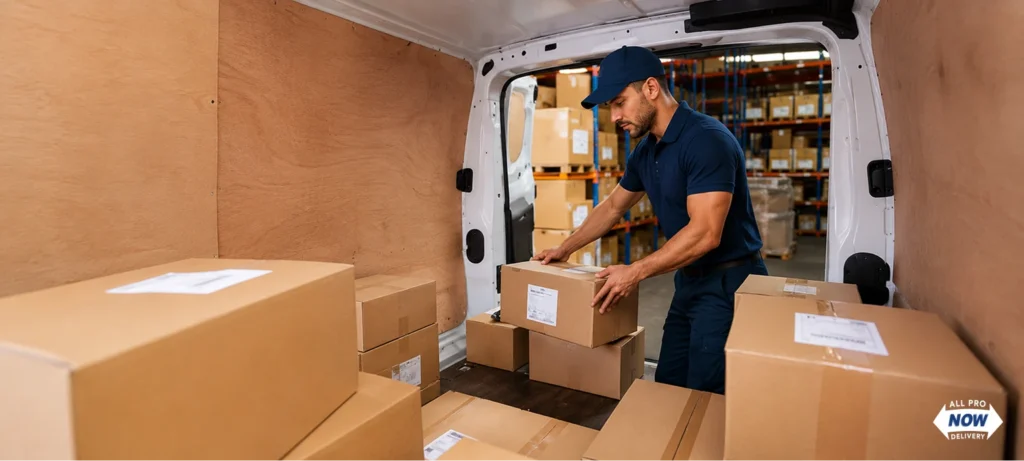
Shipping is the first stage of the fulfillment journey. It begins the moment a product is picked, packed, labeled, and handed off to a carrier, whether that’s FedEx, UPS, USPS, or a regional logistics partner.
Once a package is “shipped,” it enters the carrier’s network. From there, it typically passes through multiple regional sorting hubs before reaching a local distribution center near the recipient.
The ship date is not your arrival date. It is the departure date.
Key facts about shipping:
- Tracking begins when the carrier scans the package at pickup.
- Shipping costs are calculated based on package dimensions, weight, origin ZIP, destination ZIP, and speed tier (ground, express, overnight).
- A package shipped from a Los Angeles warehouse to a customer in Charlotte, North Carolina, may take 3–6 business days via standard ground.
- A supplier in Denver shipping materials to a job site in Miami must account for transit time before a project can begin, not after.
Common Shipping Methods in the U.S.
| Shipping Method | Typical Transit Time | Best Used For | Relative Cost |
| Ground Shipping | 3–7 business days | Non-urgent, bulkier, or lower-cost items | Lowest |
| Express / 2-Day | 2 business days from ship | Time-sensitive but not emergency orders | Moderate |
| Overnight | Next business day | Urgent materials, critical parts | High |
| Freight (LTL/FTL) | 3–10 business days | Large pallets, equipment, bulk supplies | Variable by load |
| International Shipping | 7–21+ days | Cross-border orders, customs clearance required | Highest overall |
Note: Transit times begin from the ship date, not the order date. A supplier who ships within 48 hours of an order adds 2 days before the clock above even starts.
What Is Delivery?
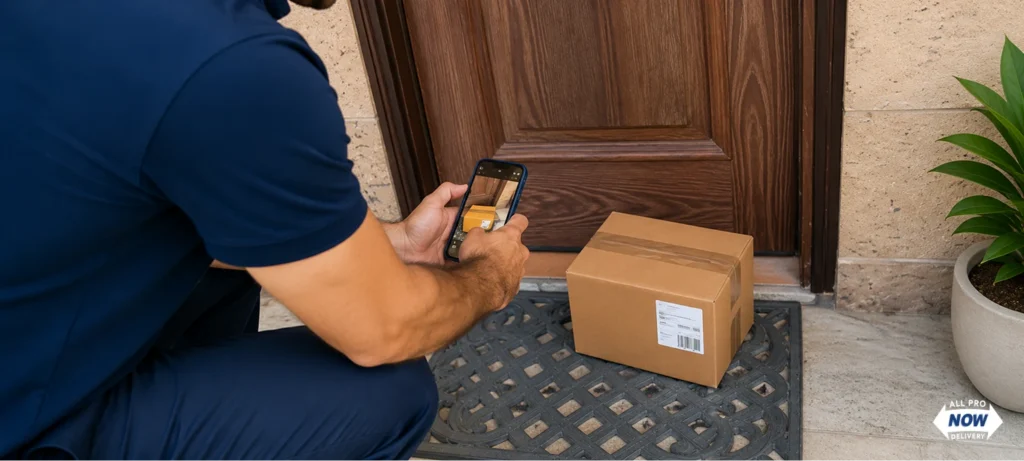
Delivery is the final stage. It is when the package physically arrives at its destination, a home, commercial property, or job site, and is placed in the hands of the recipient or left at the door.
This stage is widely called last-mile delivery, and it is the most operationally complex and costly part of the entire shipping process.
Last-mile delivery now accounts for 53% of total shipping costs, up from 41% in 2018. That single leg of the journey consumes more of the logistics budget than warehousing, middle-mile freight, and cross-docking combined.
Key facts about delivery:
- Delivery triggers the “Your order has been delivered” notification.
- Large or fragile items may require scheduled delivery windows, signature confirmation, or white-glove handling.
- Globally, 8–20% of parcels fail on the first delivery attempt commonly because the recipient isn’t home (36%), the address is incorrect (22%), or delivery windows don’t match recipient availability (67%).
- Each failed delivery adds approximately $17.20 in extra, on top of the original shipping expense.
For homeowners in Dallas, Texas, or facility managers in Denver, Colorado, a failed delivery isn’t just an inconvenience. It can delay a licensed professional’s job by days.
What’s the Difference Between Shipping and Delivery? Side-by-Side Comparison
This is the clearest breakdown of how these two stages differ across every key dimension:
| Category | Shipping | Delivery |
| Definition | Product leaves the origin warehouse or seller | Product arrives at the recipient’s address |
| Logistics Stage | First leg, dispatch and carrier handoff | Last mile, local hub to final destination |
| Who Handles It | National/regional carrier network (UPS, FedEx) | Local courier, delivery driver, or gig worker |
| Date Type | Ship date (dispatch date) | Estimated Delivery Date (EDD) |
| Customer Notification | “Your order has shipped” email or SMS | “Your package has been delivered” alert |
| Cost Drivers | Weight, size, speed tier, origin-to-hub distance | Last-mile distance, density, special handling needs |
| Failure Risk | Carrier pickup delays, labeling errors | Recipient not home, incorrect address, weather disruptions |
| Tracking Start Point | First carrier scan | Final delivery scan at the address |
Bottom line: Shipping starts the journey. Delivery ends it. The days in between are where most confusion, and most project risk, lives.
Why the Two Dates Are Never the Same
Here is what actually happens between a shipped notification and a delivered notification, step by step:
- Order placed, the clock has not started on transit yet.
- Order processed and packed, may take 1–3 business days at the warehouse.
- Carrier pickup / ship date, package enters the carrier network; tracking begins.
- Regional sorting hub, package is routed toward the destination.
- Local distribution center, package arrives in the metro area closest to the recipient.
- “Out for Delivery” scan, package is loaded onto a local delivery vehicle.
- Delivery package is physically dropped at the address; final scan logged.
Each of those steps has its own timeline. Weather events, carrier volume surges, hub backlogs, and incorrect address data can add days at any step.
Real-World Example: How the Timeline Plays Out
| Scenario | Order Date | Ship Date | Delivery Date | Total Wait |
| Standard ground: TX warehouse → homeowner in Columbus, OH | Monday | Wednesday | Following Tuesday | 8 days total |
| Express 2-day: supplier in Chicago, IL → contractor in Nashville, TN | Monday AM | Tuesday | Thursday | 3 days total |
| International: manufacturer → property manager in Seattle, WA (air) | Day 1 | Day 3 | Day 10–14 | 10–14 days |
| Failed first attempt, redeliver: Los Angeles, CA → home address | Monday | Thursday | Following Monday | 10 days total |
These gaps are not unusual. They are the standard operating reality of U.S. logistics.
The Numbers That Show Why This Distinction Matters
Confusing shipping and delivery isn’t just a semantic issue. It has measurable financial and operational consequences, backed by recent industry data.
According to OnTrac’s 2024 consumer survey, 86% of U.S. consumers define “fast delivery” as two days or less, but critically, 39% only accept two-day delivery when shipping is also free. Most of those consumers don’t realize the two-day window starts from the ship date, which may be 24–48 hours after they placed the order.
In the U.S. alone, 24.6 billion packages are projected to ship in 2026, making accurate communication of shipping vs. delivery timelines more operationally critical than ever.
38% of consumers will abandon an order if delivery takes more than a week, regardless of when it shipped. That’s a conversion and retention problem that starts with unclear date communication.
Nearly 20% of e-commerce shipments result in a failed delivery on the first attempt adding redelivery costs, support overhead, and customer frustration that disproportionately damages smaller businesses.
And the delivery stage itself is getting more expensive: U.S. delivery costs increased an average of 12% from 2024 to 2025 alone.
What “Shipping vs. Delivery” Means When Ordering Online
When you shop online and select a shipping option at checkout, here’s what the terms you see actually mean:
“Ships in 1–2 business days” → The seller will pack and dispatch within 1–2 days of your order. Transit time is not yet included.
“2-day shipping” → Transit will take 2 business days after the item ships. If the seller takes 2 days to process the order, your actual wait is 4 days.
“Estimated delivery: [date range]” → This is the most accurate number to plan around. It accounts for processing time, transit, and local delivery.
“Delivered” → The carrier’s final-mile scan confirms the package reached the address. This is the only status that means the job is done.
Common misconceptions when ordering online:
- “It shipped, so it should be here today.” Not unless it was already on the delivery route.
- “The shipping date is the arrival date.” Never. Even overnight shipping ships today and arriving tomorrow.
- “Same-day delivery means it was also shipped the same day.” In many cases, yes, but only for products stored in local fulfillment centers, not regional warehouses.
How This Applies to Professional Services, and AllProNow
The shipping-vs-delivery framework extends beyond physical products. It applies to any scheduled service, and it matters deeply when you’re coordinating professionals through a platform like All Pro Now.
Think of it this way:
- “Shipped” in services = the job is booked, confirmed, and a professional is dispatched. The work has been committed to.
- “Delivered” in services = the job is complete, inspected, and signed off. The outcome is in the customer’s hands.
The gap between those two milestones, when a pro is scheduled vs. when the work is actually done, is where misaligned expectations create disputes.
A roofing contractor in Tampa, Florida, may be confirmed (dispatched) on Monday but can’t start until Wednesday pending material delivery. An HVAC technician in Portland, Oregon, may arrive Tuesday but need a part that ships from a supplier in Sacramento, arriving Thursday. The service isn’t “delivered” until both the labor and the material gaps close.
AllProNow-verified professionals across markets including Houston, Texas; Raleigh, North Carolina; Las Vegas, Nevada; and Minneapolis, Minnesota understand this distinction. Clear scheduling, transparent timelines, and realistic scope communication are built into how they operate.
5 Practical Steps to Eliminate Shipping-vs-Delivery Confusion
These steps work whether you’re managing product orders, coordinating material deliveries, or scheduling professional services.
1. Always ask for two separate dates: Request the ship date (when it leaves) and the estimated delivery date (when it arrives). Never assume they’re the same.
2. Plan around delivery, never around the ship date: Your real planning anchor is the EDD. Build in 1–2 days of buffer on any time-sensitive project, especially in high-volume periods.
3. Set up notifications at both milestones: Most major carriers (UPS, FedEx, USPS) offer free email or SMS alerts for both “shipped” and “delivered” events. Use both.
4. Confirm address accuracy before every order: 22% of failed deliveries result from incorrect address information. A wrong suite number or ZIP code can add 3–5 days to an already tight timeline.
5. Communicate the same two-date model with your service providers: If you’re coordinating multiple trades, electrical, plumbing, general contracting, treat each as its own supply chain. The first crew’s “delivery” often triggers the next crew’s “ship date.”
Common Misconceptions About Shipping and Delivery, Cleared Up
“Shipped means it’s on its way to my door.” Partially true. It’s in the carrier network, but it may still transit through 2–3 regional hubs before reaching your local area. “Out for delivery” is the status that means it’s on the final truck.
“My delivery date is guaranteed.” Estimated delivery dates are projections, not guarantees. Carrier volume, severe weather, and address issues can shift the final date, even when the ship date was perfectly on time.
“Shipping and delivery cost the same thing.” They’re often two different cost centers. Base shipping covers the carrier network journey. Last-mile delivery fees, residential surcharges, signature fees, and white-glove delivery premiums are separate line items on many invoices.
“A late ship date always means a late delivery.” Not always. Efficient routing and buffer logistics can sometimes absorb a 1-day shipping delay without affecting the final delivery date, especially for short regional routes.
“Freight and delivery are the same.” They’re not. Freight refers to bulk transport between commercial hubs, manufacturer to warehouse, port to distribution center. Delivery is the final consumer-facing handoff. Most freight never touches your front door.

The Bottom Line
The difference between shipping and delivery comes down to two things: stage and timing. Shipping marks the start of a product’s journey. Delivery marks its end. The gap between them, often 3 to 10 days, is where timelines get miscommunicated, expectations get missed, and costs quietly compound.
For homeowners, business owners, contractors, and facility managers across states like Texas, Florida, Georgia, Ohio, Nevada, and Washington, understanding this difference is a practical operational skill, not just a logistics trivia question.
When you hire professionals through All Pro Now, you work with vetted experts who bring the same clarity to service scheduling: confirmed is not complete, dispatched is not delivered, and every project has a real start date and a real finish line.
Ready to connect with trusted local professionals in your area? Browse services at All Pro Now and get matched with verified pros who deliver, not just show up.