
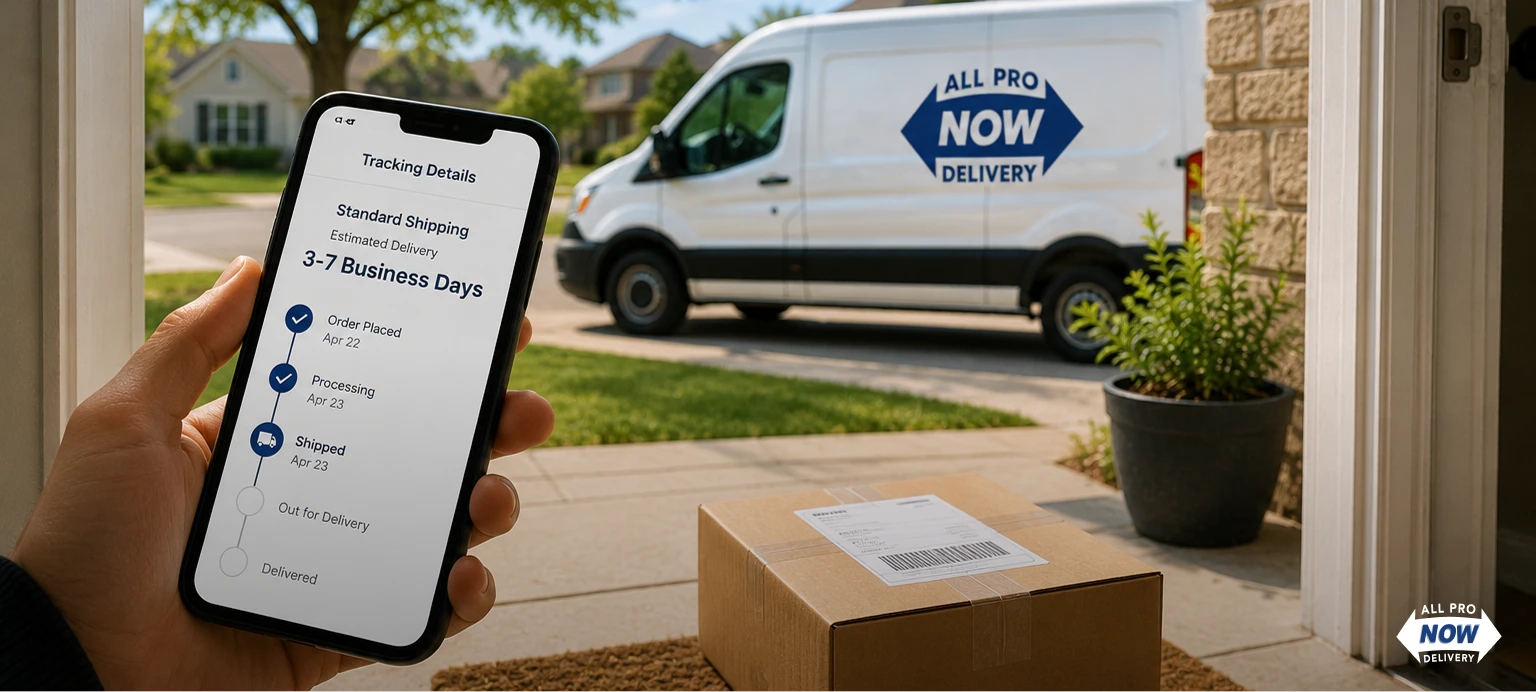
Staring at a tracking page that hasn’t moved in three days is one of the most common shopping frustrations there is. So how long does standard shipping take, really? In most cases, standard shipping takes 3 to 7 business days from the moment your order is fulfilled, though the exact window depends on carrier, distance, and warehouse location.
This blog breaks down what standard shipping actually means in 2026, why the timeline shifts so much, and what businesses can do when a standard window simply isn’t fast enough.
Key Takeaways
- Standard shipping typically takes 3 to 7 business days after an order ships, not from the moment you place it.
- Processing time (1 to 2 business days) is separate from transit time, and carriers often blur the two.
- Cross-country shipments, multi-warehouse orders, and peak-season volume all add extra days.
- Weather, road conditions, and last-mile logistics near cities like Toledo, Ohio or Miami, Florida can shift delivery by a day or more.
- E-commerce volume keeps climbing, which puts more pressure on standard shipping networks every year.

What “Standard Shipping” Actually Means
Standard shipping is the default, lowest-cost delivery tier most retailers offer. It is not a guaranteed delivery date. It is a range, and that range depends on where a package starts and where it ends up.
Retailers usually split the process into two stages: order processing and transit. Processing is the time it takes a warehouse to pick, pack, and hand a package to a carrier. Transit is the actual travel time once it leaves the building. Confusing these two stages is the single biggest reason shoppers feel misled by shipping estimates.
A Reddit thread from the r/ThredUp community makes this exact point. One shopper quoted a retailer’s own policy: “Standard Shipping: Orders are typically fulfilled within 1-2 business days of the order being placed… Once shipped, your order will be delivered in 4-9 business days.” That single sentence answers how long does standard shipping take better than most marketing pages do. Fulfillment and transit are separate clocks, and both have to run before a package shows up on your porch.
According to the U.S. Census Bureau, U.S. e-commerce sales have topped $1.1 trillion annually in recent years, and that volume keeps rising every quarter. More packages moving through the same carrier networks means standard shipping windows are under more strain than ever in 2026.
The Realistic Timeline: 3 to 7 Business Days
For most domestic orders in the US, standard shipping takes 3 to 7 business days once the package actually ships. The table below breaks the range down by common shipping tiers.
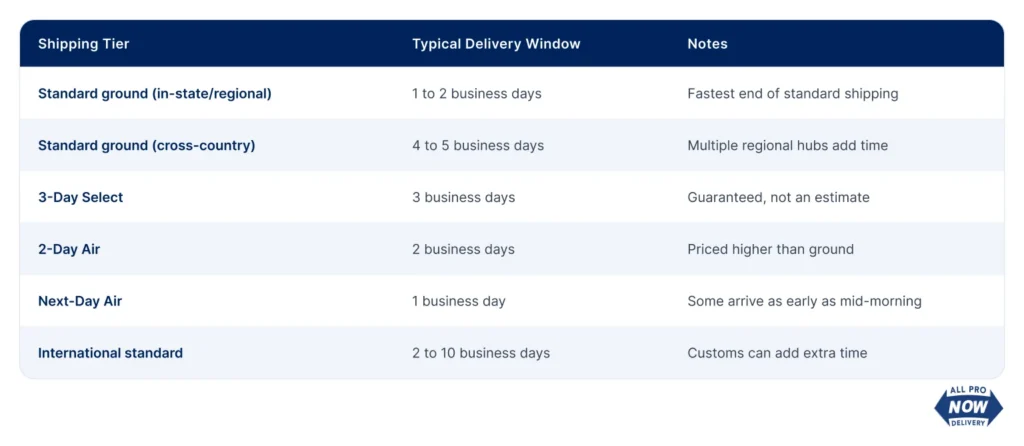
So when someone asks how long does standard shipping take to arrive, the honest answer is: it depends on where the warehouse is, where you live, and how many hops the package needs. There is no single universal number, only a realistic range.
Why Standard Shipping Estimates Are Often Wrong
If you have ever wondered how long does standard shipping take when the estimate said one thing and reality said another, you are not imagining it. A few factors consistently throw off standard delivery windows in 2026.
| Delay Factor | How It Affects Standard Shipping |
| Warehouse consolidation | Retailers combine multi-warehouse orders before shipping, adding days before transit even starts |
| Carrier cutoff times | Orders placed after the daily cutoff don’t start their shipping clock until the next business day |
| Peak season volume | Holiday and promotional surges strain networks, stretching standard shipping well past the usual window |
| Weather and road conditions | Storms, construction, or traffic can delay a driver even a few miles from the final stop |
| Business days vs. calendar days | Weekends and holidays don’t count toward the delivery window, so estimates run longer than they appear |
One Reddit user described waiting two full weeks just for a multi-warehouse order to consolidate, before the package even started its actual journey. The retailer framed this as an efficiency move, but from the customer’s side it simply added days to an already uncertain window.
The American Trucking Associations reports that trucks move more than 70 percent of the nation’s freight tonnage, which means most standard shipments spend the bulk of their transit time on the highway rather than in the air. That’s a big part of why cross-country ground shipments land at 4 to 5 business days instead of 1 to 2.
How Local Logistics Affect Delivery in Ohio and Florida
National averages only tell part of the story. Local infrastructure matters just as much as the mileage on a map.
In markets like Toledo, Ohio, proximity to major interstate corridors and regional distribution hubs can shorten standard shipping windows compared to more remote parts of the Midwest. Packages moving within northern Ohio often land at the faster end of the 1-to-5-day range.
In South Florida, including Miami, seasonal weather is the bigger variable. Hurricane season and heavy summer storms can delay both inbound freight and last-mile delivery, even when a package is only a short drive from its final destination. Businesses operating in these markets need to build in a buffer during peak storm months.
This is exactly where All Pro Now fits into the conversation. All Pro Now runs same-day and next-day freight service across Ohio and Florida for businesses that can’t afford to leave delivery timing to a standard-shipping estimate. Instead of a 3-to-7-day range built on averages, shipments move through a dedicated fleet of sprinter vans and straight trucks with real-time tracking from pickup to delivery, and no subcontracting to third-party carriers along the way.
When Standard Shipping Isn’t Fast Enough
Standard shipping works fine for low-urgency orders. It falls short the moment a business depends on a delivery window it can actually promise a customer or a partner.
If your business ships time-sensitive freight, retail inventory, medical supplies, or manufacturing components, the question worth asking isn’t how long will standard shipping take this time. It’s whether a same-day or next-day option would remove the guesswork altogether. That’s the gap AllProNow’s dedicated fleet is built to close for shippers across Ohio and Florida.
Practical Steps to Set Realistic Delivery Expectations
A few habits make shipping estimates far more accurate, regardless of which carrier you use.
Check the fulfillment window separately from the transit window before assuming a total delivery date. Place time-sensitive orders early in the day, well before the carrier’s stated cutoff. Build in extra buffers during November through January, and during hurricane season if shipping to or from Florida or the Gulf Coast. Track packages by tracking number rather than by the original delivery estimate, since tracking reflects real movement, not the original quote.
For businesses that cannot afford that kind of uncertainty, a dedicated carrier removes most of these variables from the equation entirely.
The Bottom Line
So, how long does standard shipping take? For most domestic orders, plan on 3 to 7 business days after the order actually ships, with cross-country and peak-season shipments landing at the higher end. Processing time, warehouse consolidation, weather, and cutoff times all shift that window in ways a single estimate can’t capture.
If your business needs delivery that doesn’t move on “standard” time, AllProNow’s same-day and next-day freight service across Ohio and Florida offers a faster, trackable alternative. Reach out to talk through a delivery window you can actually count on.