
Waiting on a package can feel endless when a deadline is looming. That’s exactly why so many shippers ask how long does expedited shipping take before they check out. The honest answer: usually one to three business days, depending on carrier, origin, and destination.
This blog breaks down real timelines, what slows deliveries down, and how to pick the right service the first time with a look at where a dedicated regional carrier can beat national averages.
Key Takeaways
- Most expedited shipments arrive in 1–3 business days, faster than standard ground and slower than overnight.
- Expedited sits in the middle tier quicker than standard shipping, less expensive than next-day air.
- Weather, customs, peak-season volume, and carrier cutoff times all affect delivery speed.
- Online sales now make up a growing share of total retail, according to U.S. Census Bureau data, which keeps pressure on carriers to move faster.
- Tracking numbers give the most accurate estimate, general carrier ranges are only a starting point.
What Expedited Shipping Actually Means
Expedited shipping prioritizes a package ahead of standard freight. Carriers use faster transportation, often air instead of ground. They also streamline handling and routing.
This differs from overnight or next-day air, which guarantees delivery by a specific time the following day. Expedited shipping usually promises a window, not a single guaranteed hour.
Think of it as the middle lane. Standard shipping is the economical, slower option. Overnight is the fastest and priciest. Expedited sits in between faster than standard, more affordable than overnight.
For a business shipping urgent documents, last-minute inventory, or time-sensitive parts, that middle lane often makes the most sense.
How Long Does Expedited Shipping Take, Carrier by Carrier
The exact number of days depends on who’s moving the package. Here’s what shippers can typically expect.
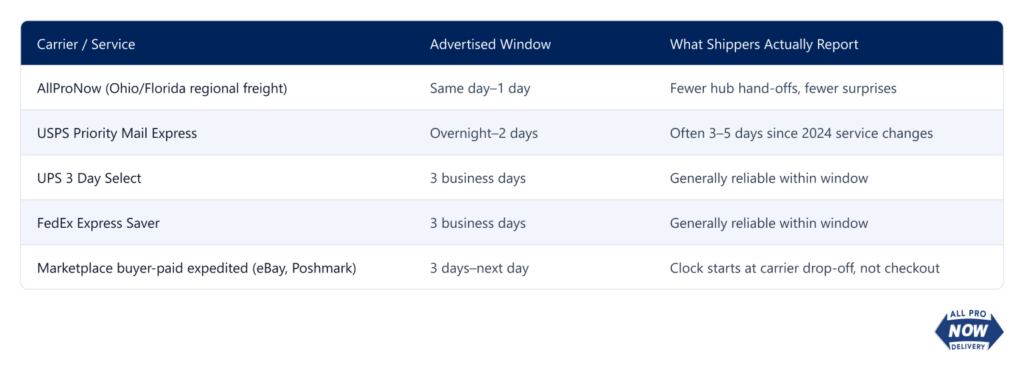
USPS Priority Mail Express advertises overnight to two-day delivery, but real-world reports on Reddit and USPS complaint forums show three to five days is now common. UPS and FedEx three-day air services tend to track closer to their advertised windows.
Marketplace platforms increasingly offer buyer-paid expedited upgrades layered on top of a seller’s normal processing time. That detail matters: the countdown starts when the seller drops the package at the carrier, not when the buyer checks out.
Factors That Change How Fast Expedited Shipping Actually Arrives
Advertised timelines are estimates, not guarantees. Several real-world factors push delivery earlier or later.
| Factor | Typical Impact |
| Daily carrier cutoff time | Missed cutoff pushes start date to the next business day |
| Seller/warehouse processing | Adds 24–48 hours before the carrier even takes the package |
| Weather and regional disruptions | Can add 1–3 days across ground and air networks |
| Peak season volume | Stretches windows industry-wide, especially November–January |
| International customs | Adds 1–7 unpredictable days on top of transit time |
| Remote or rural destinations | Adds a day versus major metro routes |
The American Trucking Associations has tracked a persistent driver shortage across the industry for years, and that capacity strain shows up most during peak shipping periods, when trucks and sorting facilities run at full volume. The National Retail Federation’s holiday shopping research also shows that a large majority of online shoppers expect delivery within two to three days of ordering a bar that gets harder to hit as e-commerce volume climbs.
None of these factors are within a shipper’s control. What is within a shipper’s control is choosing a service level, and a carrier, that builds in enough buffer for the factor most likely to hit a given lane. A Florida-to-Ohio lane in July carries a different risk profile than a Midwest lane in January, even on the same expedited service tier.
Why Speed Expectations Keep Rising
Consumer patience for slow delivery keeps shrinking, and the data backs that up. U.S. Census Bureau retail trade figures show e-commerce sales now represent close to 16 percent of total retail sales, up from single digits a decade ago. That steady climb means more total packages are competing for the same carrier capacity every peak season.
More online orders also means more customers asking, before they even finish checkout, exactly when their package will arrive. Retailers that can answer that question accurately, with a realistic range instead of an optimistic one, tend to see fewer support tickets and fewer refund requests tied to late delivery.
For B2B shippers, manufacturers, distributors, medical suppliers, the stakes are different but just as real. A missed expedited window can shut down a production line, delay a patient procedure, or leave a retail shelf empty during a peak selling week. That’s why more of these businesses are pairing national carrier accounts with a regional partner for their most time-sensitive lanes.
Where a Regional Carrier Changes the Math
National carriers move packages through multiple sorting hubs before final delivery. That network complexity is often where delays creep in.
This is where All Pro NOW fits into the picture. As a same-day and next-day freight carrier serving Ohio and Florida, All Pro NOW runs dedicated sprinter vans and straight trucks directly between origin and destination, cutting out several of the hand-offs a national network requires.
For a manufacturer in Cincinnati shipping urgent parts to a distributor in Cleveland, that means same-day or next-day arrival is realistic, not just advertised. The same logic applies to a medical supply company moving temperature-sensitive freight from Tampa to Orlando.
This regional model matters most in industries where a missed delivery window has real consequences: healthcare, automotive parts, retail replenishment, and event logistics. When a national carrier’s expedited timeline of two to three days isn’t fast enough, a dedicated regional partner like AllProNow can often close that gap.
Consider a retail chain restocking shelves ahead of a weekend promotion in Columbus. A national carrier’s expedited tier might still land the order within its advertised window, but that window often runs from Wednesday afternoon to Friday evening. A regional carrier picking up the same order that afternoon can frequently deliver by the next morning, well ahead of the promotion’s start. The difference isn’t marketing, it’s simply fewer stops between the warehouse and the store.
The same logic holds for automotive plants running just-in-time inventory. A single missing part can idle a production line for hours, and every hour of downtime carries a real cost. Manufacturers across Ohio increasingly build a same-day regional option into their supply chain specifically for this scenario, reserving national expedited services for longer, cross-country lanes where a regional carrier simply can’t reach.
Expedited vs. Standard vs. Overnight: A Quick Comparison
Choosing the right tier comes down to weighing urgency against cost.
| Shipping Type | Typical Transit Time | Best For |
| Standard/Ground | 3–8 business days | Non-urgent, cost-sensitive shipments |
| Expedited | 1–3 business days | Time-sensitive orders, urgent documents |
| Overnight/Next-Day Air | Next business day | Deadline-critical, high-priority freight |
If speed is not critical, standard shipping saves money. If a deadline is fixed and firm, overnight removes the guesswork. Expedited is the practical middle ground for most urgent-but-flexible shipments.
Tips for Getting the Fastest Delivery Possible
A few habits consistently shave time off transit, no matter which carrier is used.
- Ship early in the day, well before the carrier’s daily cutoff.
- Confirm the destination is in a standard delivery zone, not a remote or rural outlier.
- Avoid shipping right before major holidays, when networks are already strained.
- Track proactively. A tracking number gives a far more accurate estimate than any general carrier chart.
- Ask about regional options. For shipments within Ohio or Florida, a dedicated freight partner can often outperform a national carrier’s expedited tier.
Setting Realistic Expectations
Expedited shipping is fast, but it is not instant. Even carriers with strong track records occasionally hit delays from weather, volume, or network issues. The goal isn’t to find a service that never slips, it’s to pick the tier that gives enough cushion for the shipment’s actual deadline, and to know which lanes benefit from a regional alternative.
So, how long does expedited shipping take in the real world? Budget one to three business days for the transit itself, plus any seller processing time before pickup. Build in one buffer day for anything with a hard deadline.
For businesses in Ohio and Florida moving urgent freight, retail inventory, automotive components, or medical supplies, All Pro NOW’s same-day and next-day delivery network offers a dependable alternative to national carrier timelines, especially when hours matter more than advertised averages.
Ready to move an urgent shipment across Ohio or Florida? Reach out to All Pro NOW to compare expedited timelines against a same-day delivery quote.