Heavy equipment transport is one of the most operationally complex freight categories in the U.S., and one of the most expensive to get wrong. A missed permit, an incorrect weight declaration, or a carrier without the right vehicle for the load doesn’t just delay a delivery. It shuts down a job site, idles a production line, or triggers fines that dwarf the original freight cost.
The heavy equipment transport service market was valued at $10 billion in 2024 and is projected to reach $15 billion by 2033, growing at 5.5% annually as construction activity, infrastructure investment, and manufacturing expansion drive demand for specialized freight movement across the country. In Ohio alone, the $1.2 trillion Infrastructure Investment and Jobs Act has accelerated construction activity across Cleveland, Columbus, Toledo, Akron, and Youngstown, creating sustained demand for carriers that understand how commercial freight supporting heavy equipment operations actually moves.
This guide covers everything Ohio and Florida operations need to know about heavy equipment transport,regulations, permit requirements, cost drivers, vehicle selection, and how to evaluate a carrier before committing a load.
What Heavy Equipment Transport Actually Covers
Heavy equipment transport isn’t a single service category. It covers a spectrum of freight types, each requiring a different vehicle, permit structure, and operational approach.
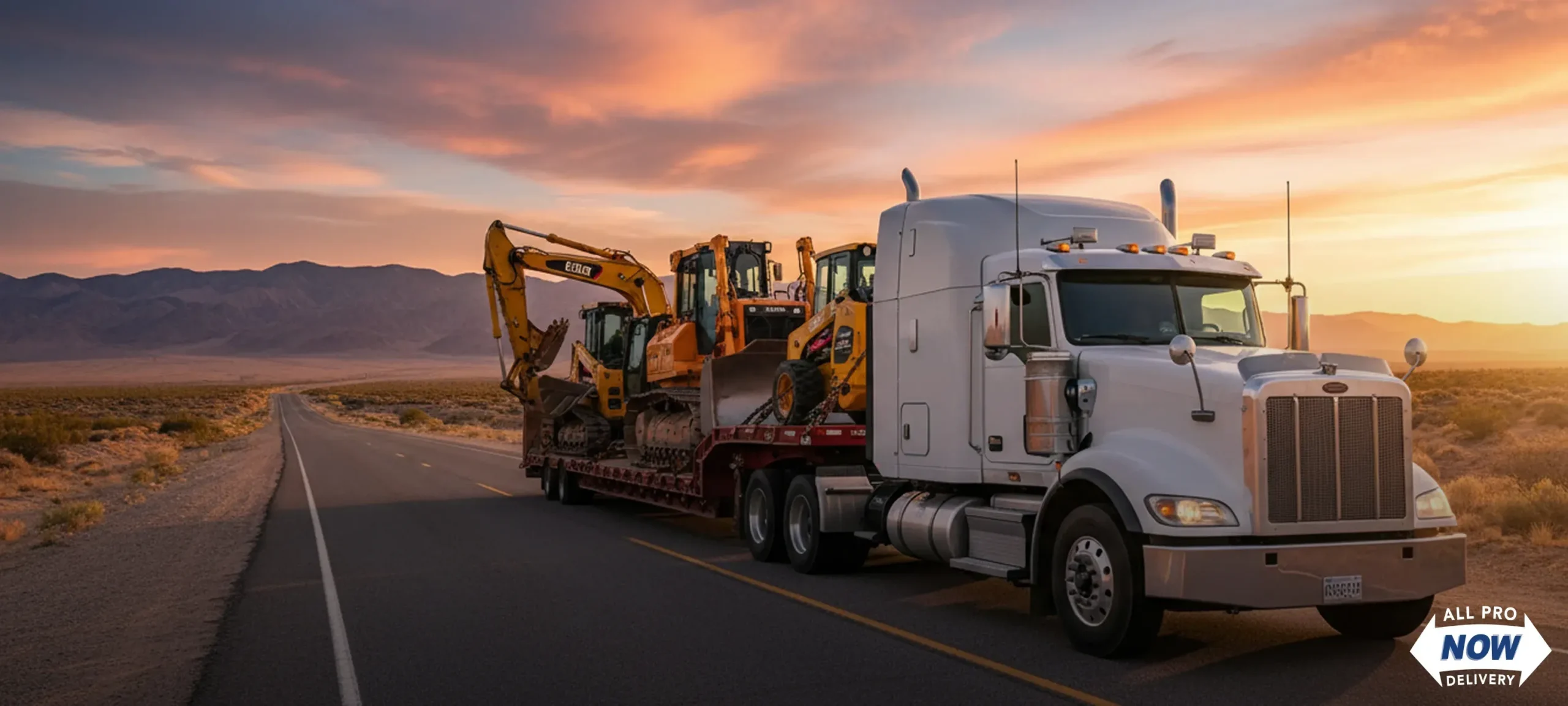
Oversized and overweight loads include the movement of excavators, cranes, bulldozers, industrial generators, and large construction machinery. These loads exceed standard legal dimensions, 8.5 feet wide, 13.5 feet tall, 53 feet long, or 80,000 lbs gross, and require special hauling permits, escort vehicles, and route-specific approval before a single mile is traveled.
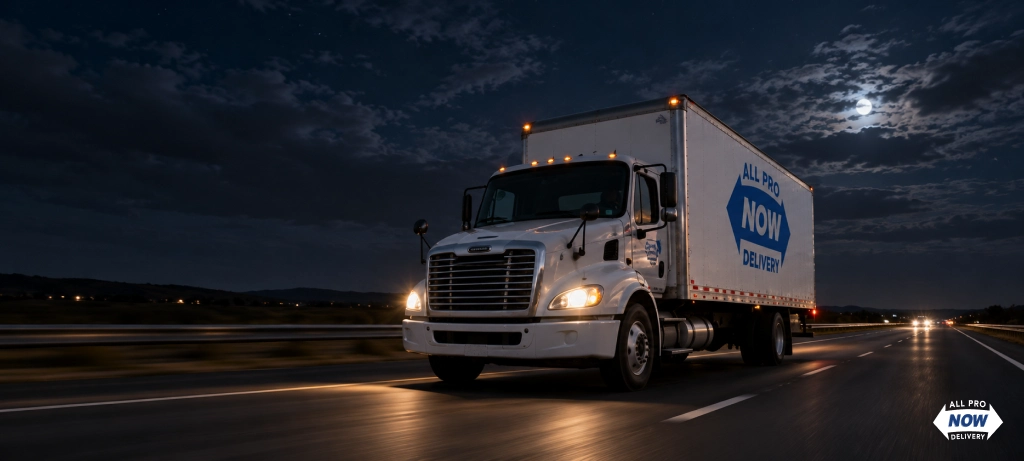
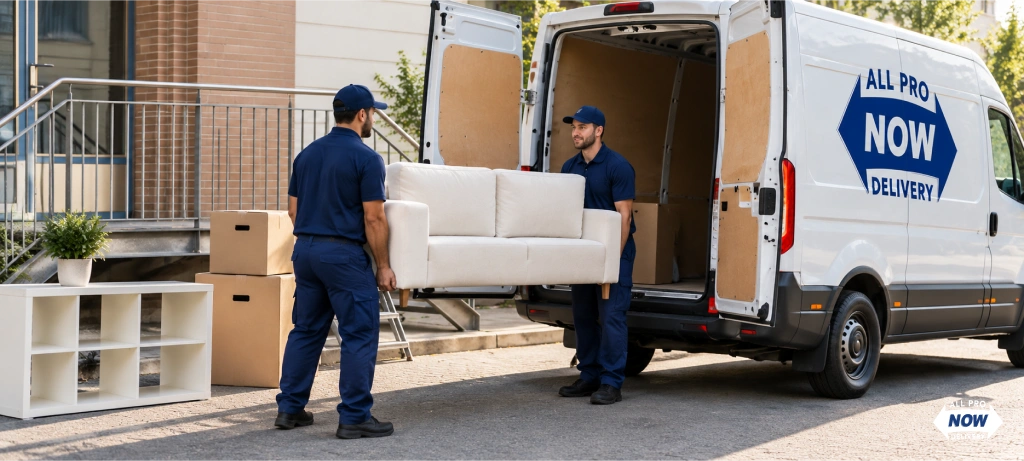
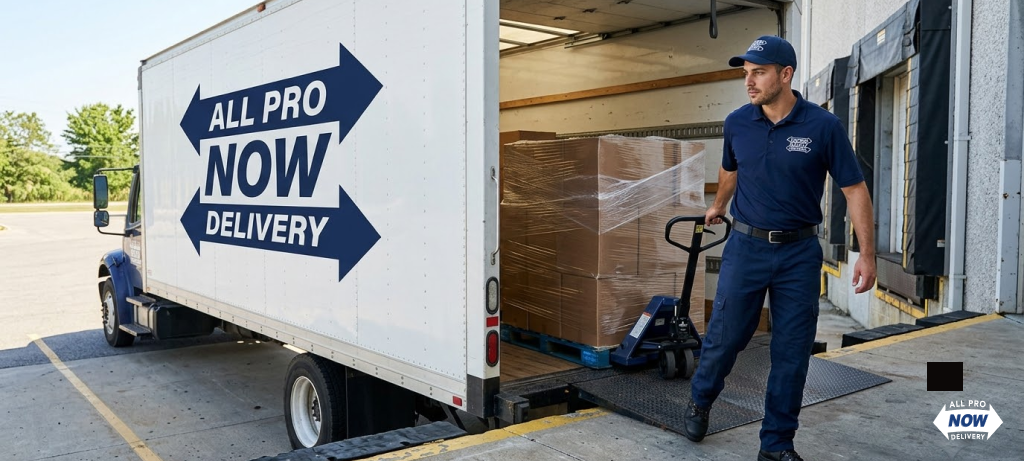
Commercial freight supporting heavy equipment operations includes the parts, components, tools, and time-critical materials that keep construction sites, manufacturing facilities, and industrial operations running. This freight category moves in commercial vehicles, box trucks, sprinter vans, and cargo vehicles, without oversize permit requirements, but with the same operational urgency as the machinery it supports.
Just-in-time equipment parts delivery is the category most Ohio manufacturers and construction companies interact with daily. A Cleveland construction company waiting on a hydraulic component for a stalled excavator doesn’t need an oversize permit. It needs a carrier that can pick up in two hours and deliver to the job site before the crew idles.
Understanding which category your freight falls into determines every downstream decision, vehicle selection, permit requirements, carrier qualification, and pricing.
Ohio Oversize Permit Requirements: What Triggers Them and What They Cost
For loads that exceed standard legal dimensions, Ohio has specific permit requirements that must be in place before movement begins. Operating without them doesn’t just risk a fine, it risks load confiscation and criminal penalties.
Ohio’s legal limits before a permit is required:
| Dimension | Legal Limit Without Permit |
| Width | 8 feet 6 inches |
| Height | 13 feet 6 inches |
| Length | 53 feet |
| Gross Weight | 80,000 lbs |
| Single Axle | 20,000 lbs |
| Tandem Axle | 34,000 lbs |
Once a load exceeds these limits, the following permit costs apply:
| Permit Type | Cost |
| Oversize single trip (one way) | $65 |
| Oversize single trip (return) | $100 |
| Oversize and overweight single trip (one way) | $135 |
| Oversize and overweight single trip (return) | $200 |
| Annual permit (up to 140,000 lbs, 14 ft wide, 14 ft 6 in tall) | $970–$2,970 |
Ohio oversize permits are valid for five days. The permit must be obtained before entering the state, not after. Fines for unpermitted overweight loads start at $100 minimum and escalate to $3 per 100 lbs of unpermitted weight once the overweight reaches 10,000 lbs. Repeat violations can result in load confiscation.
Travel time restrictions matter as much as permits. Loads up to 12 feet wide can move from 30 minutes before sunrise to 30 minutes after sunset. Loads over 12 feet wide face tighter restrictions, prohibited in many Ohio counties during peak hours (6:30–9:00 AM and 4:30–6:00 PM Monday through Friday) and not permitted on major holidays starting noon the weekday before the holiday.
Escort vehicle requirements add cost and coordination complexity. A load with overall height exceeding 14 feet 6 inches requires one lead escort equipped with a height-sensing device. Any load wider than 14 feet 6 inches requires both lead and rear escorts. Escort vehicles must maintain radio communication with the permit vehicle and carry roof-mounted amber warning lights visible from 1,000 feet.
For construction companies managing regular equipment moves between job sites in Columbus, Akron, or Toledo — understanding these rules upfront eliminates the scheduling gaps and unexpected costs that catch operations off guard mid-project.
The Real Cost Drivers in Heavy Equipment Transport
The permit is visible. The costs around the permit often aren’t.
| Cost Driver | What It Adds | Why It Catches Operations Off Guard |
| Route selection errors | Permit invalidated, load stopped | Oversize permits are route-specific — wrong route means starting over |
| Escort vehicles | $100–$300+ per escort per trip | Required for loads over specific width/height thresholds |
| Holiday and peak hour restrictions | Delivery window lost, job site idles | Travel restrictions apply even with a valid permit |
| County-level permits | Additional fees per county | Ohio county permits required separately from ODOT state permits |
| Ohio Turnpike separate permit | Additional permit cost | ODOT permits do not cover the Turnpike — separate OTIC permit required |
| Crew idle time | $500–$2,000+ per hour depending on crew size | A two-hour delivery delay on a 10-person crew adds costs the freight invoice doesn’t show |
| Carrier vehicle mismatch | Reload, reschedule, accessorial charges | Wrong vehicle for the load weight or dimensions requires a second dispatch |
The Ohio Turnpike creates a specific trap for operations moving freight between Cleveland and Toledo on I-80/I-90. An ODOT state permit does not automatically authorize travel on the Turnpike. A separate permit from the Ohio Turnpike and Infrastructure Commission is required and operators who discover this at the Turnpike toll plaza don’t have a clean resolution available on the spot.
For interstate moves, Ohio to Florida through Indiana and Kentucky, or Ohio to Pittsburgh and into Pennsylvania, each state has its own permit requirements, travel time restrictions, and escort rules. A load legal in Ohio may require additional permits and modified routing the moment it crosses into Indiana or Kentucky.
Vehicle Selection for Heavy Equipment Transport: What Actually Fits
The right vehicle for heavy equipment freight isn’t the largest one available. It’s the one that matches the load’s weight, dimensions, and delivery requirements exactly.
| Vehicle Type | Max Payload | Freight Applications |
| Sprinter Van | Up to 3,600 lbs / 4 skids | Parts, components, tools, documents for equipment operations |
| Box Truck | Up to 10,000 lbs / 12 skids | Larger parts, bulk materials, multi-stop construction site delivery |
| Flatbed Trailer | Varies by configuration | Non-divisible oversize loads — machinery, structural steel, generators |
| Step Deck / Lowboy | Varies | Tall or wide equipment requiring lower deck height to stay within permit limits |
| RGN (Removable Gooseneck) | 40,000–150,000+ lbs | Heavy machinery — excavators, bulldozers, large industrial equipment |
Vehicle mismatches in heavy equipment transport are one of the most common and expensive operational errors. A construction company in Toledo scheduling a box truck for a load that requires a flatbed doesn’t just face a reload, it faces a delayed job site start, a rescheduled crew, and a freight cost that doubles when a second dispatch is required.
For parts and components supporting equipment operations, the just-in-time category that manufacturing and construction operations depend on daily, commercial vehicles are the right tool. Sprinter vans and box trucks handle this freight efficiently, with faster dispatch times and lower cost than heavy haul specialized equipment that’s built for oversized loads.
Heavy Equipment Transport Across Ohio’s Key Freight Corridors
Ohio’s major highway network — I-71, I-75, I-76, I-77, I-80, and I-90, connects the state’s industrial centers in ways that matter specifically for heavy equipment freight operations.
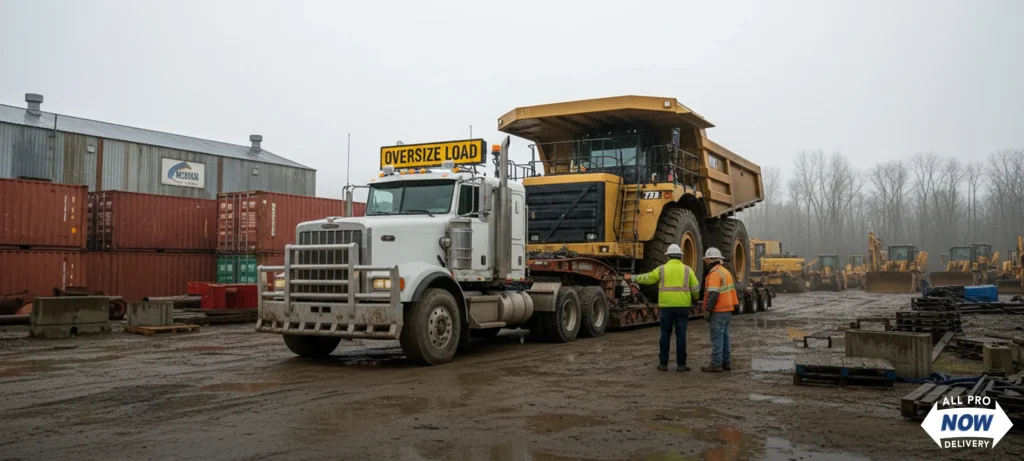
Cleveland to Columbus (I-71): The primary corridor for Northeast Ohio manufacturing and construction freight. This lane handles significant automotive parts and industrial equipment movement. Winter weather between November and March regularly affects transit times, lake-effect snow on the northern stretch of I-71 can add 45–90 minutes to planned delivery windows.
Cleveland to Toledo (I-80/I-90): Ohio’s turnpike corridor and one of the state’s highest-volume freight lanes. Separate Ohio Turnpike permits are required for oversize and overweight loads on this route. Port activity in Toledo creates additional freight complexity, continuing permits exist specifically for Michigan-Ohio border crossings near Toledo for loads moving between port facilities.
Columbus to Pittsburgh (I-70): A critical lane for construction materials and equipment parts moving between Ohio and Western Pennsylvania. Pennsylvania has its own oversize permit requirements, a load permitted in Ohio requires a separate Pennsylvania permit before crossing the state line.
Ohio to Florida (I-75): The 1,100–1,200 mile corridor connecting Ohio’s industrial base to Tampa, Miami, and Orlando. This lane handles significant volume for construction companies managing projects across both states. Florida permit requirements differ from Ohio’s, advance planning for multi-state moves on this corridor prevents mid-route compliance gaps.
Industries That Depend on Heavy Equipment Transport Getting It Right
Construction: Job-site delivery windows are fixed by crew schedules and equipment availability. A concrete pour starting at 7:00 AM doesn’t adjust for a late parts delivery. Construction operations in Akron, Pittsburgh, Indianapolis, and Columbus use same-day commercial freight to move hydraulic components, replacement parts, and time-critical materials directly to job sites, with the same urgency as moving the equipment itself.
Manufacturing: Ohio’s automotive and industrial manufacturing corridor depends on just-in-time parts delivery to keep production lines moving. A Cleveland automotive supplier waiting on a replacement component for a production line doesn’t measure cost in freight rates. It measures cost in production hours. Commercial freight handling parts movement to manufacturing facilities operates on production-schedule timing, not carrier-estimated delivery windows.
Energy and Infrastructure: Generator transport, turbine components, and industrial electrical equipment moves through Ohio’s freight corridors as infrastructure investment accelerates under federal programs. These loads frequently require coordination across ODOT permits, county permits, and Turnpike permits simultaneously.
Healthcare: Medical equipment transport, MRI components, surgical equipment, hospital facility installations, combines the dimensional complexity of heavy equipment freight with the chain-of-custody documentation requirements that healthcare compliance demands. Digital proof of delivery with GPS timestamp matters as much as permit compliance on these moves.
How to Evaluate a Carrier for Heavy Equipment Transport
Not every carrier advertising heavy equipment transport has the operational infrastructure to execute it without creating problems downstream.
| Evaluation Criteria | What to Verify | Red Flag |
| Permit experience | Do they handle permit procurement or leave it to you? | Carrier requires shipper to obtain all permits independently |
| Vehicle range | Do they have the right vehicle for your specific load? | Single vehicle type offered regardless of load requirements |
| Live GPS tracking | Is freight tracked in real time during transport? | Status updates only at pickup and delivery |
| Exception management | Are delays flagged automatically before windows close? | Shipper has to call to check status |
| Multi-state experience | Do they know each state’s permit requirements on your lane? | Carrier only familiar with Ohio regulations |
| Digital proof of delivery | GPS-stamped, photo-documented POD? | Paper POD only |
| Pricing transparency | Are all costs quoted upfront including permits and escorts? | Permit and escort costs added after booking |
The last point has specific financial implications for construction and manufacturing operations managing project budgets. A freight quote that doesn’t include permit costs and escort fees looks competitive until the invoice arrives with line items that weren’t in the original booking.
How AllProNow Supports Heavy Equipment Operations Across Ohio and Florida
AllProNow serves the commercial freight needs of construction, manufacturing, healthcare, and industrial operations across Ohio, Michigan, Indiana, Pennsylvania, Kentucky, and Florida. With 50+ years of regional freight experience, 80,000+ shipments delivered at 99% on-time performance, and a dedicated professional fleet of sprinter vans (up to 3,600 lbs) and box trucks (up to 10,000 lbs), AllProNow handles the time-critical parts, components, and materials that keep heavy equipment operations running on schedule.
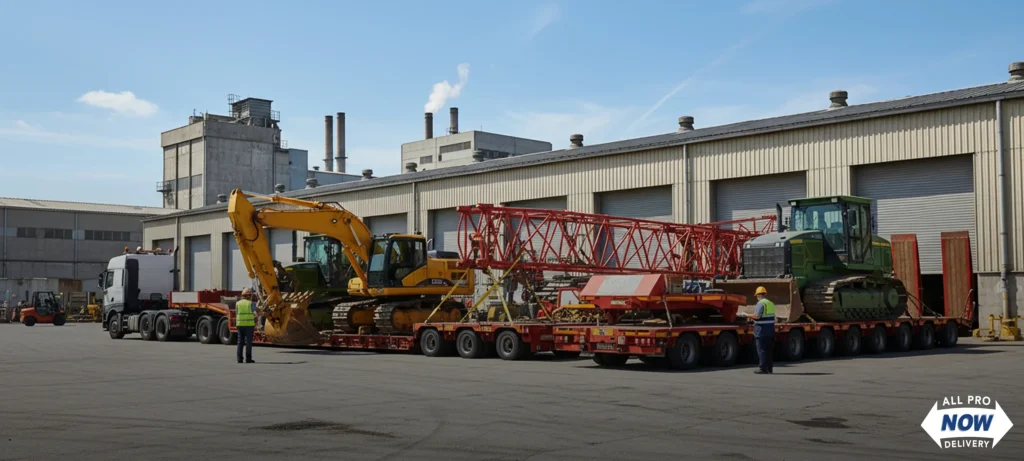
For a Cleveland construction company waiting on a hydraulic component. For a Toledo manufacturer needing a replacement part delivered to a production line before the next shift. For a Tampa job site receiving equipment materials from an Ohio distribution point on the I-75 corridor, AllProNow’s same-day commercial freight capability, live GPS tracking, and digital proof of delivery operate on the production and job-site timing that heavy equipment operations require.
Transparent flat-rate pricing means no permit surprises, no fuel surcharges added post-booking, and no accessorial fees that weren’t in the original quote. Visit AllProNow.net for an instant quote or speak with a logistics expert about commercial freight supporting your Ohio or Florida heavy equipment operations.