A shipment leaves your dock in Cleveland on Monday morning. Tuesday passes. Wednesday arrives. No delivery confirmation. No scan update. Just a tracking page reading “Label Created, USPS Awaiting Item”, and a customer on hold wanting answers.
This scenario plays out every day across manufacturing floors in Toledo, distribution centers in Columbus, and retail operations in Tampa. The central question is always the same: how long does domestic shipping take, and why doesn’t the answer match reality?
The truth is domestic shipping timelines vary more than most businesses plan for. Service level, carrier, package size, distance, and time of year all push delivery windows in different directions. This blog gives you honest, current answers, carrier by carrier, route by route, so you can plan shipments that actually land on time.
Key Takeaways
- Standard domestic shipping takes 1–5 business days for most continental U.S. routes on ground/economy service, with no delivery guarantee.
- How long domestic standard shipping takes depends on five variables: carrier zone, service tier, package specs, address type, and season.
- The USPS Office of Inspector General lists Ground Advantage at 2–5 days, Priority Mail at 2–3 days, and Priority Mail Express at 1–3 days for the contiguous U.S.
- A McKinsey 2024 Voice of Consumer Survey found 90% of U.S. consumers are willing to wait 2–3 days for delivery, but patience drops sharply beyond that window.
- Average parcel delivery speed improved by roughly 40% between 2020 and mid-2023, per McKinsey, from 6.6 days to 4.2 days. Customer expectations moved with it.
- In 2026, USPS changed its acceptance scanning process. Packages may show no movement for 24–72 hours after pickup, this is operational, not a sign of a lost shipment.
- Same-day and expedited freight are available for time-critical shipments across Ohio, Florida, Michigan, Indiana, Western Pennsylvania, and Northern Kentucky through All Pro Now.
The Real Answer: How Long Is Domestic Shipping in 2026?
Domestic shipping does not have one timeline, it has four tiers.
Domestic Shipping by Service Tier
| Service Tier | Typical Transit Time | Delivery Guarantee? | Best For |
| Same-Day | Hours (same calendar day) | Yes | Operations-critical freight, urgent B2B |
| Overnight / Express | 1 business day | Yes | Deadlines, time-sensitive documents |
| 2-Day / 3-Day Express | 2–3 business days | Yes | Customer commitments, SLA-bound orders |
| Standard Ground | 1–5 business days | No (estimate only) | Replenishment, non-urgent parcels |
| Economy / Media Mail | 2–8 business days | No | Books, media, bulk low-priority items |
The word “standard” is where most businesses get burned. Standard ground is an estimate, not a commitment. When a missed delivery date costs you a production run, a customer relationship, or a contract clause, you need a guarantee, not a probability.
What Actually Controls How Long Domestic Shipping Takes
1. Carrier Shipping Zones
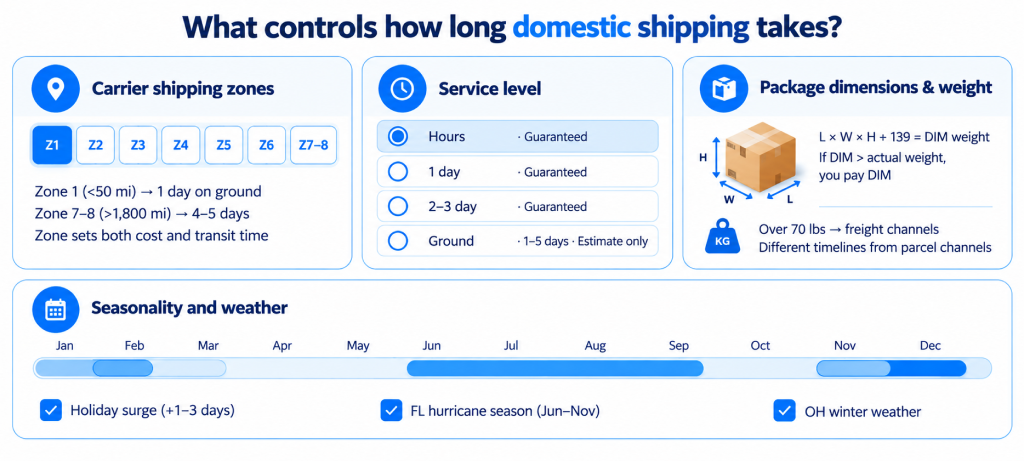
Every major U.S. carrier divides domestic routes into zones numbered 1 through 8. Zone 1 covers shipments originating within 50 miles of the destination. Zone 8 covers cross-country hauls exceeding 1,800 miles.
A manufacturer in Toledo shipping to Detroit is likely Zone 2, ground transit of one business day. That same shipper sending to Miami is Zone 7–8, standard ground takes 4–5 days. The zone determines cost and transit time simultaneously.
For businesses on Ohio’s I-71/I-75 corridor or Florida’s I-4 spine, zone proximity is a competitive advantage. Shipments between Columbus and Indianapolis, Cleveland and Pittsburgh, or Tampa and Orlando frequently land in 1–2 days on ground service without paying for express.
2. Service Level
Service tier is the single biggest variable you control before a shipment leaves the dock. Ground service trades speed for cost. Express tiers, 2-day, overnight, same-day, add cost but add certainty.
For businesses where a late delivery triggers a production stoppage, a missed customer SLA, or a contract penalty, “estimated 2–5 days” is not a planning tool. It’s a risk.
3. Package Dimensions and Weight
Dimensional (DIM) weight pricing applies on most carrier rate tables. Per USPS, packages larger than 1 cubic foot are priced on DIM weight, Length × Width × Height ÷ 139, if that figure exceeds actual weight. A large, lightweight package may route through different handling channels with different timelines than a compact, dense parcel.
Shipments over 70 lbs move via freight channels with distinct transit structures from parcel channels.
4. Residential vs. Commercial Address
Commercial addresses receive priority on most carrier route sequences, typically by 5 PM. Residential deliveries extend to 8–9 PM. If your receiving dock closes at 4 PM, shipping to a commercial address and flagging that on the label prevents a failed delivery attempt that adds a full day.
5. Seasonality and Weather
November through January is the U.S. shipping system’s most congested period. Standard ground timelines routinely extend by 1–3 days during the holiday shipping surge, even without any formal carrier delay declaration.
Ohio adds a second variable: winter weather. Ice and snow in Cleveland, Akron, Youngstown, and Toledo regularly disrupt regional ground routes. Florida’s hurricane season, June through November, creates its own disruptions, particularly in coastal markets from Jacksonville to Miami. Businesses shipping time-sensitive freight during either window should upgrade service level or shift to a dedicated regional carrier.
How Long Does Domestic Standard Shipping Take by Carrier?
USPS: 2–5 Business Days (Ground Advantage)
The USPS Office of Inspector General confirms Ground Advantage delivers in 2–5 days for the contiguous United States. Priority Mail averages 2–3 days. Priority Mail Express carries a 1–3 day guarantee with a money-back commitment and delivers 365 days a year, including holidays.
Ground Advantage starts at $7.90 for parcels up to 70 lbs. Priority Mail Express starts at $35.65. Tracking is included on all three services. USPS also offers a free package pickup through Click-N-Ship, a practical time-saver for businesses with consistent parcel volume.
Important 2026 update on tracking: USPS restructured its acceptance scanning process under its “Delivering for America” modernization plan. Local post offices now frequently skip the initial acceptance scan. Packages load directly onto trucks and head to Regional Processing and Distribution Centers (RPDCs) before receiving their first scan event. From a shipper’s perspective, tracking reads “Label Created, USPS Awaiting Item” for up to 72 hours even when the package is physically in motion.
This isn’t a lost package. It’s a structural change. Third-party platforms, Shopify, Pirate Ship, eBay seller dashboards, face additional delays because of new USPS authentication protocols restricting how quickly scan events flow to external systems. For seller protection on platforms with fulfillment timers, always request a printed acceptance receipt at the counter.
UPS Ground: 1–5 Business Days
UPS Ground is the standard workhorse for domestic B2B parcel shipping. UPS Ground includes $100 declared value coverage, real-time tracking, and Saturday residential delivery in most markets. Packages shipping within the same state, Cleveland to Columbus, Tampa to Orlando, typically land in 1–2 days on ground service.
For businesses that need certainty, UPS offers three guaranteed overnight tiers (Early, Standard, and End-of-Day) plus 2nd Day Air and 3 Day Select, all with money-back guarantees where weather and other exceptions don’t apply.
FedEx Home Delivery / FedEx Ground: 1–5 Business Days
FedEx Home Delivery runs 7 days a week, including Sundays in markets covering more than half the U.S. population, particularly useful for consumer-facing retailers with weekend order volumes. FedEx Ground serves commercial addresses Monday through Friday.
Within-state routes in Ohio or Florida typically transit in 1–3 business days on FedEx Ground. Cross-state lanes between Ohio and Florida run 3–5 days.
How Long Is Domestic Shipping by Route? Real-World Timelines
Standard Ground vs. Express: Common Business Routes
| Origin | Destination | Standard Ground | 2-Day Express | Overnight |
| Cleveland, OH | Columbus, OH | 1–2 days | 2 days (guaranteed) | Next business day |
| Columbus, OH | Toledo, OH | 1–2 days | 2 days (guaranteed) | Next business day |
| Cleveland, OH | Pittsburgh, PA | 1–2 days | 2 days (guaranteed) | Next business day |
| Columbus, OH | Detroit, MI | 1–2 days | 2 days (guaranteed) | Next business day |
| Toledo, OH | Indianapolis, IN | 1–2 days | 2 days (guaranteed) | Next business day |
| Youngstown, OH | Pittsburgh, PA | 1 day | 2 days (guaranteed) | Next business day |
| Tampa, FL | Orlando, FL | 1–2 days | 2 days (guaranteed) | Next business day |
| Tampa, FL | Jacksonville, FL | 1–2 days | 2 days (guaranteed) | Next business day |
| Cleveland, OH | Tampa, FL | 4–5 days | 2 days (guaranteed) | Next business day |
| Columbus, OH | Miami, FL | 4–5 days | 2 days (guaranteed) | Next business day |
All ground estimates assume correct address data, no weather events, and no peak-season congestion. During November–January, add 1–2 days to standard ground estimates.
Delivery Guarantees vs. Estimated Delivery: Know the Difference
This is the distinction most shippers overlook until it costs them.
Guaranteed services carry a money-back commitment if the package arrives late (weather and force-majeure exceptions aside):
- USPS Priority Mail Express
- UPS Next Day Air, 2nd Day Air, and 3 Day Select
- FedEx Overnight, 2Day, and Express Saver
Estimated services offer no refund for late arrival:
- USPS Ground Advantage
- UPS Ground
- FedEx Ground and Home Delivery
If you’re quoting customers a delivery date based on ground estimates, you’re quoting a probability. For contract-bound commitments, SLA agreements, or time-critical production timelines, use a guaranteed service level, or a dedicated regional carrier that backs its commitments with its own fleet.
When Standard Shipping Doesn’t Fit: Operations-Critical Freight
Standard domestic shipping was built for low-urgency parcel volume. It was not built for a medical device that needs to reach a hospital in Akron today. It was not built for a manufacturing component that shuts down a Columbus production line if it’s missing. It was not built for a retail operation in Tampa promising same-day order fulfillment.
For businesses where a delayed shipment has a direct operational or financial cost, the conversation isn’t about carrier and service tier, it’s about a different category of logistics entirely.
All Pro Now operates same-day delivery and expedited freight routes across a four-state regional footprint, serving twelve metro areas with its own fleet, no brokers, no subcontractors.
Ohio coverage: Cleveland, Columbus, Toledo, Akron/Canton, Youngstown, plus the same-day Ohio corridor.
Florida coverage: Tampa, Orlando, Miami, Jacksonville, available through same-day Florida service.
Michigan and Pennsylvania: Detroit, Pittsburgh, with same-day Michigan and same-day Pennsylvania coverage.
With 50+ years of logistics experience, 100,000+ shipments delivered, a 99%+ on-time record, and fuel surcharges that run 0–7% against an industry average of 18–50%, All Pro Now is built for businesses that cannot afford to treat delivery as an estimate.
Industries regularly served include manufacturing and industrial distribution, healthcare and medical supply, construction and building materials, electronics, and B2B e-commerce fulfillment. Vehicles range from Sprinter vans handling up to 3,600 lbs and 4 standard pallets, to box trucks handling up to 10,000 lbs and 12 pallets.
For businesses with recurring freight needs across multiple carriers, All Pro Now also offers managed logistics services, acting as an outsourced logistics department with carrier/vendor management, lane planning, KPI reporting, and cost optimization.
How to Reduce How Long Domestic Shipping Takes: Practical Steps
Drop off before the carrier cutoff: Most carrier locations cut off same-day dispatch between 2 PM and 5 PM. A package dropped at 5:01 PM ships the next business day. For consistent same-day dispatch, know your carrier’s cutoff and build it into your warehouse workflow.
Verify every address before printing a label: Wrong ZIP codes and missing suite or apartment numbers are among the most common causes of transit delays. A bounce-back on a bad address adds 3–5 days and often triggers a return-to-sender. Use carrier address validation tools before the label prints.
Ship to commercial addresses when operationally possible: Commercial stops appear earlier on carrier route sequences. They also solve the missed-delivery problem that adds a full business day each time a driver finds no one to sign.
Match service level to actual urgency: Ground service for replenishment stock with a week of lead time. Two-day express for customer-facing order commitments. Same-day or overnight options for anything where a delay triggers a real operational cost. The cost difference between ground and 2-day on a 5-lb parcel is rarely more than $8–$12. The cost of a missed deadline is almost always higher.
Build a buffer during peak windows: The four highest-risk shipping periods in the U.S. calendar are Black Friday week, the two weeks before Christmas, the week after Christmas, and back-to-school (late July through August). Standard ground estimates during these windows should be treated as best-case, not expected, timelines.
For regional freight in Ohio, Florida, Michigan, or Pennsylvania: Contact All Pro Now for expedited and same-day options. Get an instant rate estimate before committing to a carrier that can’t meet your deadline.
What the Data Says About Domestic Shipping Expectations
Consumer research shapes the practical stakes for businesses that ship.
A McKinsey survey of more than 1,000 U.S. consumers found that 90% are willing to wait two or three days for deliveries, especially if it lets them avoid shipping costs. The same survey found that 90% of consumers are likely to abandon shopping carts with high shipping costs for standard items, and that consumers prioritize reliability, assurance that packages arrive within the promised delivery window, over raw speed.
Speed ranked as consumers’ top delivery priority in 2022. By 2024, it had fallen to fifth place. Cost, reliability, flexibility, and transparency all ranked ahead of it in McKinsey’s 2024 Voice of Consumer Survey.
The practical implication: businesses that give customers a reliable 2–3 day window and hit it consistently outperform competitors offering 1-day estimates they cannot keep. Reliability beats speed when reliability is the rarer outcome.
For B2B shipments, manufacturing, healthcare, construction, industrial distribution, the calculus is different. A delayed parcel is an inconvenience for a consumer. A delayed shipment is often a production stoppage, a patient waiting on medical equipment, or a job site standing idle. The threshold for using expedited or same-day courier services is lower because the cost of delay is higher.
Carrier Service Comparison at a Glance
Domestic Carrier Standard vs. Expedited: Key Facts
| Carrier | Standard Service | Standard Transit | Express Option | Express Transit | Guarantee? |
| USPS | Ground Advantage | 2–5 days | Priority Mail Express | 1–3 days | Yes (Express only) |
| UPS | UPS Ground | 1–5 days | UPS Next Day Air | 1 business day | Yes (Air only) |
| FedEx | FedEx Ground | 1–5 days | FedEx Priority Overnight | 1 business day | Yes (Express only) |
| All Pro Now | Expedited Freight | 1–3 days (regional) | Same-Day Delivery | Hours | Yes |
Source: Carrier published service standards; USPS OIG; All Pro Now service specifications.
When Standard Shipping Isn’t Fast Enough
Knowing how long does domestic shipping take is the starting point. Choosing the right service for what’s actually on the line is what separates businesses that ship on time from businesses that apologize for delays.
For most parcel shipments with flexible timelines, ground service covers the need. For businesses across Ohio, Florida, Michigan, Indiana, Western Pennsylvania, and Northern Kentucky where a delayed shipment has a direct operational or financial cost, “estimated 2–5 days” is not a plan, it’s a risk.
All Pro Now connects shippers to a dedicated regional driver network with real-time GPS tracking, fixed annual fuel surcharges, zero hidden fees, and a 99%+ on-time delivery record across 100,000+ shipments. Same-day delivery. Expedited freight. LTL for larger loads. Parcel delivery for volume shippers. All backed by 50+ years of regional logistics experience.
Get an instant rate estimate at AllProNow.net or call (833) 961-1099. When the shipment can’t wait, neither can your logistics partner.