You placed an order. Now you’re refreshing your phone every 30 minutes wondering where it is. Tracking package shipments sounds simple, enter a number, get an answer. But between competing carrier portals, cryptic status codes, and international hand-offs, it can feel like a second job.
This blog breaks down exactly how tracking package status updates work in the United States in 2026, from USPS certified mail and US mail tracking numbers to same-day delivery with live GPS visibility. Whether you’re a business owner shipping medical supplies in Cleveland, a retailer moving freight to Tampa, or an individual waiting on an e-commerce order in Indianapolis, you’ll find clear, practical answers here.
Why Tracking Package Matters More Than Ever in 2026
The scale of American shipping has reached numbers that were hard to imagine just a decade ago.
An estimated 24.6 billion packages are projected to ship within the US in 2026, a 4.9% year-over-year increase. That’s roughly 67 million packages moving across American roads, airports, and postal networks every single day.
Consumer expectations have risen alongside that volume. 80% of consumers now say they expect same-day delivery, and 98% say the delivery experience affects their brand loyalty. Separately, 76% of shoppers said a positive delivery experience influenced their decision to repurchase from a brand in 2025, up from 72% in 2024.
Tracking is no longer a nice-to-have feature. For consumers and businesses alike, tracking package movements in real time is now a baseline expectation.
The live package tracking market is estimated at $6.4 billion in 2024, and is expected to reach $13.7 billion by 2030, growing at a compound annual rate of 13.2%. GPS, RFID, and barcode technology are driving that growth as carriers at every level invest in real-time visibility infrastructure.
Key Takeaways
- The US will ship an estimated 24.6 billion packages in 2026
- 98% of consumers say delivery experience affects brand loyalty
- USPS, UPS, FedEx, and Amazon Logistics each use different tracking number formats, knowing which is which saves time
- Certified mail tracking starts with 9407 and is legally admissible as delivery proof
- Businesses in Ohio, Michigan, Indiana, Pennsylvania, Kentucky, and Florida can access same-day delivery with live GPS tracking through AllProNow
- International packages can go 10+ days without a scan update, that’s normal during ocean/air transit
- “In Transit” does not mean lost, it typically means the package is between scan points
How Tracking Package Works
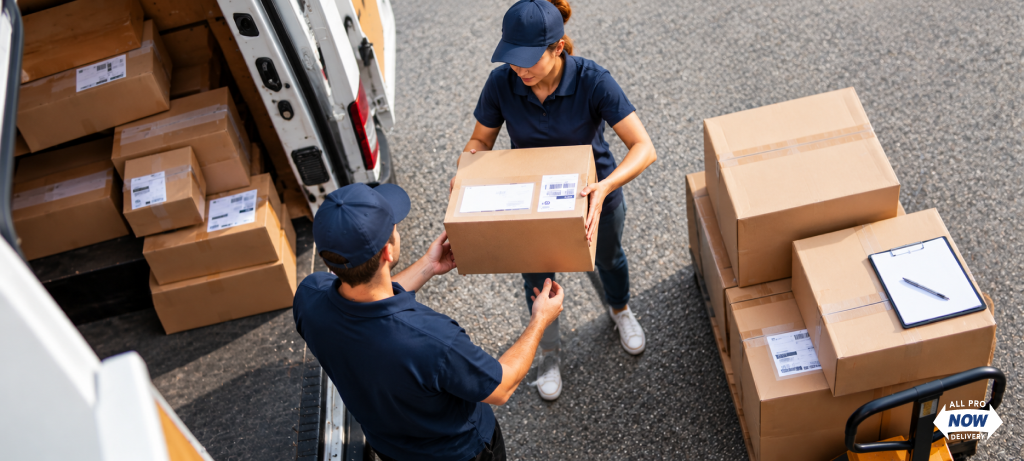
When a carrier physically picks up or scans a shipment, that event is recorded as a timestamped entry tied to your tracking number. Every subsequent scan, at a sorting facility, regional hub, local delivery station, and final drop-off, adds another entry to that record.
Those entries populate the tracking page you see online. Most carriers update scans every few hours. Premium services update in near real time. The gap between updates doesn’t always mean the package is stuck, it often means it’s moving on a truck between scan points.
What the Tracking Number Actually Tells You
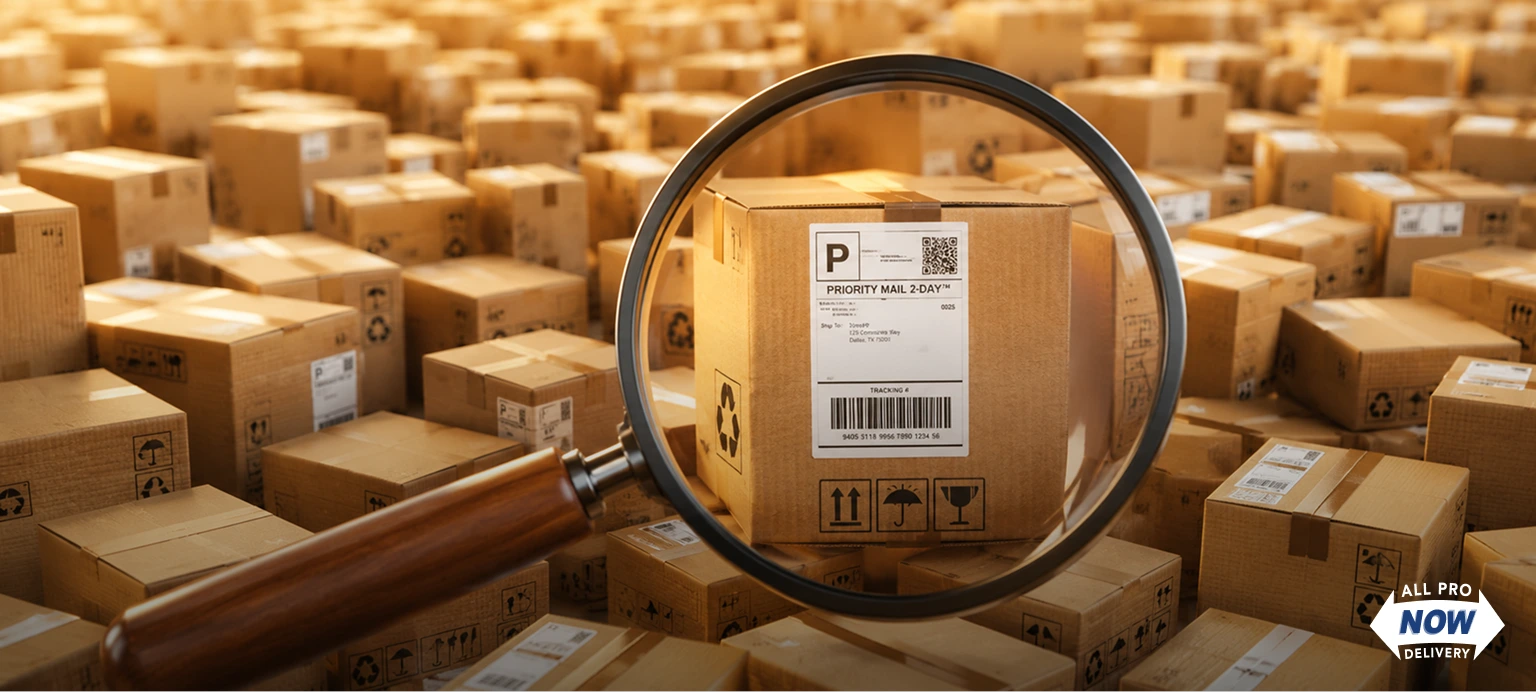
Your tracking number isn’t random. Each carrier uses a distinct format, and understanding the format helps you go directly to the right carrier portal without guessing.

Source: USPS official tracking formats; carrier-published guidelines, 2026
Tracking Package Through USPS
USPS remains the most widely used carrier for domestic US consumer shipments. When tracking package deliveries through USPS, volume is projected to total 7.84 billion shipments in 2026. The average American received 21 packages via the US Postal Service in 2024.
To track a USPS package, go to tools.usps.com/tracking and enter your US mail tracking number. You can also text your tracking number to 28777 (2USPS) for instant status updates by SMS, useful when you don’t have browser access.
Understanding USPS Tracking Status Messages
| Status Message | What It Means | What to Do |
| Pre-Shipment Info Sent | Label created but package not yet scanned | Wait 24 hours for carrier pickup scan |
| Accepted | Package in USPS possession | Normal, tracking is now active |
| In Transit to Next Facility | Moving between scan points | Normal, no action needed |
| Out for Delivery | On a delivery vehicle today | Expect delivery by end of business day |
| Delivered | Dropped off at address | Check mailbox, porch, or building mail area |
| Notice Left | Carrier attempted, no one home | Reschedule or pick up at local post office |
| Alert / Exception | Delay, address issue, or weather | Contact USPS at 1-800-ASK-USPS |
Source: USPS Tracking Status Definitions, USPS.com, 2026
USPS updates can lag 12–24 hours at busy sorting facilities, particularly over weekends. If your status hasn’t changed in more than 48 hours on a domestic shipment, visit the USPS Informed Delivery dashboard or contact your local post office directly.
Certified Mail Tracking: What Makes It Different
Certified mail is a specific USPS service that creates legally verifiable proof of mailing and delivery. It’s widely used for legal documents, tax filings, contract notices, and business correspondence.
USPS Certified Mail costs $6.08 for stamped mail in 2026, with the $5.30 certified fee remaining unchanged during the January 2026 USPS rate adjustments, even as Priority Mail rose 6.6% and USPS Ground Advantage jumped 7.8%.
A 22-digit tracking number enables real-time online tracking at every stage of delivery. The recipient must sign for delivery, creating legal proof of receipt, and USPS maintains signature records for two years as official verification.
Your certified mail tracking number is a 20–22 digit number that starts with 9407 (or 9589 on some newer commercial labels). Enter it at USPS.com/tracking to see the full scan history.
Tracking Package Through UPS and FedEx
UPS and FedEx are the primary carriers for commercial business-to-business (B2B) shipments and heavier freight.
UPS tracking numbers start with 1Z followed by 16 characters. Go to ups.com/track and enter the number to see detailed scan history. UPS tends to provide granular updates for commercial shipments, with tight delivery windows on business days.
FedEx tracking numbers are typically 12 or 15 digits. FedEx offers strong overnight and priority shipping coverage. Both UPS and FedEx allow you to set up delivery alerts via text or email at each key scan point, a feature worth enabling the moment you receive a tracking confirmation.
Track Package With Order Number vs. Tracking Number
This is one of the most common points of confusion in US package tracking.
An order number is internal to the retailer. It lives in their database and identifies your purchase within their system. A tracking number (also called a waybill or consignment number) is issued by the carrier once the shipment is physically scanned into their network.
For tracking package shipments with an order number, log into the retailer’s website or app, navigate to your order history, and look for a “Track Shipment” link or a separate carrier tracking number field. Once the carrier physically scans the shipment, that tracking number becomes live, usually within 24 hours of label creation.
If the retailer’s site says “label created” but no carrier data is showing, wait 24 hours before raising a concern. The label may have been generated before the physical pickup scan.
Tracking Package Internationally
International tracking follows a more complex path than domestic shipping. A package from China, Germany, or the UK typically passes through:
- The origin country’s postal or courier network
- International air or ocean freight
- US Customs processing at a major port of entry
- Hand-off to a domestic carrier (usually USPS) for the final mile
The most common point of confusion is the gap during transit. A package might scan in Shanghai, then show no update for 10–14 days. That silence typically represents ocean freight time or air cargo staging, where scanning infrastructure is limited. It does not mean the package is lost.
Once a package clears US Customs and enters the domestic postal stream, USPS scan updates become much more frequent.
Major US Customs Entry Points and Typical Processing Times:
| Port of Entry | Typical Customs Processing | Notes |
| Los Angeles / Long Beach | 1–5 business days | Largest US import gateway |
| New York / JFK | 1–4 business days | Major air freight hub |
| Chicago O’Hare | 1–3 business days | Central distribution point |
| Miami International | 1–4 business days | Key gateway for Latin American and EU imports |
| Houston / IAH | 2–5 business days | Growing volume for Gulf-region imports |
Note: Processing times increase during peak holiday seasons (October–January) and during periods of elevated import volume.
For tracking package international shipments without knowing the carrier, the USPS tracking portal can often identify international tracking numbers once they’ve been handed off to USPS for domestic delivery. If the number isn’t recognized initially, check again in 24–48 hours after the customs handoff completes.

Same-Day Delivery and Real-Time Tracking for Businesses
Consumer tracking apps handle standard multi-day shipments well. But businesses operating in time-sensitive industries need something fundamentally different.
A hospital pharmacy in Columbus waiting on a medication transfer needs ETA visibility to the minute, not the day. A manufacturing plant in Detroit can’t hold a production line waiting on a blind shipment. A construction firm in Pittsburgh needs proof of delivery the moment materials arrive on site.
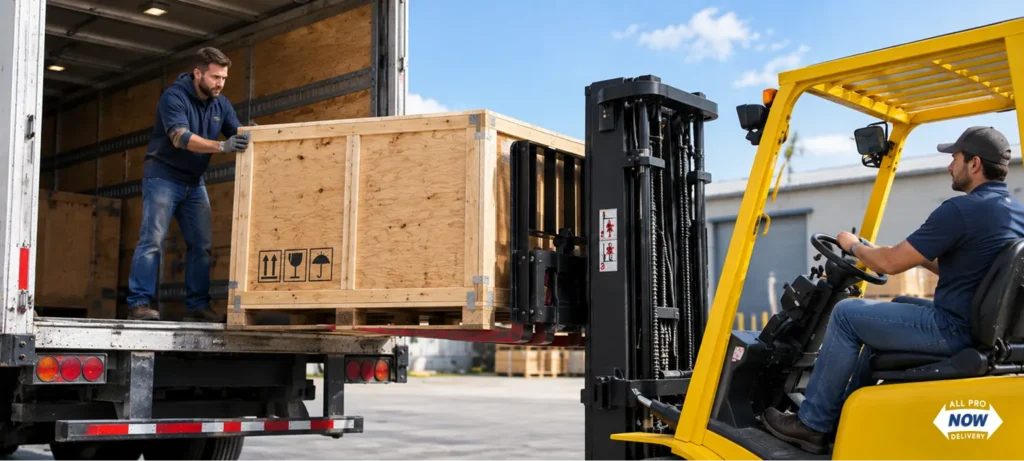
This is where AllProNow fills a gap that standard carrier tracking can’t. AllProNow is a same-day courier and freight management platform based in Westlake, Ohio, with over 50 years of combined logistics experience. The platform provides live GPS tracking on every shipment, showing driver location, estimated arrival time, and digital proof of delivery the moment a package is signed for.
AllProNow serves businesses across Northeast Ohio, Columbus, Toledo, Akron, Detroit, Youngstown, Pittsburgh, Indianapolis, Northern Kentucky, Tampa, Miami, and Orlando. The dedicated fleet of sprinter vans and box trucks handles everything from individual parcels to palletized freight.
Industries that rely on AllProNow’s tracking-enabled same-day service include:
- Medical and healthcare facilities — specimen transport, pharmacy transfers, lab samples
- Retailers and e-commerce companies — same-day fulfillment across Ohio and Florida
- Manufacturers and construction firms — time-critical parts and materials delivery
- E-commerce businesses — last-mile delivery with live tracking and no hidden fees
Transparent pricing, no fuel surcharges, and a 99% on-time delivery performance record across service lanes. For businesses where tracking package status alone isn’t enough, and you need to know the driver’s exact location in real time, get an instant quote at allpronow.net or call (833) 961-1099.
Practical Tips for Tracking Package Shipments More Effectively
Enable carrier notifications immediately: Every major carrier allows you to opt into text or email alerts at key scan events. Do this as soon as you receive a tracking confirmation. You’ll stop compulsively refreshing carrier sites.
Know the difference between “In Transit” and “Delayed”: “In Transit” is a normal status, it means the package is between facilities. “Delayed” or “Exception” alerts indicate an actual issue that may require action. Don’t conflate the two.
Check the USPS Informed Delivery dashboard: If you’re expecting a USPS package, USPS Informed Delivery sends you a daily email with grayscale images of incoming mail pieces and tracking summaries. Free to enroll at informeddelivery.usps.com.
Screenshot your tracking package history: If you need to file a claim for a lost or delayed package, a complete scan history dramatically strengthens your case with the carrier or retailer. Save it early tracking history on some carriers expires 90–120 days after delivery.
For international packages, contact the retailer, not the carrier: If a package has been stuck in customs for more than 7–10 business days, the retailer has more leverage to open a formal inquiry than you do as an individual. Start there.
WISMO (“Where Is My Order”) inquiries make up 30–40% of all e-commerce support tickets, and over 50% during peak seasons, costing $5 to $22 each when handled by a human agent. That statistic alone explains why real-time tracking isn’t just a convenience: for businesses, it’s a direct cost reduction tool.
Stop Guessing, Start Tracking
Tracking package shipments in 2026 requires understanding which carrier has your shipment, which portal shows accurate data, and what those status messages actually mean. With 24.6 billion US packages expected to ship this year, the infrastructure for visibility has never been more sophisticated, but it only works if you know how to use it.
For consumers: know your tracking number format, use the right carrier portal, and set up SMS alerts. For international shipments, expect silence during transit and focus on the domestic leg once customs clears.
For businesses that need same-day delivery with built-in live tracking, across Ohio, Michigan, Indiana, Pennsylvania, Kentucky, and Florida, AllProNow is built precisely for that. Real-time GPS, digital proof of delivery, and transparent pricing with no hidden fees.
Request an instant quote at allpronow or call (833) 961-1099.