

Your line is down. A critical component didn’t turn up. Standard freight is sitting in a hub 200 miles away, while the next scheduled delivery is three days away.
That’s not a logistics goof-up, it’s $260,000 per hour in unplanned downtime, according to Aberdeen Research. In automotive manufacturing, Siemens gives it a value, $2.3 million per hour.
Expedited shipping birthed for exactly such scenarios. Not to get your package a day earlier, but to get your freight moving on its own dedicated truck, direct to your dock, before the damage compounds.
Our blog breaks down how expedited shipping works, what it’ll cost you, and how to know when it’s the right call versus overkill.
What Expedited Shipping Actually Means
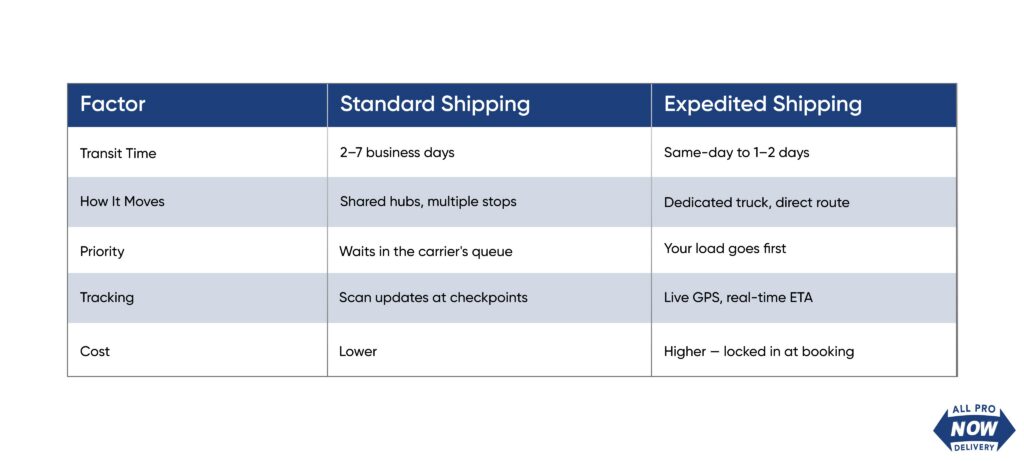
Expedited shipping is not just a faster version of standard freight. It’s a structurally different service.
Standard carriers move freight through a shared hub-and-spoke network, your load gets sorted, consolidated, and moved along with dozens of others on the carrier’s schedule. Expedited shipping removes your load from that network entirely.
You get a dedicated vehicle dispatched specifically for your shipment. No hub sorting. No consolidation stops. No waiting behind other loads.
Here’s what that looks like in practice:
- Same-day dispatch directly from your pickup location
- Direct routing from origin to destination; no intermediate stops
- Transit time typically ranges from a few hours to next-day, depending on distance
- Your freight is the only load on that truck
- Live GPS tracking from dispatch to delivery
- Digital proof of delivery within minutes of drop-off
One thing to clarify: expedited shipping is not the same as express. Express is a separate overnight-tier service most commonly offered by national parcel carriers like FedEx or UPS. Expedited, in the freight sense, means dedicated capacity and direct routing a fundamentally different operational model.
Also worth noting: the term ‘expedited’ is not standardized across carriers. One carrier’s expedited service might mean 2-day; another’s means 4 hours. Always confirm the actual delivery window before you book.
What Drives Expedited Shipping Rates
Four variables set the price on every expedited freight move: distance, shipment weight, vehicle type, and when you book. Get those four right and you won’t see surprises on the invoice.
Vehicle selection is the most commonly mishandled variable:
- Sprinter Van: max 3,600 lbs, up to 4 pallets; best for parts runs, urgent courier, smaller LTL replacement loads
- Straight Truck: max 10,000 lbs, up to 12 pallets; best for multi-skid shipments, larger manufacturing loads
Booking the wrong vehicle type either means a failed pickup or paying for capacity you didn’t need. Confirm weight and pallet count before you call.
Timing affects your rate significantly:
- Book before noon for same-day; driver availability is highest in the morning
- After 2 p.m., driver pools shrink and rates reflect the tighter supply
- Rough weight estimates get corrected at pickup and re-billed accordingly
- Predictable weekly routes should run on scheduled courier; reserve expedited for genuine urgency
| Vehicle | Max Weight | Max Pallets | Best For |
| Sprinter Van | 3,600 lbs | 4 pallets | Parts runs, urgent courier, small LTL |
| Straight Truck | 10,000 lbs | 12 pallets | Multi-skid loads, larger manufacturing freight |
One rule that should never change between quote and invoice: the number itself. A reputable carrier locks in the rate at booking. No fuel surcharges added after the fact. No accessorial fees showing up three days later. If a carrier can’t commit to a locked rate at booking, that’s your signal to keep looking.
Who Needs Expedited Shipping, and Why It Pays for Itself
Expedited freight is not a luxury tier for impatient shippers. For the people who use it regularly, it’s a cost-control tool. The freight bill is almost always smaller than the cost of the alternative.
Where Expedited Shipping Becomes Non-Negotiable
Manufacturing & JIT Operations
Plant managers running JIT schedules don’t have buffer inventory to cover a missed delivery. When a supplier shorts a critical component and your line is down, a $400 same-day freight charge to keep the line running isn’t a hard call — it’s the obvious one.
- No buffer inventory → immediate operational risk
- Downtime costs exceed freight cost within minutes
- Expedited shipping = production continuity
Auto parts suppliers in Detroit, industrial distributors in Cleveland, and fabricators in Akron run same-day freight regularly. The math is straightforward: expedited shipping costs a fraction of one hour of downtime.
Healthcare & Medical Logistics
A hospital or surgical center can’t pre-stock every supply, device, or specimen. When a lab specimen misses its processing window, the sample is invalidated and collection starts over. When a surgical instrument doesn’t arrive on time, the OR schedule shifts.
Medical expedited delivery has additional requirements beyond speed:
- GPS-confirmed delivery
- Timestamped proof of delivery
- Documented chain of custody from pickup to drop-off
These are compliance requirements, not preferences.
Construction & Field Operations
An idle crew in Pittsburgh or Fort Myers is paid labor with zero output. Add general contractor penalty clauses and a slipped completion date, and the downstream scheduling cascade from one missed delivery can run up costs that dwarf the freight bill several times over.
Contractors across Ohio, Western Pennsylvania, and Northern Kentucky book expedited freight specifically because the math is clear:
- Paid labor with no productivity
- Penalty clauses for delays
- Cascading scheduling disruptions
Same-day delivery costs less than a lost workday.
E-commerce & Distribution
According to Baymard Institute’s 2024 research:
- 23% of online shoppers abandon a cart due to slow delivery
- Total cart abandonment rate: 70.19%
Slow shipping is among the few causes a merchant can directly fix.
Regional distributors and e-commerce operations in Indianapolis, Saginaw, and across the Midwest use expedited shipping to:
- Recover from fulfillment errors
- Close priority orders faster
- Prevent customer churn
Why Expedited Shipping Pays for Itself
| Scenario | Risk Without Expedited Shipping | Cost Impact | Why Expedited Wins |
| Manufacturing (JIT) | Production line downtime | Thousands per hour | Freight cost is negligible vs downtime |
| Healthcare | Missed procedures / invalid samples | Operational + compliance risk | Ensures time-sensitive delivery |
| Construction | Idle labor + penalties | Compounding project delays | Prevents cascading cost overruns |
| E-commerce | Cart abandonment | Lost revenue | Converts high-intent buyers |
The Core Insight
Across industries, the decision isn’t about paying more for speed, it’s about paying less than the cost of delay.
That’s why expedited shipping isn’t a premium option.
It’s a financial decision grounded in operational reality.
How Expedited Freight Tracking Works
Standard freight tracking means checkpoint scans, your load checked into a hub somewhere, hours ago. That’s not useful when you’re coordinating a receiving dock, a surgical prep team, or a job site crew around a specific arrival window.
Real expedited shipping tracking is live GPS. You see where the driver is right now, and the ETA updates as they move. There’s no guessing whether the truck is 20 minutes out or 2 hours out.
Every expedited shipment should include these tracking essentials:
- Live GPS on the driver’s vehicle, not hub checkpoint scans
- A shareable tracking link your dock or receiving team can access directly
- Electronic proof of delivery in your inbox within minutes of drop-off
- Signature, timestamp, and photos included in the POD
For healthcare, manufacturing, or any operation with documentation requirements, digital POD isn’t optional. A verbal confirmation doesn’t hold up in a compliance review or a dispute.
Three questions to ask any carrier before you book: Is tracking live GPS or scan-based? Can my dock team access the tracking link directly? Is digital POD available at delivery? Vague answers to any of those are your signal to keep looking.
How to Book Expedited Freight the Right Way
Most delays in expedited shipping aren’t caused by the carrier, they’re caused by incomplete information at booking. Get the details right before you call, and the rest moves quickly.
- Have your load details ready: pickup ZIP, delivery ZIP, exact weight, pallet count, and your hard deadline, before you start the booking process
- Get a real rate online, not a callback, a reliable platform returns an actual price from your specific ZIP codes in seconds, not a range or a promise to follow up
- Pick the right truck for the load, booking a sprinter van for a straight-truck load means a failed pickup; booking a straight truck for a four-pallet run means capacity you paid for and didn’t use
- Confirm your tracking link at booking, not after it should be in your confirmation email the moment the booking goes through
- Download the digital POD as soon as the driver completes the drop signature, timestamp, and photos should be in your inbox within minutes; file it
One mistake that consistently costs shippers: waiting until the afternoon to book a same-day load. If you know the freight needs to move, book in the morning. After 2 p.m., driver availability drops and rates reflect it.
Another common error is running predictable weekly routes on expedited pricing. If the same load goes out every Tuesday, a scheduled courier run is cheaper and just as reliable. Expedited is for when things go sideways not a substitute for planning routine runs.
| Scenario | Use Expedited? | Reason |
| Line down, part missing, JIT schedule | Yes | Cost of downtime exceeds freight bill |
| Medical specimen or surgical supply, time-critical | Yes | Compliance + patient care timeline |
| Crew idle on-site, penalty clauses active | Yes | Labor cost + GC penalties stack fast |
| Fulfillment error, customer waiting on priority order | Yes | Cart abandonment and churn are real costs |
| Routine weekly replenishment, no hard deadline | No | Scheduled courier is cheaper and predictable |
| Load can wait a day without downstream impact | No | Standard freight is the right tool |

AllProNow: Dedicated Expedited Shipping Across the Midwest and Southeast
AllProNow runs a dedicated commercial fleet of sprinter vans and straight trucks, not gig drivers in personal vehicles. Operating out of Cleveland since 1990, with 80,000+ shipments delivered and a 99% on-time record.
Core coverage markets include:
- Ohio: Cleveland, Akron, Canton, Columbus, Toledo, Youngstown, Cincinnati, Westlake
- Michigan: Detroit, Grand Rapids, Saginaw
- Indiana: Indianapolis
- Pennsylvania: Pittsburgh, Johnstown
- Kentucky: Cincinnati metro, Lexington
- New York: Buffalo
- Florida: Jacksonville, Orlando, Sanford, Tampa, Fort Myers, Miami
Pricing is locked in at booking. No fuel surcharges added as an afterthought. No post-delivery accessorial fees. The number on the quote calculator is the number on the invoice.
Plug your pickup and delivery ZIPs into the quote calculator at allpronow.net. You’ll get a real rate in seconds, not a range, not a callback. If your load needs to move today, you know where to start.
For expedited shipping on time-critical freight across the Midwest and Southeast, AllProNow has been the answer since 1990. Get your quote at allpronow.net.